Last updated 2026-08-20
TL;DR
Scissor lift rental is short-term hire of vertical MEWPs, usually by the day, week, or month. You start with an entity, a free IRS EIN, a state tax permit if rentals are taxable, insurance that schedules the iron, and transport credentials if your combination hits 10,001 pounds. Buy two or three common heights last. Confirm every fee with the issuing board. There is no federal rental license.
What is scissor lift rental?
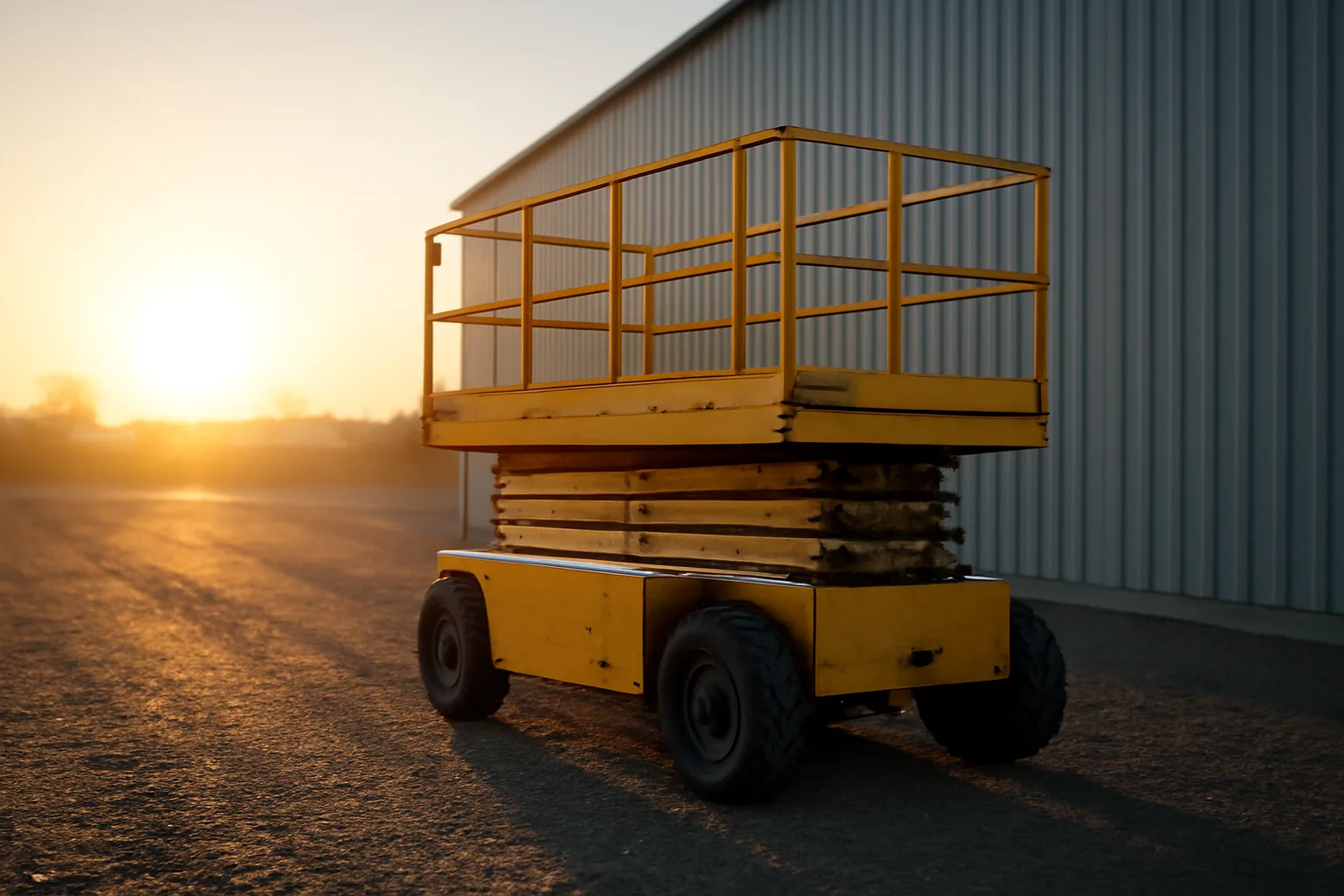
Scissor lift rental is the short-term hire of a mobile elevating work platform that rises straight up on stacked supports. You own or finance the machine. A contractor pays for a day, a week, or a month, then sends it back. That is the whole product. You sell uptime and a unit that still matches its capacity plate. You do not sell a labor crew.
Most fleets mix electric slab scissors for indoor concrete with rough-terrain diesel or dual-fuel units for dirt and gravel. The heights that actually move are boring. Nineteen and 26 foot electrics turn constantly. The 32 to 40 foot rough-terrain units move when steel and masonry are busy. Super-tall machines sit unless you already have a repeat caller.
OSHA tells employers not to load scaffolds past rated capacity, and it requires fall protection on a scaffold more than 10 feet above a lower level.[1] Your job as the rental house is narrow. Send out a machine whose plate, guardrails, and pothole protection still work. The customer's employer owns the people on the platform.
Terms vary by shop. Some city yards post a 4-hour minimum. Many bill a week as three or four days. I would not photocopy a national chain card and call it research. Street rates drift hard by market. Use a local read such as scissor lift rental cost in florida or scissor lift rental cost in california, then call two competitors on a Tuesday. Monday rate checks lie.
How do you start scissor lift rental?
You start scissor lift rental on paper, not on a dealer lot. Form an entity your state recognizes, get a free EIN from the IRS, open a business bank account, and ask your state revenue department whether equipment rental is taxable. Bind insurance that schedules the machines. Then buy two or three lifts your market already runs short on.
That order saves people. The operator who buys a 60-foot rough-terrain unit first, then calls an agent, then meets the inland marine deductible, gets stuck.
File the entity with your secretary of state or corporations division. The SBA register-your-business guide maps the federal, state, and local layers without hype. Open the actual state form after you read it, not a blog recap.[14] The IRS says applying for an EIN "is a free service offered by the Internal Revenue Service."[3] Use IRS.gov. Ignore the paid middleman sites.
Ask revenue whether rental of tangible personal property is taxable. In California, CDTFA Publication 46 is the document that walks through leasing and rental of that property. Your state has its own publication. Confirm it.[4]
Get the local business license if your city or county writes one down. Zoning matters if you park iron at a house. Plenty of first-year operators keep two or three units on a cheap fenced lot and deliver with a used trailer. If the truck and trailer combination hits 10,001 pounds, interstate work can pull you into a USDOT number.[5]
Hire nobody until the binder exists. Write a one-page contract with hour limits, a return standard, and a damage-waiver option if your state even lets you sell one. Then buy iron.
What licenses do you need to rent scissor lifts?
There is no federal scissor lift rental license. That myth is what wastes consult fees. You need ordinary business paper, any local rental or dealer license your city actually prints, and transport credentials if your vehicles qualify as commercial motor vehicles.
Confirm every item with the board that issues it. Secretaries of state handle entities. Revenue departments handle seller's permits. City clerks handle local tax certificates. State DMV or motor-carrier offices handle intrastate USDOT, IRP, and IFTA questions. None of those boards will give me a processing time I can honestly publish. Confirm the current fee and the current form on their page.
If you have employees, workers' compensation is mandatory in most states. Texas is the well-known private-employer exception, and even there many jobsites will not let you through the gate without a policy. Confirm with your state workers' compensation agency. A forum post is not the rule.
Operator qualification is not your business license. OSHA puts scaffold training on the employer of the person on the platform.[6] If your driver sets the machine up or demonstrates it, that person needs the training. If your tech stands on a platform to repair a unit, you are the employer on that scaffold.
I would not pay anyone for a bundled "rental license kit." Read the clerk page and the revenue publication yourself.
| Paper item | Who issues it | When it usually triggers |
|---|---|---|
| Entity | State corporations office | Before leases, bank accounts, or policies |
| EIN | IRS | Before hiring or a real business account |
| Sales tax permit | State revenue department | If your state taxes equipment rental (confirm) |
| Local business license | City or county clerk | If the local code requires it |
| USDOT number | FMCSA for interstate work | Combination at 10,001 lb in interstate commerce |
| CDL | State DMV | Generally 26,001 lb GVWR (confirm class) |
Do OSHA rules apply if you only rent the machine?
Yes, in pieces. OSHA's construction scaffold rules apply to the employer whose people stand on the platform. That is usually your customer. You still carry duties if you employ drivers, techs, or anyone who works on or around the lifts.
29 CFR 1926.451(g)(1) says "each employee on a scaffold more than 10 feet (3.1 m) above a lower level shall be protected from falling to that lower level."[1] Many scissors use guardrails as the main fall system. Manufacturer manuals still ban standing on those rails. Your contract should say the customer supplies trained operators and follows the manual.
OSHA 1926.454 requires the employer to have each employee who works on a scaffold trained by a qualified person to recognize the hazards of that scaffold type.[6] Print the citation on the checkout sheet. It reminds the customer who owns the training duty.
OSHA fact sheet 3842 covers falls and tip-overs from scissor lifts. It is a free handout. Use it.[7] Rule 1926.452 adds requirements for specific scaffold types, including mobile scaffolds. Do not pretend you memorized every paragraph. Keep the standard bookmarked.[2]
Aerial-lift rule 1926.453 covers extensible and articulating boom platforms. A straight scissor is usually not that machine. Mix the two packets and you will teach the wrong harness rule.[8]
If your company had 10 or fewer employees at all times last calendar year, 29 CFR 1904.1 may excuse you from routine OSHA 300 logs unless OSHA or BLS writes you. Read the section. Do not guess.[9]
What insurance do first-year yards actually bind?
Bind general liability, inland marine (the floater that follows the iron), commercial auto on the truck, and hired or non-owned auto if anyone runs errands in a personal car. Add workers' comp the day you have an employee, or sooner if your state requires it for you.
I would not open the gate on a liability-only policy. The lift is the asset. A stolen or burned 26-foot electric unit with no scheduled floater is how a year-one shop dies. Ask for a scheduled list. Blanket forms that under-value used machines are how claims get ugly.
Damage waivers are a fight. Some states treat a waiver like insurance and regulate the wording and the money. Confirm with your insurance regulator and a lawyer licensed in your state. I am not that lawyer.
Customers will ask for additional-insured endorsements and primary wording. Price the certificate work. Do not hand blanket additional-insured status to every drywall sub who texts you a job name.
An umbrella can wait until a GC bid requires it. Buying a huge umbrella in month one is often a waste if you have three machines and a pickup.
How much money do you need to start a yard?
Nobody publishes a clean national startup number that I would trust. Dealers will not hand you an honest "open a yard" figure, and used prices move with housing starts. What I can tell you is the order of spend, and which lines people undercount.
Paper is cheap. The EIN is free.[3] State entity filing fees exist and they change. Confirm the current fee on your secretary of state's form page. Insurance deposits and the first quarter of premium usually dwarf those filing fees. Then come the machines, the trailer, the truck, basic tools, and three months of lot rent.
I would start with two electric slab scissors in the 19 to 26 foot class if my mystery-shop calls showed indoor work. If the work was exterior, I would mix one electric and one 26 to 33 foot rough-terrain unit. One hero machine is a bad fleet. When it is down, you are down.
Skip the wash bay, the custom wrap, and the giant shop. A used trailer with working brakes and a chain set that is not junk will make more money than a logo. Track hours. If you want a simple kit later, the $179 one-time 2-6 Machine Telematics Kit from ScissorPath is one option. A paper hour log also works. I ran paper longer than I should have.
Do not finance an entire new fleet in year one unless you already have contracts in writing. Interest plus a slow winter will eat you.
Which scissor lifts should you buy first?
Buy what two local competitors are already short on. Call them as a customer. Ask for a 19-foot electric this Thursday. Then a 26. Then a 32-foot rough-terrain. The pause on the phone is the data.
I would avoid 60-foot-plus units until a customer has rented one from you twice. They need a bigger trailer, a more careful driver, and they sit through winter.
Check which ANSI/SAIA A92 generation the machine was built to. Units built to the 2018 A92.20 design suite have different gates, load sensing, and manuals than older A92.6 scissors. Your training packet and your parts habit have to match the unit you own. Buy the standard if you train people. Do not pirate it.
On used iron, look at scissor-arm bushings, pothole protection that actually drops, emergency lowering, and batteries that are not a box of dead cells. A cheap lift with a four-thousand-dollar battery surprise is not cheap. If the capacity plate is gone, do not rent the machine. OSHA load language cares about rated capacity.[1]
What rules apply when you deliver a lift?
Delivery is where a rental house meets highway law. A pickup and trailer that together sit at 10,001 pounds or more can require a USDOT number in interstate commerce. FMCSA says you need that number if you operate a vehicle in interstate commerce with a gross vehicle weight rating or gross combination weight rating, or gross vehicle weight or gross combination weight, of 4,536 kg (10,001 pounds) or more.[5]
A single vehicle or combination at 26,001 pounds GVWR generally needs a CDL.[10] Read the door-jamb sticker and the trailer plate. Then scale the combo once. Do not guess.
Intrastate rules differ. Your state patrol or DMV publishes the in-state carrier threshold. Confirm it. I will not invent your state's number.
On the jobsite, chock the wheels, set outriggers if the model has them, and do not toss the keys to someone who says they have used one. Walk the function test. Soft fill plus a raised rough-terrain scissor is a tip-over you already saw coming.
If you cross state lines often, ask your accountant about IRP plates and IFTA fuel tax. Those are real accounts. Confirm enrollment with your state's IRP office.
What paperwork belongs with every rental?
A signed contract, a pre-rental inspection with photos, the operator manual (or a note that it sits in the document box), a function-test checklist, and a certificate of insurance from the customer if your contract requires it. Keep damage photos on a card you control, not in a text thread you will lose.
Write down the customer, the job address, who may move the machine, the hour-meter start, fuel or charge level, and platform height. Repeat the same photo angles at return.
I keep a one-page OSHA reminder that names 1926.451 and 1926.454 and says the customer's employer trains the operator.[1][6] It is not legal magic. It is a nudge.
If you have employees, keep injury records when 1904 actually applies, plus driver files if you sit in FMCSA territory.[9][5] Retention periods differ. Confirm with the rule.
Sales tax exemption certificates matter when you rent to a body your state treats as exempt. Keep the certificate. Auditors ask.
If you want this list as a longer sequence, read the scissor lift rental guide for the real first-year paper path.
How do first-year scissor lift rental shops lose money?
They buy the wrong height. They skip the floater. They deliver free across the county. They ignore hour meters, so a two-shift machine bills as one day. They take a GC's 60-day pay and fund it on a card.
Late fees and trip minimums are not rude. They are how a three-machine yard stays alive. I would print a delivery radius and a trip fee on the quote, not after the driver is already rolling.
Maintenance is the other hole. Scissor stacks need pins and bushings. Electric units need batteries treated like assets. If you cannot keep a charge schedule, do not buy a pack of tired flooded cells because the listing was cheap.
Theft is real. A locked yard and a tracker beat a prayer. Register serial numbers. File the police report the same day.
Winter in the north will idle slab scissors. Price that season into cash, or you will sell a machine in February at the worst bid. Use scissor lift rental cost in arizona or scissor lift rental cost in georgia only as a sanity check. Your street is the data.
What taxes hit a scissor lift rental business?
Federal income tax on profit, self-employment tax in many disregarded-LLC setups, employment taxes if you have staff, and usually state sales tax on the rental charge. Confirm taxability and filing frequency with your state revenue department. I will not quote a rate that will be wrong next quarter.
IRS Publication 946 classifies many construction assets in a 5-year MACRS class. Read the tables. Do not invent a bonus-depreciation story without a current-year tax person, because Congress flips that switch.[11]
Keep a mileage log on the truck. Publication 334 walks small businesses through common deductions and record habits.[12]
If you collect sales tax, it is not your money. Open a separate tax account the week the permit arrives. People who skip that meet the first return with an empty operating account.
County personal-property tax exists in many places. Assessors will find the lifts. Ask the county assessor how they want the rendition filed. Confirm the due date on their form.
What does a sane first year look like?
A sane first year is two to six machines, one truck that is not cute, one trailer that passes a lighting check, insurance that names the iron, and contracts you actually enforce. You will say no to jobs that need a boom you do not own.
Census NAICS 532412 is the box for construction, mining, and forestry machinery and equipment rental and leasing without operators. That is the industry label if a bank or insurer asks.[13] It does not grant a license. It is a statistics code.
Read one more paper-path piece before you wire a dealer. The scissor lift rental guide that follows the paper path and the guide for people starting out cover the same bones from different angles. For yard-level checklists, see guide 103 for first-year yards.
ScissorPath is an independent publisher, not a law firm and not a service company. If you want a start checklist on this site, use /start. Confirm every fee and form with the board that issues it. No article can promise approval or a timeline.
Frequently asked questions
What is scissor lift rental?
It is short-term hire of a vertical mobile elevating work platform. You own or finance the lift. The customer pays by the day, week, or month and returns it. You sell uptime, delivery, and a machine that still matches its rated capacity. You are not selling a labor crew. Indoor electrics and outdoor rough-terrain units are the usual mix.
How do you start scissor lift rental?
Form a state entity, get a free IRS EIN, register for sales tax if your state taxes equipment rental, bind liability plus an equipment floater, then buy two or three common-height machines. Confirm each filing with the issuing board. There is no federal rental license. Buying iron first is how people get stuck.
Do I need a special state license to rent scissor lifts?
Usually no special occupational license exists at the federal level, and most states do not run a dedicated scissor-lift rental board. You still need entity paper, a tax permit if rentals are taxable, a local business license if the city requires one, and transport credentials if your truck and trailer qualify as a commercial motor vehicle. Confirm with each board.
Who trains the operator, the rental house or the customer?
OSHA 1926.454 puts scaffold training on the employer of the person on the platform. That is usually the customer. If your driver demonstrates the unit or your tech stands on it to repair it, you become the employer for that work and you owe the training. Put the citation on the checkout sheet so the duty is obvious.
Is a scissor lift an aerial lift under OSHA?
Usually not under 1926.453. That rule covers extensible and articulating boom platforms. A straight scissor is generally handled with the scaffold rules in 1926.451 and 1926.452, plus the manufacturer's manual. Mixing the two packets teaches the wrong harness practice. Read both standards and the manual for the exact model you rent.
Do I need a CDL to deliver a scissor lift?
You need a CDL when the vehicle or combination meets your state's CDL class, commonly a GVWR of 26,001 pounds or more. A lighter combo can still need a USDOT number in interstate commerce at 10,001 pounds. Read the door sticker and the trailer plate, then scale the load once. Confirm class with your DMV.
Is sales tax due on a scissor lift rental charge?
Often yes, because many states tax the rental of tangible personal property. California spells that world out in CDTFA Publication 46. Your state has its own publication and rate. Some customers can present a valid exemption certificate. Keep those certificates. Confirm taxability with your revenue department before you send the first invoice.
Can I start scissor lift rental from a house lot?
Sometimes, if zoning and HOA rules allow commercial storage and your insurer will bind the location. Neighbors and stolen batteries are the real problems. A cheap fenced lot is cleaner. Confirm home-occupation and outdoor-storage rules with the city or county zoning desk before you park the first machine in a driveway.
What height should I buy first?
Mystery-shop two local yards. The height they cannot promise for Thursday is your first buy. In most towns that is a 19-foot or 26-foot electric slab, sometimes a mid-size rough-terrain unit. I would not start with a 60-foot-plus machine. It needs a bigger trailer and it sits when the weather turns.
Do I need workers' compensation if I have no employees?
Many states do not require a policy for a true owner-only shop, but Texas-style optionality and owner exemptions vary. Jobsites and GCs will still ask for a certificate. The day you hire, most states make the policy mandatory. Confirm with your state workers' compensation agency. Do not treat a forum answer as the statute.
How do I handle a wrecked or stolen machine?
Photograph it before it leaves. Photograph it at return. Call the insurer the same day and file a police report for theft. Your contract should state the customer's care duty and any damage-waiver limits your state allows. A scheduled inland marine policy is what actually pays. A liability-only policy will not replace the iron.
What NAICS code do lenders want for this business?
Census NAICS 532412 covers establishments primarily engaged in renting or leasing construction, mining, and forestry machinery and equipment without operators. That is the usual box for a scissor lift rental shop. It is a statistics code. It does not replace a tax permit, a local license, or an insurance binder.
Are used scissor lifts a bad idea in year one?
Used is how most first-year yards start. Bad used is the problem. Walk away from missing capacity plates, dead battery packs, and pothole protection that does not deploy. Match the A92 generation to your manuals. A cheap unit that needs a full battery change next month was not cheap.
How should I set a delivery fee?
Print a radius and a trip fee on the quote. Free delivery across the county is how a three-machine shop works for free. Price fuel, driver time, tolls, and the risk of a wait at the gate. If the combo is heavy enough for USDOT or CDL rules, that compliance time belongs in the fee too.
Sources
- OSHA 29 CFR 1926.451 General requirements (scaffolds): Each employee on a scaffold more than 10 feet above a lower level shall be protected from falling; scaffolds shall not be loaded past rated capacity.
- OSHA 29 CFR 1926.452 Additional requirements applicable to specific types of scaffolds: Section 1926.452 adds requirements for specific scaffold types, including mobile scaffolds at 1926.452(w).
- IRS Apply for an Employer Identification Number (EIN) online: Applying for an EIN is a free service offered by the Internal Revenue Service.
- California CDTFA Publication 46, Leasing and Rental of Tangible Personal Property: California's tax agency publishes Publication 46 on the sales and use tax treatment of leased or rented tangible personal property.
- FMCSA Do I need a USDOT number: A USDOT number is required for many interstate commercial motor vehicles at 10,001 pounds GVWR/GCWR or more.
- OSHA 29 CFR 1926.454 Training requirements (scaffolds): The employer shall have each employee who performs work while on a scaffold trained by a qualified person on that scaffold type's hazards.
- OSHA Fact Sheet 3842, Preventing Falls and Tip-overs from Scissor Lifts: OSHA publishes a dedicated fact sheet on falls and tip-overs from scissor lifts.
- OSHA 29 CFR 1926.453 Aerial lifts: 1926.453 applies to extensible and articulating boom aerial lifts, a different equipment class than a straight scissor lift.
- OSHA 29 CFR 1904.1 Partial exemption for employers with 10 or fewer employees: Employers with 10 or fewer employees at all times during the last calendar year may be excused from routine OSHA injury and illness records unless OSHA or BLS informs them in writing.
- FMCSA Commercial Driver's License (CDL): A CDL is generally required to operate a CMV with a GVWR of 26,001 pounds or more.
- IRS Publication 946, How To Depreciate Property: Publication 946 sets MACRS classes and tables used to depreciate business property, including many construction assets in a 5-year class.
- IRS Publication 334, Tax Guide for Small Business: Publication 334 explains common small-business income, deduction, and recordkeeping rules.
- U.S. Census Bureau NAICS 532412 definition (2022): NAICS 532412 comprises establishments primarily engaged in renting or leasing construction, mining, and forestry machinery and equipment without operators.
- U.S. Small Business Administration, Register your business: The SBA guide maps federal, state, and local business registration steps a new firm still has to complete with the actual issuing offices.