Last updated 2026-08-19
TL;DR
Scissor lift rental is owning mobile work platforms and charging by the day, week, or month. There is no federal rental license. You file a state entity, get a free IRS EIN, bind insurance, train and inspect under OSHA scaffold rules, and confirm city tax and zoning with the local board. Buy common electric machines first. Confirm every fee with the agency that collects it.
What is scissor lift rental?
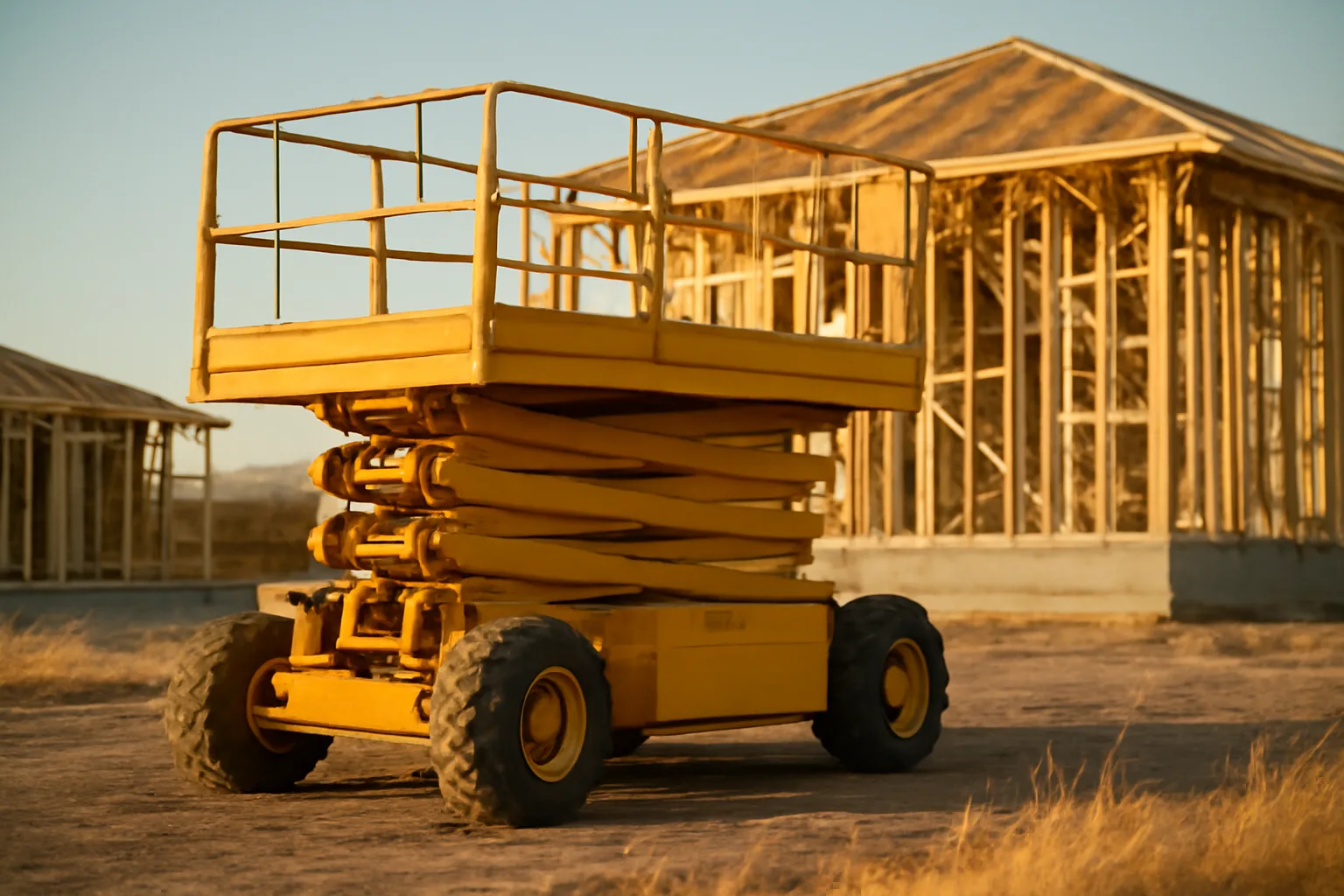
Scissor lift rental is a hire business. You own or finance mobile work platforms, keep them inspected, and charge a customer to use one for a day, a week, or a month. You keep title. The customer gets temporary possession plus a machine that still works on Friday.
That is the product. Height, indoor floor load, outdoor grade, and whether the battery holds a charge.
People mix up three trades. Working at height on a job is one. Owning a fleet is another. Holding a contractor license and also owning lifts is a third. Scissor lift rental sits in the middle. You are an equipment lessor. Some cities treat you like any other shop with a cash drawer. Some states want a seller's permit because rental receipts are taxable. A few boards get picky if you also sell used units, or if you send an operator who does the customer's work.
The machines are mobile supported platforms. In construction, OSHA treats many scissor lifts as scaffolds, not as the aerial lifts in 29 CFR 1926.453. That split changes the checklist. Read 29 CFR 1926.451 and 1926.452 before you copy a boom-lift form off the internet [1][3].
Your customers are usually contractors and facilities crews. Sometimes a homeowner painting a gable. Contractors will ask for a certificate of insurance, additional insured wording, and a current inspection. Homeowners will ask if it fits through a side gate. Price both honestly.
This is not passive income. Dead batteries, flat tires, and a no-show truck will eat a Saturday. If you want paper-light money, pick another yard.
How do you start scissor lift rental?
You start on paper, then you buy one machine you can actually rent. Form an LLC or corporation with your secretary of state, get a free EIN from the IRS, open a business bank account, bind insurance, and write a rental contract that names who inspects what [6][7]. Then confirm the city business license and the sales or use tax account with those boards. There is no federal scissor lift rental license.
Here is the order I would actually use.
File the entity first. The SBA register-your-business guide maps the federal and state split, but it will not list your city's fee. Confirm that fee with the city clerk [7].
Apply for an EIN next. The IRS says, "Applying for an EIN is a free service offered by the Internal Revenue Service." Use the agency form. Ignore sites that charge you for a free number [6].
Call an insurance broker who already writes inland marine (the floater on the fleet) plus general liability. Do not buy a machine you cannot insure. Some carriers want serial numbers before they bind.
Decide how you will deliver. A pickup and a tag trailer looks cheap until you cross the FMCSA weight line.
Write the packet: rental agreement, daily inspection sheet, handoff familiarization, and a damage matrix. OSHA expects a competent person to inspect scaffolds for visible defects before each work shift [1]. Your packet should make that somebody's named job.
Buy the first unit from a dealer who will show the hour meter, the last annual inspection, and the battery report. Skip auction photos until you have rented for a year.
Put the machine on a real invoice. Utilization beats a pretty fence.
If you hire anyone, federal overtime and minimum wage rules apply to most employees [12]. Do not pay cash per drop and hope. Confirm every state tax rate and municipal license cost with the board that invoices you. I will not invent those numbers. They move.
Do you need a license to rent scissor lifts?
No federal license exists for scissor lift rental. There is no national card that makes the shop legal in all 50 states.
What you will find is ordinary business paper plus workplace safety duties. The IRS wants an EIN if you have employees, a qualified retirement plan, or you file certain returns. Banks and insurers often want that EIN even for a single-member LLC [6]. OSHA wants a training and inspection program on the machines you send out [2][13]. FMCSA wants a USDOT number if you operate a commercial motor vehicle in interstate commerce that meets its threshold table, including a gross vehicle weight rating of 10,001 pounds or more [8].
| Paper | Who issues it | What it covers |
|---|---|---|
| Free EIN | IRS | Federal tax ID |
| Entity filing | Secretary of state | Legal existence |
| City or county business license | Local clerk | Right to operate at an address |
| Sales or use tax account | State revenue department | Tax on taxable rental receipts |
| USDOT number | FMCSA | Interstate CMV over the weight trigger |
| Training and inspection file | You, under OSHA | Duty to train and inspect |
State contractor boards are a different animal. Renting a lift is usually not contracting. Offering an operator who performs the customer's work can look like contracting. If you plan to supply a person who hangs drywall from your platform, call the contractor board. If you only drop the machine and leave, you are closer to a rental shop.
Some states license equipment dealers when you sell inventory. A pure rental fleet that never sells a unit may sit outside that statute. Confirm. Do not take a website as a ruling.
City zoning is the sleeper. A residential driveway with two lifts and a gooseneck can violate home-occupation rules. Check zoning before the first delivery.
What OSHA rules actually apply to scissor lifts?
For construction work, treat a scissor lift as a mobile scaffold unless counsel tells you a different standard controls that job. 29 CFR 1926.451 sets general scaffold rules. 29 CFR 1926.452 adds type-specific rules, including mobile scaffolds in paragraph (w) [1][3]. 29 CFR 1926.454 is the training rule [2].
OSHA's text in 1926.451(f)(3) is blunt: "Scaffolds and scaffold components shall be inspected for visible defects by a competent person before each work shift, and after any occurrence which could affect a scaffold's structural integrity." [1]
That sentence belongs on your checkout sheet.
The training duty sits on the employer of the person on the platform. If you only rent the machine, your customer is often that employer. If you send an operator, you are. Your contract should not pretend otherwise. 1926.454 requires training before the employee works on that type of scaffold, and retraining when there is reason to believe the person lacks the skill [2].
OSHA also publishes Safe Use of Scissor Lifts (OSHA 3842). It is a short fact sheet on tip-overs, collapses, electrocution, and falls [4]. Hand it out. Do not replace the CFR with a blog summary.
General industry jobs (factories, warehouses) can pull in 29 CFR 1910 walking-working surfaces rules and, for some vehicle-mounted gear, 1910.67 [5]. Do not mix the books. Match the standard to the site.
Keep a competent person named in writing. Competent person is an OSHA term, not a weekend certificate. It means the person can spot the hazard and has the authority to stop the work. 1926.20 also requires the employer to initiate and maintain programs needed to comply [13]. A binder that nobody opens is not a program.
What training do operators need before they leave the yard?
They need training on the hazards of that type of scaffold or mobile elevating work platform, and they need it before they work on it. OSHA 1926.454 does not sell a national wallet card. It requires the employer to train [2].
ANSI/SAIA A92.24 is the industry training standard many general contractors now write into bid packages. It is not a substitute for the CFR. A four-hour class does not last forever, and I will not pretend it does.
Retrain when the machine type changes, when site hazards change, or when someone shows they forgot. That is the 1926.454(c) idea in plain English [2].
I would not rent to a walk-in who has never seen a scissor lift without a documented familiarization on that model. Push the ground controls. Show the pothole protection. Show the wind and slope limits in the manual. Get a signature. Keep it for the claim you hope never comes.
Manufacturer familiarization is separate from "I sat in a classroom in 2019." New A92 practice treats them as different events. Follow the manual that shipped with the serial number.
A forklift card under 29 CFR 1910.178 does not cover a scissor lift. Do not accept one as proof. If a GC demands an A92.24 card, that is a customer spec, not a federal license to be in the rental business. Meet the spec or decline the job.
What insurance and tax paper come first?
Entity, EIN, bank account, then insurance. That order keeps the policy in the right name.
General liability is what a GC will ask to see. Inland marine or an equipment floater is what pays when a lift walks off a truck or takes a bath. Auto (or hired and non-owned) covers the chase truck. Workers' compensation is a state statute once you have employees. Umbrella is what larger GCs add to the email.
I will not invent premium ranges. They swing with zip code, loss history, and whether you rent to homeowners. Get two quotes. If a quote looks like a gift, read the theft deductible.
Additional insured and waiver of subrogation language will show up on every decent contractor job. Your broker should already know the ISO endorsements. If they do not, find another broker.
On the tax side, IRS Publication 946 explains how to depreciate business property under MACRS [10]. A scissor lift is not a mystery class. Keep the bill of sale and the placed-in-service date. Talk to a CPA about section 179. I am not your CPA.
Sales tax on rentals is a state question. Some states tax the rental stream. Some want you to collect on delivery fees. Confirm with the department of revenue, not a comment thread.
OSHA injury recordkeeping under 29 CFR 1904 has a partial exemption for employers with 10 or fewer employees, with exceptions for certain industries and for reporting severe injuries [9]. Count heads honestly. Report a fatality or in-patient hospitalization on the OSHA timeline even if you are small.
How much does first-year scissor lift rental cost?
Nobody publishes a clean national sticker for year one of a two-machine shop. Purchase prices move with hours, battery health, region, and whether the unit is electric slab or rough-terrain diesel. Dealer quotes scatter so widely that a fake average would be worse than this: get two written quotes on the same serial-number range and believe those.
What I would actually spend money on, in order: the insurance binder, a delivery method that is legal for the weight, two common indoor electric machines (the 19-foot class is the grocery SKU of this trade), chargers that live at the yard, and a contract a lawyer in your state has read once.
What I would not spend money on in month one: a 40-foot rough-terrain unit because bigger day rates look exciting, a custom wrap, or a lead service that sells the same call to four yards.
Yard rent is the silent killer in cities. A rural lot with power and a hose may be enough. A downtown warehouse looks sharp and can erase the profit on two machines.
Maintenance is real. Batteries, scissor bushings, pothole switches, tires. Budget a downtime reserve. A machine that is down is not a fleet. It is yard art.
If you are hunting the local board path rather than a national myth, start with the state pages for scissor lift rental board in California, Florida, and Arizona. Confirm fees on the board site the week you file.
Do you need a USDOT number to haul scissor lifts?
You need a USDOT number when you meet FMCSA's criteria, not because the machine is yellow. FMCSA says you must have a USDOT Number if you have a vehicle used to transport the goods in its threshold table and you operate in interstate commerce. The property-carrying threshold includes a gross vehicle weight rating, gross combination weight rating, gross vehicle weight, or gross combination weight of 10,001 pounds or more [8].
A one-ton truck plus a loaded equipment trailer crosses that line often. Weigh the combination. Read the door-sticker GVWR. Do not guess.
Interstate means across a state line, plus the broader FMCSA reading of commercial crossings. Intrastate-only hauls can still trigger a state DOT number. Confirm with your state patrol commercial section.
A CDL is a different threshold. 49 CFR 383.91 puts a combination in Class A when the GCWR is 26,001 pounds or more and the trailer towed has a GVWR over 10,000 pounds [11]. Plenty of small shops stay under that with a lighter trailer and a compact scissor. Plenty blow past it the day they buy a rough-terrain unit. Run the numbers on a scale, not on a forum.
Hazmat plates do not apply to a standard electric scissor. Diesel in the equipment tank is not the same as hauling cargo tanks. Do not over-register to look official.
What should a rental agreement and inspection sheet include?
Name of your legal entity, the customer's legal name, the serial number, hour meter out, hour meter in, delivery address, stated platform capacity, and who is the competent person on site. Then the ugly parts: damage matrix, tire and battery charge-backs, lost-key fees, and what happens if they use it as a crane. They will try.
State that the customer will not override limit switches, will not climb guardrails, and will keep the lift away from energized lines. Point them at the manufacturer manual in the box. OSHA 3842 is worth handing over as a one-pager on tip-over and fall hazards [4].
Inspection sheet: guardrails and gates, emergency lowering, ground and platform controls, pothole protection, tires or wheels, hydraulics, safety decals, function test, and a slope check. 1926.451 already requires a competent-person visual inspection each shift [1]. Your sheet is how you prove anyone did it.
Mobile scaffold rules in 1926.452(w) limit riding a moving scaffold unless specific conditions are met [3]. Put "do not travel elevated unless the manual and the standard both allow it" in plain English.
Add photos at handoff and return. Phones are cheap. Arguments about a cracked rail are not.
Do not copy a national chain's 18-page terms and pretend you understand them. Pay a local attorney once.
How do city and state boards fit into scissor lift rental?
They fit as ordinary business regulators, not as a secret aerial-lift guild. Secretary of state filings create the entity. The department of revenue (or comptroller) issues the sales-and-use account if rentals are taxable. The city or county issues the local business license tied to an address. A fire marshal may care about charging banks and diesel cans. Zoning cares about trucks at 5 a.m.
Contractor boards care if your work looks like construction. Dealer boards care if you retail machines. Transportation boards care about the chase truck. Each one has its own form. None of them replace OSHA.
If you want the local paper path, read the state kits rather than a national checklist. Start with Alabama, Colorado, Georgia, Connecticut, and Idaho. Confirm fees and forms on the board site the week you file. I will not invent a current fee or a processing time. Boards change both without calling you.
Cal/OSHA has its own scaffold text in Title 8, including section 1637 general requirements [14]. If you operate in California, that is the book a safety director will quote. Washington's Chapter 296-874 WAC is the scaffold chapter for that state [15]. Do not export a Florida packet to those states and hope.
What first-year mistakes waste money?
Buying height you cannot deliver. A 32-foot rough-terrain unit that does not fit your trailer is a paperweight with a note.
Skipping the contract because the first customer is a cousin.
Running without inland marine because you think general liability covers the fleet. It often does not.
Training nobody, then arguing with OSHA or an insurer after a tip-over.
Ignoring utilization. Two machines at 40 percent use will lose to one machine at 70 percent. Hour meters do not lie. If you want a cheap way to see hours on a tiny fleet, ScissorPath has a $179 one-time 2-6 machine telematics kit that is enough hardware for that job. You do not need an enterprise platform in year one. A paper hour log works if you actually write in it.
Renting to a site with a known overhead line because the day rate looked good.
Hiring a driver you pay cash per drop and calling them a contractor. Wage and hour rules are not optional for most employees [12].
I would rather turn down a job than send a slab electric onto mud. The recovery bill is the rental profit for a month.
How do you keep the first year from stalling?
You keep one calendar: inspections, chargers, and invoices. Miss any of those three and the week falls apart.
Track hours every return. Schedule the annual inspection before the sticker lapses. Keep manuals in a bin, not in a broken windshield. 1926.451 still wants that competent-person look every shift, even when you are slammed [1].
Hire slow. The first employee multiplies FLSA, workers' compensation, and OSHA recordkeeping questions [9][12]. Make sure the revenue is there.
Stay inside the machines you can service. If your mechanic has never seen a scissor stack, you do not own a fleet. You own a towing bill.
Indoor electric units in the common 19-foot class will book more days in most towns than a diesel giant you are afraid to send out. Add rough-terrain later, when a real customer asks twice.
When you want the startup sequence on one page, go to /start. ScissorPath is an independent publisher, not a law firm and not a service company. Confirm filings with the board that stamps them. No approval timeline is promised here, because boards do not work that way.
Frequently asked questions
What is scissor lift rental?
Scissor lift rental is a hire business. You own or finance mobile work platforms and charge a customer to use one for a set term. You keep title. The customer gets temporary possession. The product is a working platform plus delivery and a machine that passes inspection. It is not a contracting license and it is not a federal permit.
How do you start scissor lift rental?
File a state entity, get a free IRS EIN, open a bank account, bind liability and equipment insurance, write a rental contract, and confirm the city license and tax account with those boards. Then buy a common electric machine and put it on an invoice. There is no federal scissor lift rental license. Confirm every fee before you pay a third-party site.
Do I need OSHA certification to rent scissor lifts?
No national OSHA wallet card licenses a rental shop. OSHA 1926.454 requires the employer of the person on the platform to train that person on the hazards of that scaffold type. If you only drop the machine, your customer often holds that duty. If you send an operator, you do. Keep familiarization records anyway. GCs may still demand an ANSI A92.24 card as a job spec.
Can I run scissor lift rental from my house?
Sometimes, if zoning and the home-occupation rules allow commercial trucks and outdoor storage. Many cities do not. A driveway with two lifts and a gooseneck can draw a complaint fast. Confirm zoning and the local business license before the first delivery. A cheap rural lot with power often costs less than a fine and a forced move.
Do customers need a license to operate a rented scissor lift?
There is no federal operator license for a scissor lift. The customer's employer must train the person under OSHA 1926.454 (construction) or the matching general-industry rules. Some sites require an ANSI A92.24 card. A forklift card is not a substitute. Your handoff should still include model familiarization and a signed inspection.
Is a scissor lift an aerial lift under OSHA?
Often no, not under 29 CFR 1926.453. In construction OSHA commonly treats scissor lifts as mobile scaffolds under 1926.451 and 1926.452. That is why guardrails and shift inspections show up the way they do. Some vehicle-mounted gear in general industry can pull in 1910.67. Match the standard to the site instead of copying a boom-lift packet.
How often do you inspect a rental scissor lift?
OSHA 1926.451 requires a competent person to inspect scaffolds for visible defects before each work shift and after any event that could hurt structural integrity. You should also function-test at every handoff and keep the manufacturer's periodic and annual inspections current. A signed sheet plus photos beats a memory of "it looked fine."
Do I need a CDL to deliver scissor lifts?
Only if the truck and trailer meet federal or state CDL thresholds. 49 CFR 383.91 puts many combinations in Class A at a GCWR of 26,001 pounds or more when the trailer is over 10,000 pounds GVWR. A compact electric scissor on a light trailer may stay under. A rough-terrain unit often does not. Weigh it. A USDOT number can apply at 10,001 pounds even when a CDL does not.
What insurance do general contractors usually ask for?
A certificate showing general liability, plus additional insured and waiver of subrogation wording, is the usual email. You still need an equipment floater (inland marine) for the fleet and auto coverage for the chase truck. Workers' compensation applies once you have employees. I will not invent limit numbers. Ask two brokers what GCs in your zip code actually require.
Are scissor lift rental receipts taxable?
Often yes, but it is a state rule, not a federal rental tax. Some states tax the rental stream. Some tax delivery separately. A few treat short-term equipment hire like a sale for sales-tax purposes. Confirm with your department of revenue and collect on the account they issue. Do not copy another state's rate.
Can I rent a scissor lift without an operator?
Yes. Bare rental is the normal shop model. You drop or they pick up, you collect a signature on the inspection and familiarization sheet, and their employer trains the operator. If you supply a person who does the customer's work, you may look like a contractor to a state board. Keep those two offers on separate paper.
What size scissor lift should I buy first?
I would start with common indoor electric units in the 19-foot class. They fit more jobs, more trailers, and more elevators than a diesel giant. Add rough-terrain after a real customer asks twice and you can legally haul it. Nobody has a national utilization table that makes a 40-foot unit smart in month one.
How long does operator training last?
OSHA 1926.454 does not print an expiration date on a card. It requires training before the work and retraining when the machine, the hazards, or the person's skill changes. ANSI A92.24 programs often use a three-year classroom cycle plus familiarization on each model. Follow the standard your customer specified and the manual for that serial number.
Do I need a dealer license to rent lifts?
Maybe, if your state treats you as a dealer when you sell inventory or take trade-ins. A fleet that only rents and never sells may sit outside that statute. Confirm with the motor vehicle or dealer board, not with a forum. Entity filings and a city business license are still required in most places even when no dealer license applies.
Sources
- OSHA 29 CFR 1926.451 General requirements for scaffolds: Scaffolds must be inspected for visible defects by a competent person before each work shift and after any occurrence that could affect structural integrity.
- OSHA 29 CFR 1926.454 Training requirements: The employer must train each employee who performs work on a scaffold to recognize hazards and must retrain when the employee lacks needed skill or understanding.
- OSHA 29 CFR 1926.452 Additional requirements applicable to specific types of scaffolds: Mobile scaffold rules in paragraph (w) add type-specific limits, including conditions on riding a moving scaffold.
- OSHA Publication 3842 Safe Use of Scissor Lifts: OSHA's scissor lift fact sheet covers tip-over, collapse, fall, and electrocution hazards and safe-use practices.
- OSHA 29 CFR 1910.67 Vehicle-mounted elevating and rotating work platforms: General industry has a separate standard for certain vehicle-mounted elevating and rotating work platforms.
- IRS Apply for an Employer Identification Number (EIN) Online: Applying for an EIN is a free service offered by the Internal Revenue Service when you use the IRS application.
- U.S. Small Business Administration Register your business: Business registration, licenses, and permits vary by state and locality and must be confirmed with those agencies.
- FMCSA Do I need a USDOT number: A USDOT number is required for interstate commerce when the vehicle meets FMCSA threshold criteria, including 10,001 pounds GVWR, GCWR, GVW, or GCW for property-carrying vehicles.
- OSHA 29 CFR 1904.1 Partial exemption for employers with 10 or fewer employees: Employers with 10 or fewer employees are partially exempt from routinely keeping OSHA injury and illness records, with listed exceptions.
- IRS Publication 946 How To Depreciate Property: Business property such as machinery is depreciated under MACRS, and placed-in-service records matter for the deduction.
- 49 CFR 383.91 Commercial motor vehicle groups (eCFR): CDL Class A applies to combinations with a GCWR of 26,001 pounds or more if the trailer being towed has a GVWR over 10,000 pounds.
- 29 U.S.C. § 207 Maximum hours (Cornell LII): The Fair Labor Standards Act requires overtime pay of at least one and one-half times the regular rate for covered employees over 40 hours in a workweek.
- OSHA 29 CFR 1926.20 General safety and health provisions: The employer shall initiate and maintain programs as necessary to comply with construction safety and health standards.
- Cal/OSHA Title 8 section 1637 General Requirements (scaffolds): California has its own general scaffold requirements in Title 8 section 1637 that apply on Cal/OSHA sites.
- Washington Chapter 296-874 WAC Scaffolds (L&I chapter PDF): Washington's scaffold rules live in Chapter 296-874 WAC and are the state book for scaffold and related platform work.