Last updated 2026-08-19
TL;DR
Scissor lift rental means leasing mobile elevating work platforms by the day, week, or month, usually under NAICS 532412. You start with an entity, a free IRS EIN, local zoning, and a tax certificate, then add OSHA scaffold or aerial-lift duties, DOT rules if you haul, and sales-tax collection. No single national rental license exists. Confirm fees and permits with the board that issues them.
What is scissor lift rental?
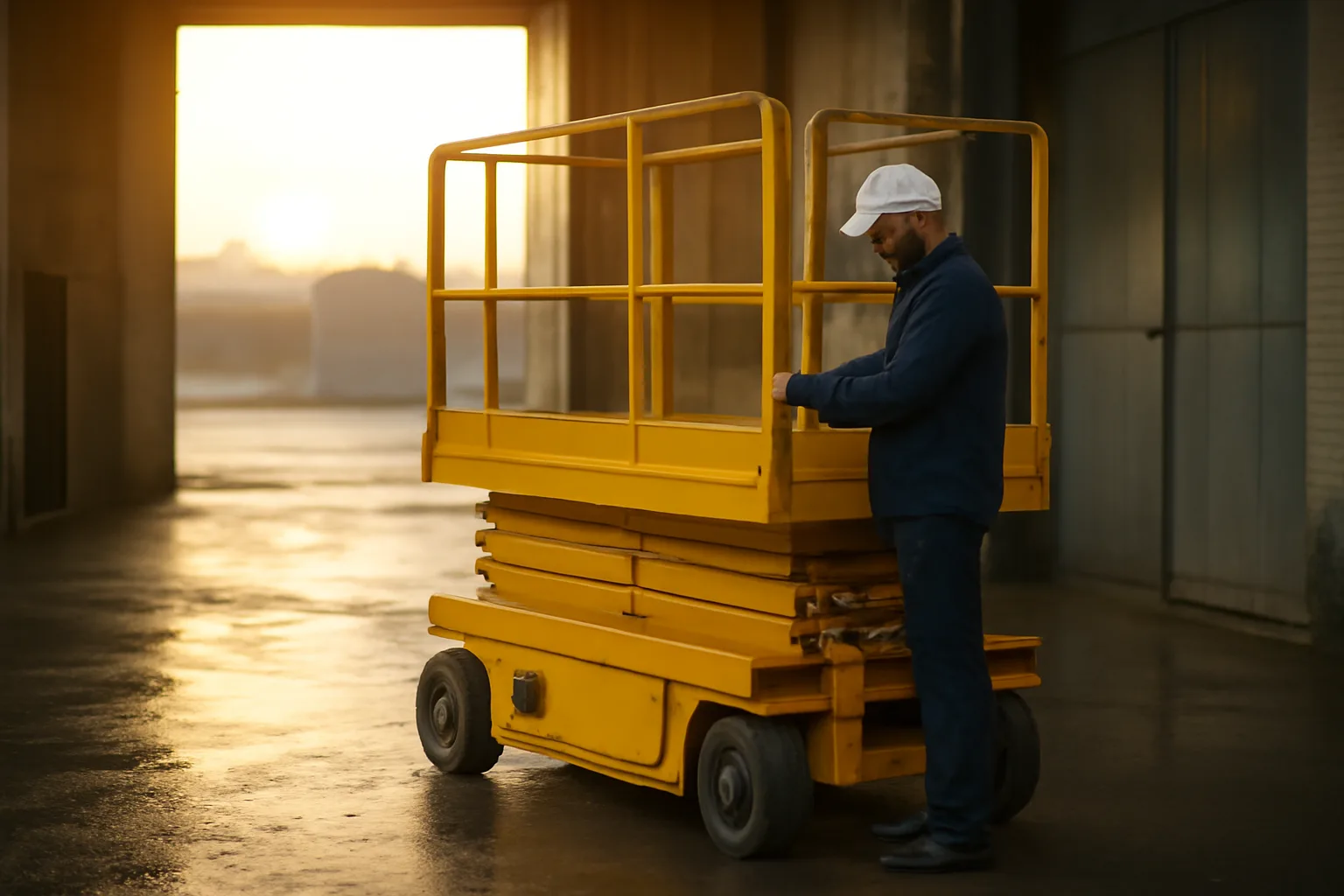
Scissor lift rental is the short-term lease of mobile elevating work platforms that raise a flat deck on a crisscross stack. You charge by the day, week, or month. The customer takes the machine, or you deliver it, and they return it when the job ends.
That is the whole product. Height and time. You are not selling a construction service unless your own people operate the lift on the customer's site.
The Census Bureau files this work under NAICS 532412, Construction, Transportation, Mining, and Forestry Machinery and Equipment Rental and Leasing. [1] That code also covers other heavy gear. A yard that only has 19-ft electrics still sits there. So does a yard that mixes scissors with booms.
People mix rental up with a nearby trade. Renting the machine is not the same as being the electrician who stands on it. If you want that contrast spelled out, read scissor lift rental vs nearby career.
Two machine families dominate small yards. Narrow electric slabs for indoor work. Rough-terrain diesel or hybrid units for dirt. The paper path is similar. The fuel, emissions, and tire problems are not.
You make money when the deck is out and the invoice clears. You lose money on dead batteries, unpaid door dings, and a truck stuck in traffic. I would rather start with a few clean electrics I can service than a mixed diesel fleet I cannot keep running.
Nobody has a public, current, national series for what a used 26-ft electric actually trades for this month. Dealer sheets move with batteries and who is dumping fleet. Treat any post that quotes one tidy average fleet cost as marketing.
How do you start scissor lift rental?
You start scissor lift rental the way you start any equipment yard, then you add lift-specific safety and transport rules. Form an entity, get a free EIN from the IRS, clear local zoning, collect a business tax certificate, buy insurance, write a rental contract, and only then take delivery of machines.
The U.S. Small Business Administration still frames the opening sequence as a 10-step path that begins with a plan and a structure choice. [8] I would not write a 40-page plan. I would write two pages on who pays you, where the machines sleep, and what happens when one gets stolen.
Pick an LLC or a corporation only after you talk to a CPA who files returns in your state. The SBA structure page is a decent map of the tradeoffs. It is not your operating agreement. [9] Confirm filing fees with your secretary of state. Those fees change and I will not invent them.
The IRS is blunt about the tax ID. "Applying for an EIN is a free service offered by the Internal Revenue Service." [7] Do it on IRS.gov. Do not pay a random site to click the same form.
Then the local pile. Zoning for outdoor storage. A city or county business tax certificate. A resale or seller's permit if your state taxes equipment rental. A yard lease that lets you unload at 6 a.m. Confirm each of those with the clerk or board that issues it.
If you have employees, OSHA duties start on day one. If you haul interstate on a truck that weighs enough, FMCSA duties start too. Those are the two federal stacks that surprise people who thought a rental license was one form.
I would not buy six machines before I have a signed yard and a contract template a lawyer in my state has read. Machines are easy to want. Paper keeps you from eating a total-loss claim.
Do you need a special scissor lift rental license?
No federal agency issues a scissor lift rental license. You stack ordinary business paper, then add transport and safety duties that depend on how you operate. Confirm every local certificate and tax permit with the board that issues it.
That answer disappoints people who want one national card. It also saves you from waiting on a myth.
What you may need, depending on place and facts, is boring and real. A state entity filing. A local business tax certificate. A seller's permit, because many states tax the rental of tangible personal property. A contractor license only if you supply operators or bid construction work, not if you rent unmanned machines. Confirm that line with your state contractor board. I have watched people over-file and under-file on the same street.
If you store diesel and oil above the EPA threshold, you may need a Spill Prevention, Control, and Countermeasure plan. [12] If you run a truck in interstate commerce at 10,001 pounds or more, you need a USDOT Number. [10]
California adds its own elevating-work-platform operating rules under Title 8. [13] Other OSHA state-plan states write their own text. Federal OSHA states use 29 CFR. Confirm with the plan state if you are in one.
I would call the city clerk and the state department of revenue before I call a lift dealer. Dealers will sell you a machine on a handshake. Clerks will tell you whether the lot is even legal.
What OSHA rules apply to a scissor lift rental yard?
If your employees maintain, deliver, demonstrate, or operate scissors, OSHA rules apply. On construction sites, scissor lifts are generally handled under the scaffold rules in 29 CFR 1926 Subpart L, including 1926.451 and the training rule in 1926.454. [4] [3] Aerial-lift text in 1926.453 still matters for boom-type gear and for a few shared practices. [2] In general industry, 1910.67 covers vehicle-mounted elevating and rotating work platforms. [6]
The rental house is an employer. The customer is often a different employer. Your duty is for your people and your workplace. The customer's duty is for their people. Your contract should not pretend you can sign away a statutory duty.
OSHA 29 CFR 1926.454 requires the employer to train each employee who performs work while on a scaffold. [3] The regulation says: "The employer shall have each employee who performs work while on a scaffold trained by a person qualified in the subject matter to recognize the hazards associated with the type of scaffold being used and to understand the procedures to control or minimize those hazards." [3]
You also need a competent person for scaffold inspections. OSHA's definition in 29 CFR 1926.32 is not a certificate mill. It is a person who can spot the hazard and who has authority to fix it. [5] Cards from a weekend class do not replace that authority.
1926.451 requires visible-defect inspections before each work shift and after any occurrence that could affect structural integrity. [4] For a rental yard that means your techs and your delivery people, not a laminated card in a drawer.
1926.453 tells people to stand firmly on the floor of the platform and not to climb the rails. [2] Put that in the packet you hand the renter. It does not make you their employer. It does show you warned them.
ANSI/SAIA A92.22 (safe use) and A92.24 (training) are the documents most manufacturers and larger rental firms write into delivery paperwork. They are consensus standards. They are not a substitute for the CFR unless a rule incorporates them. I would still train to them. Customers and insurers ask.
Do you need a USDOT number to haul rented scissor lifts?
You need a USDOT Number if you operate a commercial motor vehicle in interstate commerce that meets FMCSA's weight or hazmat tests. FMCSA requires a USDOT Number when a vehicle used in interstate commerce has a gross vehicle weight rating or gross combination weight rating, or gross vehicle weight or gross combination weight, of 10,001 pounds or more. [10]
A one-ton truck and a loaded equipment trailer cross that line constantly. Weigh the combination. Do not guess from the sales brochure.
Intrastate-only hauls can still trigger a state DOT number. Confirm with your state patrol or motor carrier desk. I will not invent that state's threshold.
A CDL is a different card. Federal CDL territory generally starts much higher than the USDOT 10,001-pound test, or kicks in when you haul enough passengers or placarded hazmat. Plenty of scissor deliveries stay under a CDL if you pick the truck and trailer on purpose. Plenty do not. Confirm with your DMV before you hire a driver who only has a regular license.
I would rather run a lighter truck and two trips than save a day and discover I needed authority I do not have. Fines are real. So is an insurance denial after a wreck.
If you never deliver, and the customer always trailers the machine, this stack may not apply to you. Get that in the contract. Customers lie about trailer ratings.
What business paper should you file first?
File the entity with your secretary of state, then get the EIN, then open the bank account in the entity's name. That order keeps your personal checking account out of a later lawsuit. Confirm the entity fee with the state filing office. Do not use a number you saw on a forum.
The SBA register-your-business guide is a clean federal overview of the usual stops: entity, licenses, and tax IDs. [15] It will not list your county's outdoor-storage overlay. You still have to call.
Get a written zoning confirmation for outdoor equipment storage and occasional after-hours loading. A verbal should-be-fine from a landlord is not paper.
Sales-tax permits come from the state department of revenue in most states. Many states tax equipment rental. Some exempt certain resales or certain lessees. Confirm the rate and the exemption certificates your customers will hand you.
Insurance binders belong in this pile even though they are not a government license. Inland marine or scheduled equipment covers the lifts. Auto covers the truck. General liability covers the your-machine-hurt-my-building claim. Workers' comp is a state rule once you have employees. Confirm coverage triggers with a licensed agent in your state. Premiums are not a number I can honestly publish here.
I would skip fancy letterhead and spend that money on a lawyer-reviewed rental agreement. The agreement needs delivery condition photos, a charge or fuel policy, a missing-key fee, and a clear line that the renter supplies trained operators.
What training records do you have to keep?
Keep training records for every employee who works on, delivers, or demonstrates a lift. OSHA 1926.454 is the construction training rule. [3] 1910.67 expects the employer to instruct and train in general industry. [6] The file should name the person, the machine class, the trainer, the date, and the topics.
Topics that actually matter are dull on purpose. Fall protection. Tip-over. Electrocution. Trapped-against. Potholes. Wind. The manufacturer's notes for that model, not a generic cartoon.
If you only rent unmanned and your employees never stand on a deck, you still train the yard and the drivers. They load, chain, and sometimes start a dead unit in a parking lot.
ANSI A92.24 is what bigger customers will ask for by name. I would buy the standard and train to it rather than invent a two-hour slideshow. I would not pay a trainer who only prints cards and never looks at your actual machines.
How long do you keep the file? OSHA does not hand you one magic rental-industry retention number for training cards. Keep them for the life of employment plus a few years. Your insurer may want longer. Confirm with counsel. I keep more paper than I want. I have never regretted a dated sign-off.
Pre-delivery inspection sheets go with the machine copy and a yard copy. Photos with timestamps beat a checkbox someone initialed in the truck.
How do sales tax and NAICS codes work for scissor lift rental?
Use NAICS 532412 on bank, insurance, and census forms unless your mix of work is honestly something else. [1] BLS parks the broader industry under rental and leasing services (NAICS 532). [14] The code does not license you. It just stops a clerk from guessing you are a contractor.
Sales tax on the rental charge is a state question. A lot of states treat the lease of tangible personal property as taxable. Some tax delivery separately. Some do not. Confirm with the state department of revenue and keep exemption certificates when a customer claims one.
If you sell used machines later, that is another tax event. Same board. Same need to confirm, not to copy a rate from a blog.
I would not advertise tax-free weekend rentals unless the statute actually names equipment rental. People get cute with holiday ads and then fund a sales-tax audit.
Federal income tax is ordinary business income. Ask a CPA about depreciation and listed-property rules for the year you buy. I am not going to pretend a schedule here. Those rules move.
For a side-by-side of how other operators frame the same first-year choices, scissor lift rental guide 12 and scissor lift rental guide 18 are useful next reads.
What insurance and yard rules trip new scissor lift rental yards?
Insurance and zoning kill more new yards than OSHA citations do. You can open without a perfect safety binder. You cannot open if the landlord's carrier refuses outdoor storage, or if your own carrier will not schedule used lifts with unknown hour histories.
Ask the agent, in writing, whether boom and scissor rentals need a separate inland marine form, what the per-item deductible is, and whether a renter's damage waiver you sell is even allowed in your state. Some states treat those waivers like insurance. Confirm. I would not sell a waiver I cannot defend.
Yard rules that actually bite are unglamorous. Stormwater if you wash machines. Fire code if you charge lithium packs in a closed room. SPCC if your diesel, hydraulic oil, and waste oil add up. 40 CFR 112.1 uses a 1,320-gallon aggregate aboveground storage threshold in the standard applicability test. [12] A couple of transfer tanks and a waste cube get you there faster than people think.
Neighbors complain about beeping alarms at dawn. Write delivery hours into the lease.
I would walk the lot at night before I sign. Lighting and a fence do more than a camera you never review.
Compare notes with scissor lift rental guide 24 if you are weighing a paved city lot against a cheap dirt parcel.
What do first-year scissor lift rental operations look like on paper?
First-year operations look like a stack of repeating forms, not a grand opening. Every outbound machine gets a condition report and photos. Every inbound machine gets the same, plus a charge or fuel reading. Every employee injury has its own federal and state path.
OSHA 1904.1 gives a partial recordkeeping exemption to employers with 10 or fewer employees, though serious events still have to be reported. [11] Confirm whether you are truly at or under that headcount and whether your industry is on OSHA's exemption list. Do not assume a two-person yard never reports anything.
I like a simple hour log more than a dashboard I will ignore. If you want hour counts without a dealer login tax, ScissorPath has a $179 one-time 2-6 Machine Telematics Kit. A clipboard works too if you actually write the hours down.
Monthly paper I would not skip is short. Bank rec. Sales-tax filing on the state's calendar. Insurance driver list. A one-page fleet status: out, down, due for service.
Annual paper is the entity report with the state, a workers' comp audit if you have it, and a reread of the rental contract after the first cracked-glass fight. There will be one.
If you want other operators' year-one checklists in this same series, scissor lift rental guide 30 and scissor lift rental guide 36 go deeper on adjacent choices.
What should you skip spending money on in year one?
Skip the national franchise pitch until you have rented your own six machines for a year. You are buying a logo and a software login. You already have the hard parts.
Skip a huge diesel rough-terrain on day one if your calls are indoor tenant-improvement work. That machine needs a different trailer, a different customer, and a different repair kit.
Skip paying a website to file your EIN. The IRS does it free. [7]
Skip a custom-built rental OS in month one. You need contracts, photos, and invoices. Spreadsheets are ugly and they work.
Skip operator-included rental unless you want contractor licensing and a much larger insurance bill. Unmanned rental is a cleaner paper path. Confirm that split with the contractor board anyway.
Skip painting every unit in a signature color before the machines have earned their keep. Paint does not collect. Uptime does.
I would spend money on chains, a decent yard forklift or loader for loading, and a lawyer. Those three pay.
More comparison pieces live at scissor lift rental guide 42 and scissor lift rental guide 48 if you are still weighing this against other ways to work.
How do indoor electric and diesel fleets differ on compliance?
Indoor electric scissors create battery, charger, and water (or lithium) issues. Diesel rough-terrain units create fuel, DEF, emissions, and SPCC issues. The OSHA platform rules look alike. The environmental paper does not.
EPA nonroad diesel rules are why newer off-road engines look the way they do. If you buy older diesels cheap, you may inherit local idling rules and jobsite bans you cannot talk your way around. Confirm any nonroad restrictions with the air district if you are in a strict county. I will not invent a city sticker fee.
Electrics are quieter and they go through hospital and school doors. They also die at 6 a.m. if nobody plugged them in. Your first-year ops manual should assign a name to the person who checks chargers, not the shop.
California's Title 8 rules for elevating work platforms add state operating instructions on top of federal text. [13] If you run there, read section 3646 before you write your delivery card. Other plan states have their own sections. Federal OSHA states stay with 29 CFR.
ScissorPath is an independent publisher, not a law firm and not a rental house. Nothing here is legal advice. Confirm every fee, quota, and form with the board that issues it. If you want a start checklist next to this reference, go to /start.
Frequently asked questions
What is scissor lift rental?
It is the short-term lease of mobile elevating work platforms, usually by the day, week, or month. The Census Bureau places the work in NAICS 532412. You are renting a machine, not selling a construction trade, unless your own people operate the lift on the customer's site. Confirm contractor-board lines if you add operators.
How do you start scissor lift rental?
Form an entity, get a free EIN on IRS.gov, clear zoning, get the local tax certificate and any seller's permit, bind insurance, and write a rental contract before the first machine arrives. Then add OSHA duties if you have employees and FMCSA paper if you haul interstate at 10,001 pounds or more. Confirm every fee with the issuing board.
Is there a federal scissor lift rental license?
No. There is no national rental card. You combine ordinary business filings with OSHA, tax, and sometimes DOT or SPCC duties. State contractor licenses usually attach when you supply operators or bid construction work, not when you only rent unmanned machines. Confirm that split with your contractor board.
Are scissor lifts scaffolds or aerial lifts under OSHA?
On construction sites OSHA generally applies 29 CFR 1926 Subpart L scaffold rules, including 1926.451 and 1926.454, to scissor lifts. 1926.453 is the aerial-lift section and still matters for shared practices and boom-type equipment. General industry uses 1910.67 for vehicle-mounted platforms. Read the section that matches the worksite.
Do I need ANSI A92 training to rent machines out?
ANSI/SAIA A92.22 and A92.24 are consensus standards, not a federal license. Larger customers and insurers still ask for them by name. OSHA already requires scaffold or platform training for your employees under 1926.454 or 1910.67. I would train to both the CFR and A92 rather than print novelty cards.
Do I need a USDOT number to deliver scissors?
FMCSA requires a USDOT Number when a vehicle used in interstate commerce has a GVWR, GCWR, GVW, or GCW of 10,001 pounds or more. A pickup plus a loaded equipment trailer often meets that test. Intrastate rules differ by state. Confirm with FMCSA for interstate work and with your state motor carrier desk for in-state hauls.
Is an EIN really free?
Yes. The IRS says applying for an EIN is a free service offered by the Internal Revenue Service. Use IRS.gov. Paid third-party sites click the same form and charge you for the privilege. You still need the EIN before most banks will open a business account.
What NAICS code do scissor lift rental companies use?
NAICS 532412, Construction, Transportation, Mining, and Forestry Machinery and Equipment Rental and Leasing, is the Census code that fits most scissor lift rental yards. BLS groups the broader industry under NAICS 532. The code is for forms and data. It is not a permit.
Do I need a contractor license to rent unmanned lifts?
Usually no, if you only rent the machine and the customer supplies the operator. If your people operate on the job, or you bid construction work, many states pull you into contractor licensing. That line is state-specific. Confirm with the contractor board before you advertise operator included.
When does an SPCC plan show up in a small yard?
40 CFR 112.1 uses a 1,320-gallon aggregate aboveground oil storage threshold in the standard applicability test. Diesel transfer tanks, hydraulic totes, and waste oil count. A small diesel fleet can cross the line without looking like a bulk plant. Confirm applicability with EPA's rule text and your state environmental desk.
How many employees before OSHA 300 logs?
OSHA 1904.1 gives a partial recordkeeping exemption to employers with 10 or fewer employees, but serious events still must be reported and some industries are excluded from the exemption. Count everyone who meets OSHA's employee test. Confirm your status against 1904.1 and the current partially exempt industry list.
Can I start scissor lift rental from a house driveway?
Sometimes for a single electric machine and customer pickup, often not once you store several units or run a delivery truck. Zoning, HOA rules, and insurance usually break first. Get written zoning confirmation for outdoor equipment storage before you take a second unit. A landlord's shrug is not paper.
Who trains the operator, the rental house or the customer?
If the lift is unmanned, the customer is the employer of the person on the deck and owes that person training. You still train your own techs and drivers, and you should hand over manufacturer warnings and a condition report. If you supply the operator, that person is your employee and your training duty.
What paper should go out with every machine?
A signed rental contract, timestamped condition photos, a pre-delivery inspection sheet, the manufacturer's operator manual or a pointer to it, and basic hazard notes (rails, wind, power lines, potholes). Keep a yard copy. Photos settle more door-ding fights than any clause you wrote at midnight.
Sources
- U.S. Census Bureau, NAICS 532412 (2022) definition: Scissor lift and similar heavy equipment rental is classified under NAICS 532412, Construction, Transportation, Mining, and Forestry Machinery and Equipment Rental and Leasing.
- OSHA 29 CFR 1926.453 Aerial lifts: 1926.453 sets aerial-lift work practices, including standing firmly on the platform floor and not climbing rails.
- OSHA 29 CFR 1926.454 Training requirements: Employers must train each employee who performs work while on a scaffold to recognize hazards and control them.
- OSHA 29 CFR 1926.451 General requirements for scaffolds: Scaffolds must be inspected for visible defects by a competent person before each work shift and after any occurrence that could affect structural integrity.
- OSHA 29 CFR 1926.32 Definitions: Competent person is defined as someone who can identify existing and predictable hazards and who has authority to correct them.
- OSHA 29 CFR 1910.67 Vehicle-mounted elevating and rotating work platforms: General industry aerial platform rules require employer instruction and training of operators.
- IRS, Apply for an Employer Identification Number (EIN) online: Applying for an EIN is a free service offered by the Internal Revenue Service.
- U.S. Small Business Administration, 10 steps to start your business: SBA frames starting a business as a 10-step federal guide beginning with planning and structure.
- U.S. Small Business Administration, Choose a business structure: SBA outlines the legal and tax tradeoffs among common entity types for new firms.
- FMCSA, Do I need a USDOT number: A USDOT Number is required for vehicles used in interstate commerce at a GVWR, GCWR, GVW, or GCW of 10,001 pounds or more.
- OSHA 29 CFR 1904.1 Partial exemption for employers with 10 or fewer employees: Employers with 10 or fewer employees receive a partial OSHA injury-recordkeeping exemption, with reporting still required for specified serious events.
- 40 CFR 112.1 SPCC General applicability: The standard SPCC applicability test uses a 1,320-gallon aggregate aboveground oil storage capacity threshold.
- Cal/OSHA Title 8 section 3646, Operating instructions (elevating work platforms): California Title 8 adds state operating instructions for elevating work platforms on top of federal rules.
- U.S. Bureau of Labor Statistics, Industries at a Glance: Rental and Leasing Services (NAICS 532): BLS groups commercial and consumer rental firms under NAICS 532, rental and leasing services.
- U.S. Small Business Administration, Register your business: SBA lists the usual federal and state registration stops: entity filing, licenses, and tax IDs.