Last updated 2026-08-20
TL;DR
Scissor lift rental means you own or finance vertical work platforms and hire them out by the day, week, or month. Start with a legal entity, a free IRS EIN, state and local tax permits, insurance, and a written rental packet. OSHA treats most construction scissor lifts as scaffolds under 29 CFR 1926 Subpart L. Confirm licenses with your state board. Do not buy iron first.
What is scissor lift rental?
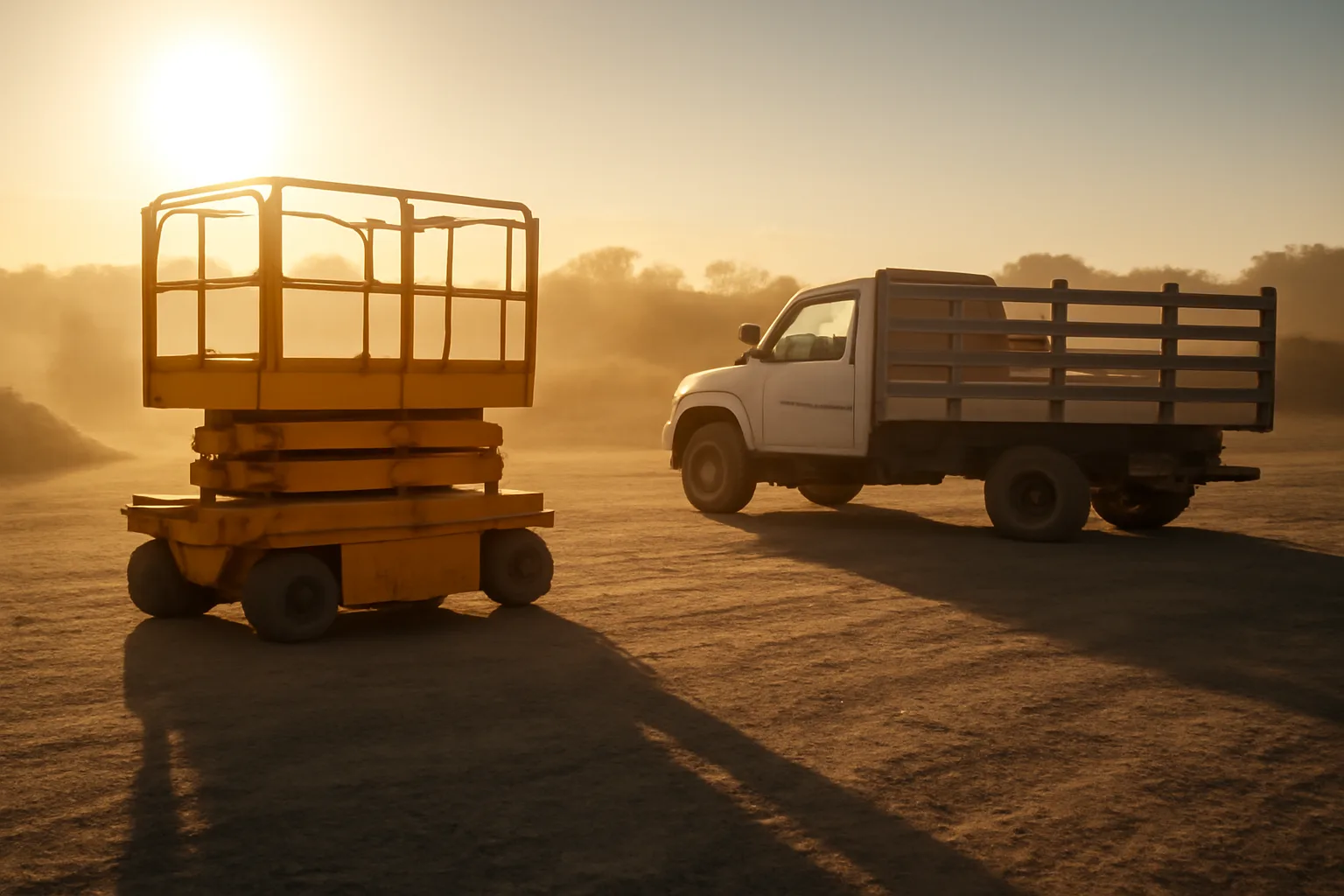
Scissor lift rental is the short-term hire of a powered platform that travels straight up on a stacked, crossing arm set. You charge by the day, week, or month. The customer runs the machine. You own it, maintain it, and eat the claim if your contract is thin.
That is the product. It is not a construction company. In most states it is not an occupational license either. It is equipment rental. The Census Bureau files construction machinery and equipment rental and leasing under NAICS 532412. [12]
People mash this together with boom lift rental. A boom reaches out and up. A scissor lift mostly goes straight up, with a bigger platform and a lower skill floor for new users. Indoor electric slab machines fit warehouses, retail build-outs, and schools. Rough-terrain machines fit gravel, mud, and unfinished pads. Stock the wrong family and you own a parked payment.
Hire terms get messy if you let them. A day might mean 24 hours or an 8-hour shift. A month might mean 28 days. Write the clock into the contract. Leave it oral and you will argue at the gate.
I treat this as a paper trade with steel bolted on. The steel is easy to buy. The paper is what keeps a drop from becoming your personal problem.
You will hear national myths. A common one says you need an OSHA license to rent. You do not. OSHA writes workplace rules. It does not charter rental houses. [1] Your customer's employer still carries duties when the lift sits on a construction site. You carry duties as the person who sent out a machine that can kill someone.
If you want a state-shaped checklist, use a real jurisdiction note such as scissor lift rental board in california or scissor lift rental board in florida. Do not copy a license the board does not sell.
How do you start scissor lift rental?
You start scissor lift rental by forming a legal entity, getting a free IRS EIN, registering for state and local tax permits, buying insurance, locking a legal place to park machines, then buying or financing two to four lifts you can actually rent. Confirm every fee and form with the board that issues it. Buy iron last, not first.
Here is the order I would run. File an LLC or corporation with your state. The SBA structure guide maps the tradeoffs, but it is no substitute for the filing clerk in your capital. [11] Apply for an EIN on the IRS site the same day. The IRS says, "Applying for an EIN is a free service offered by the Internal Revenue Service." [7] Anyone charging you for the number itself is selling you a line.
Register the business where you operate. The SBA is plain that how and where you register depends on structure and location. [6] That usually means a state business registration, a local business tax certificate, and a sales or rental tax permit, because equipment hire is taxable in most states. Confirm with your department of revenue. I cannot quote your rate. It moves by state and sometimes by city.
Call a broker who already writes equipment rental, not your cousin's auto agent. Bind general liability and equipment coverage before the first machine hits your yard. The SBA insurance overview is a launch checklist, not a quote. [8]
Then get a yard that zoning allows for outdoor storage and truck traffic. Then buy machines. Then write the rental contract, the delivery ticket, and the inspection sheet. Then rent.
Skip to a handshake and a used lift with no title packet, and you will learn this order the expensive way.
Do you need a special license to rent scissor lifts?
Most states do not issue a dedicated scissor lift rental license. You need ordinary business registration, tax permits, and whatever local zoning and dealer rules apply. Confirm that with your state, because a few jurisdictions pile on equipment-dealer or contractor rules if you also sell or install.
There is no federal OSHA card that authorizes you to be a rental house. OSHA regulates workplaces. It does not charter rental companies. [5]
If you only rent and deliver, you sit in the same bucket as any other construction-equipment rental shop. Start providing an operator and many customers, plus some states, treat that closer to a service contractor. I would keep operator-for-hire out of year one unless you already hold the right contractor license. It changes your risk. Sometimes it changes the license you must hold.
CDL rules attach to the truck. A yard permit attaches to the land. A sales-tax account attaches to the revenue. Keep those separate in your head or you will file the wrong form and think you are "licensed" when you are only halfway there.
State notes differ. Compare scissor lift rental board in arizona with scissor lift rental board in georgia before you assume a Sun Belt rule travels. New England shops should start with scissor lift rental board in connecticut rather than a national blog checklist.
Are scissor lifts aerial lifts under OSHA?
On construction sites, OSHA generally treats scissor lifts as scaffolds, often as mobile scaffolds, not as the aerial lift category in 29 CFR 1926.453. Read Subpart L first. Do not run your shop on toolbox-talk folklore.
29 CFR 1926.451 sets the general scaffold rules, including capacity, inspection, and fall protection. [1] 29 CFR 1926.452 adds type-specific rules, including mobile scaffolds in paragraph (w). [2] OSHA's August 1, 2000 interpretation is the letter shops still hand around: scissor lifts get addressed through the scaffold standards rather than the aerial lift standard. [4]
That matters for your rental packet. Cite only aerial lift 1926.453 on your form and you pointed the customer at the wrong page. 29 CFR 1926.451(g)(1) requires fall protection on a scaffold more than 10 feet above a lower level. [1] Guardrails on a scissor lift are the usual method when the manufacturer built them for that. Do not tell a renter to clip off in a way the manual forbids. The manual wins arguments after a drop.
General industry (fixed plants, stores, many warehouses) can pull in 29 CFR 1910.67 for vehicle-mounted elevating and rotating work platforms. [5] Construction versus general industry is a real split. If your customer is restocking racking, the 1910 world may apply. If they are framing a school, it is 1926.
I would put both citations in the packet and tell the renter to follow the manufacturer and their own competent person. You are not their safety director. Do not pretend to be.
What training does OSHA require for scissor lifts?
OSHA requires the employer of the people on the scaffold to train them. That is usually your customer, not you, unless you send your own techs or operators. 29 CFR 1926.454(a) says: "The employer shall have each employee who performs work while on a scaffold trained by a person qualified in the subject matter to recognize the hazards associated with the type of scaffold being used and to understand the procedures to control or minimize those hazards." [3]
You still need trained people on your payroll. Mechanics who service lifts. Drivers who offload them. Anyone you put on a platform. Keep those records in a folder you can find at 2 a.m.
The market also runs on ANSI/SAIA A92.20 (design), A92.22 (safe use), and A92.24 (training). Those are industry standards, not statutes. Confirm the current edition with SAIA before you print a year on a form. Rental houses that ignore them look sloppy when a lawyer asks what ordinary care meant. I would require proof of user training before a machine leaves, or give a short orientation and document it. I would not sell OSHA certification. That phrase is marketing sludge.
29 CFR 1926.451(f)(3) also says scaffolds and components get inspected for visible defects by a competent person before each work shift, and after any occurrence that could affect structural integrity. [1] Your checkout sheet should match that idea. 29 CFR 1926.32 defines a competent person as one who can identify hazards and who is authorized to take corrective measures. [10]
A renter who refuses to name a competent person is a renter I turn away. That is not drama. That is how you stay out of a fatality file.
What insurance do first-year scissor lift shops actually buy?
Buy commercial general liability, inland marine or an equipment floater on the lifts, commercial auto on the truck, and workers' compensation the day you have an employee. Confirm limits with a broker who writes rental accounts. I will not invent a premium. Anyone who pastes a national average in a blog is guessing.
The SBA lists insurance as a launch step and reminds you that needs vary by business. [8] Equipment rental is a hard class if your forms are weak. Renters drive machines into mezzanines. They leave keys in a grocery lot. They tow a self-propelled lift with a pickup that cannot stop.
I want a rental agreement that shifts lawful risk to the renter, plus a damage waiver option if your state lets you sell one. Some states police those waivers. Confirm. I also want the renter to carry their own liability and to name you as additional insured when the job is commercial. Homeowners are messier. I would rent to homeowners only with a higher deposit and a hard ban on homemade attachments.
Bonds are not a federal rental requirement. A city might want a business license bond. A landlord might want extra insured status. A bank that floors your fleet will want a loss-payee endorsement. That is the endorsement pile, not a mystical surety.
Do not cheap out on rented-equipment coverage and then cry when a slab lift walks off a trailer. Confirm current iron prices with two dealers. They move.
Do you need a USDOT number or CDL to deliver lifts?
You may need a USDOT number if you operate a commercial motor vehicle in interstate commerce at 10,001 pounds GVWR or more. FMCSA's own registration page is the test, not a forum post. [9] Many scissor-lift plus rollback or gooseneck combinations clear that weight without trying.
A CDL depends on the vehicle, the GVWR or GCWR, and whether you haul for others or only your own goods as a private carrier. FMCSA's CDL page is the federal floor. States add their own wrinkles. [13] I would take the actual truck to a DMV or a reputable trainer with the door-sticker weights in hand. Do not guess from a Facebook group.
Intrastate-only shops still get state DOT numbers in a lot of states. Confirm with your state patrol commercial section. Processing times and fees change. I will not invent them.
Subcontract delivery and you still need a contract that names who is the motor carrier and who carries the cargo insurance. A lift that falls off a ramped trailer is a claim with photos that last forever.
I would not buy a triple-axle trailer in month one to be ready. Rent delivery or use a rollback until you know your radius.
What paper should every scissor lift rental packet include?
Every rental packet should include a signed rental agreement, a condition report with photos, the operator manual (or a clear pointer to it), an inspection checklist, and a short statement of who is the competent person on the renter's side. That is the minimum I would send out the gate.
Add proof of the renter's insurance when the job is commercial. Add a delivery ticket with hour-meter and fuel or charge level. Add a late-return and dirty-return schedule so you are not negotiating at dusk on a Friday.
Cite the right OSHA parts. Point at 1926.451 and 1926.454 for construction scissor lifts. [1] [3] Point at the manufacturer's manual for wind, slope, and occupancies. If you mention ANSI A92.22, say it is a safe-use standard, not a government license.
Keep the signed pack for years, not months. Fatality lawsuits move slow. Your memory is not a record.
I like a one-page do-not sheet: no homemade platforms, no standing on rails, no outdoor use of an indoor slab in wind, no towing a self-propelled lift like a trailer unless the manual says you can. Short. Ugly. Readable.
If you later put GPS hour meters on a small fleet, ScissorPath has a $179 one-time 2-6 Machine Telematics Kit. I would still wait until machines actually leave the yard, and I would put the logging in the contract so the renter knows abuse gets timestamped.
How much capital does a first-year fleet take?
Nobody publishes an honest, current, public dataset of turnkey scissor lift rental startup cost that survives contact with your zip code. Iron, rent, insurance, and a truck dominate. Confirm each line with a dealer, a landlord, and a broker. I will not invent a national total.
Budget these as categories, not fake dollars: two to four used electric slabs if your calls are indoor, or two rough-terrain units if your market is dirt pads. A truck or a contracted hauler. First and last month on a yard. An insurance down payment. A shop jack, batteries or a charger farm, and a parts float. Working capital so a 60-day contractor invoice does not bounce payroll.
New machines look clean in a photo. Used machines with service records make money sooner. I would buy the ugly lift with a documented mast inspection over the shiny one hiding a painted-over crack.
Banks and captive finance will ask for a down payment and a personal guarantee. That is normal. If a seller offers no-credit terms and wants to keep title in a cousin's name, walk.
Software can wait until two machines actually leave the yard every week. Buying a custom app before a sales-tax permit is backwards.
Should you buy electric slab or rough-terrain lifts first?
Buy the type your closest customers already call other shops to request. Call three contractors and two facility managers. Ask what they cannot get on short notice. Stock that. Ignore fleet-tour videos.
Electric slabs win in warehouses, hospitals, stores, and finished interiors. They need charge time, indoor storage, and customers who will not drive them through gravel. Rough-terrain diesel or hybrid units win on new construction, mud, and outdoor elevations. They need fuel discipline, spill kits, and neighbors who will not scream about smoke.
I would not mix six sizes in year one. Two working heights that match local ceiling and facade work will turn more than a catalog.
Tires, pothole protection, and platform capacity show up on every lost-rental call. If your city is all slab-on-grade warehouses, a 19-foot or 26-foot electric class is the usual ask. Confirm current model names with dealers. Model lines change.
Look at scissor lift rental board in colorado if your jobs freeze, and scissor lift rental board in alabama if heat and humidity cook batteries. Climate is a fleet choice, not a slogan.
What taxes and local permits hit rental revenue?
Sales tax or rental tax usually applies to the hire charge. Some states tax delivery separately. Some cities stack a local rental tax on top. Confirm the mapping with your department of revenue. File on their calendar. I will not quote a rate.
You may owe personal property tax on the fleet. Counties love equipment lists. Hide machines and you will meet an assessor later with penalties.
Zoning and occupancy permits attach to the yard. Outdoor storage, fencing, and after-hours truck noise get neighbors to call the city. A residential driveway shop is how you meet code enforcement. I would not do it. Idaho shops can start with scissor lift rental board in idaho rather than assuming a coastal rule applies.
Hire people and you pick up unemployment insurance and workers' comp filings. The IRS EIN is the federal hook. [7] State withholding accounts are separate. Confirm with your state workforce agency.
Contractor customers will ask for a W-9 and sometimes a resale certificate. Know which rentals are taxable even to a contractor. Many states tax equipment rental even when job materials are resale-exempt. This is where people under-collect and then write a painful check.
What do first-year scissor lift rental operations look like?
First-year operations look like dispatch, dead batteries, scratched handrails, and contractors who swear they reserved a machine they never booked. Your job is a boring calendar and a ruthless checkout.
Inspect at every outbound and inbound. Photograph. Log hours. Charge or fuel to a set standard. 1926.451 expects a competent person to inspect scaffolds each shift on the job. [1] You cannot do their shift inspection. You can refuse to send a damaged unit and you can document the unit you did send.
Maintenance is not optional. Hydraulic leaks and failed pothole switches are how people get hurt. Follow the manufacturer's intervals. Keep the work orders. A lift with no service file is a deposition exhibit.
Utilization is the only vanity metric I care about. If a machine sat most of last month, cut the rate, move it, or sell it. Do not tell yourself it is a strategic spare when you own four units.
Hire slow. One driver-tech who shows up beats three cousins. Write simple steps: how to load, how to chock, who can discount. If cash is tight, contract hauling beats a truck payment you cannot feed.
What is a waste of money in year one?
A new high-reach rough-terrain unit for the big jobs is a waste if your phone rings for 19-foot electrics. A downtown showroom is a waste. A custom app is a waste. Paying a website mill for dozens of empty pages is a waste.
I would spend on insurance that actually covers rented equipment, on a truck that can legally haul what you own, and on lifts with known mast and battery histories. I would spend on a lawyer to mark up a rental contract once. That invoice hurts less than a copied form from another state.
Training theater is a waste. A sticker that says OSHA certified shop is a waste and a lie. Keep real records instead.
For a simple next step after you finish this page, go to /start. ScissorPath is an independent publisher, not a law firm and not a service company. Confirm filings with the board that takes the money.
Frequently asked questions
What is scissor lift rental?
Scissor lift rental is short-term hire of a vertical work platform that rises on crossing arms. You own or finance the machine and charge by the day, week, or month. The customer uses it on their site. You keep maintenance, insurance, and the delivery problem. It is equipment rental, usually NAICS 532412, not a construction contracting trade in most states.
How do you start scissor lift rental?
Form an entity, get a free IRS EIN, register for state and local tax permits, bind rental-ready insurance, secure a zoned yard, then buy two to four machines you can actually rent. Write the contract and inspection sheet before the first outbound. Confirm every fee with the issuing board. Buy iron last.
Do I need an OSHA license to rent scissor lifts?
No. OSHA does not issue a rental-house license. OSHA writes workplace rules such as 29 CFR 1926 Subpart L for construction scaffolds. Your customer's employer must train users. You still need ordinary business, tax, and zoning permits. Confirm extras with your state if you also sell machines or provide operators.
Are scissor lifts the same as aerial lifts under OSHA?
Usually no on construction sites. OSHA addresses most scissor lifts through the scaffold standards in 29 CFR 1926.451 and 1926.452, not 1926.453 aerial lifts. General industry jobs may also touch 1910.67. Put the right citations in your packet and follow the manufacturer's manual on guardrails and tying off.
What insurance should a new scissor lift rental shop carry?
Plan on commercial general liability, an equipment floater or inland marine on the fleet, commercial auto, and workers' comp once you have staff. Ask a broker who already writes rental accounts for limits. Premiums are local. I will not invent one. Get loss-payee wording if a lender has a lien on the machines.
Do I need a CDL or USDOT number to deliver a scissor lift?
FMCSA requires a USDOT number for many interstate commercial motor vehicles at 10,001 pounds GVWR or more. A CDL depends on vehicle weight ratings and how you haul. Check FMCSA and your state DMV with the actual door-sticker weights. Intrastate shops often still need a state DOT number. Confirm. Do not guess.
Can I run scissor lift rental from my house?
I would not. Zoning, neighbors, and after-hours truck noise catch driveway fleets fast. You also need a legal place to charge, repair, and photograph machines. Most cities treat outdoor equipment storage as a commercial use. Confirm zoning before you advertise. A cheap industrial pad beats a code case.
Should I buy electric or rough-terrain lifts first?
Buy what local customers cannot get this week. Electric slabs fit interiors and warehouses. Rough-terrain units fit dirt and outdoor pads. Call contractors and facility managers before you shop. Two working heights beat six idle sizes. Climate and job mix should pick the fuel type, not a video.
Who has to train the person standing on the platform?
The employer of that person, under 29 CFR 1926.454 on construction jobs. That is usually the renter, not the rental house, unless you supply an operator. You still train your own techs and drivers. I would collect proof of user training or give a documented orientation before the machine leaves.
Is scissor lift rental sales-taxable?
In most states the hire charge is taxable, and delivery sometimes is too. Contractor resale certificates often do not wipe out tax on equipment rental. Rates and local add-ons vary. Confirm SKUs and filing dates with your department of revenue. Do not copy another state's rule.
What should be in a scissor lift rental contract?
A signed hire agreement, photo condition report, hour-meter and charge or fuel reading, manual pointer, inspection checklist, named competent person, insurance requirements, and late or dirty-return fees. Cite 1926.451 and 1926.454 for construction use. Keep the pack for years. Copied out-of-state forms are a bad bet.
How many machines should I buy in year one?
I would start with two to four units you can keep busy, not a showroom. Match indoor electric or rough-terrain to real call volume. Sell or move a machine that sits. Utilization pays notes. A parked spare with no bookings is just a loan. Confirm prices with dealers. They move.
Do I need a contractor license to rent scissor lifts?
Usually no if you only rent and deliver. Providing an operator, installing, or performing construction work can flip you into contractor rules. That is state-specific. Confirm with your contractor board before you advertise operated rental. Year one is cleaner as pure equipment hire.
What records should a first-year shop keep?
Keep signed contracts, photos, hour logs, service work orders, training files for your staff, renter insurance certificates, and tax filings. OSHA 1926.451 expects shift inspections on the job by a competent person. You cannot store their inspections, but you can prove what you sent. Fatality files last longer than your memory.
Sources
- OSHA 29 CFR 1926.451 General requirements for scaffolds: Scaffold capacity of 4 times maximum intended load, competent-person inspection before each work shift, and fall protection more than 10 feet above a lower level
- OSHA 29 CFR 1926.452 Additional requirements applicable to specific types of scaffolds: Type-specific scaffold rules, including mobile scaffolds in 1926.452(w)
- OSHA 29 CFR 1926.454 Training requirements: Employers must train each employee who works on a scaffold to recognize hazards and control them
- OSHA standard interpretation August 1, 2000 (scissor lifts and scaffolds): OSHA addresses scissor lifts through construction scaffold standards rather than the aerial lift standard
- OSHA 29 CFR 1910.67 Vehicle-mounted elevating and rotating work platforms: General industry rules for vehicle-mounted elevating work platforms, distinct from construction Subpart L
- U.S. Small Business Administration, Register your business: How and where a business must register depends on its structure and location
- IRS, Apply for an Employer Identification Number (EIN) online: Applying for an EIN is a free service offered by the Internal Revenue Service
- U.S. Small Business Administration, Get business insurance: Insurance is a launch step and coverage needs vary by business
- FMCSA, Do I need a USDOT number: USDOT registration applies to many interstate commercial motor vehicles at 10,001 pounds GVWR or more
- OSHA 29 CFR 1926.32 Definitions (competent person): A competent person can identify hazards and is authorized to take corrective measures
- U.S. Small Business Administration, Choose a business structure: Business structure choice changes registration, tax, and liability treatment
- U.S. Census Bureau, NAICS 532412 (2022): NAICS 532412 is construction, transportation, mining, and forestry machinery and equipment rental and leasing
- FMCSA, Commercial Driver's License: Federal CDL rules depend on vehicle type and weight ratings, with states administering licenses