Last updated 2026-08-20
TL;DR
Scissor lift rental is a local fleet business. You own mobile elevated work platforms and hire them out by the day or week. No federal rental license exists. You form a state entity, get a free IRS EIN, collect sales tax, follow OSHA scaffold rules in 29 CFR 1926.451 and 1926.452, train users, and insure serial numbers. Confirm every fee with the board that cashes the check.
What is scissor lift rental?
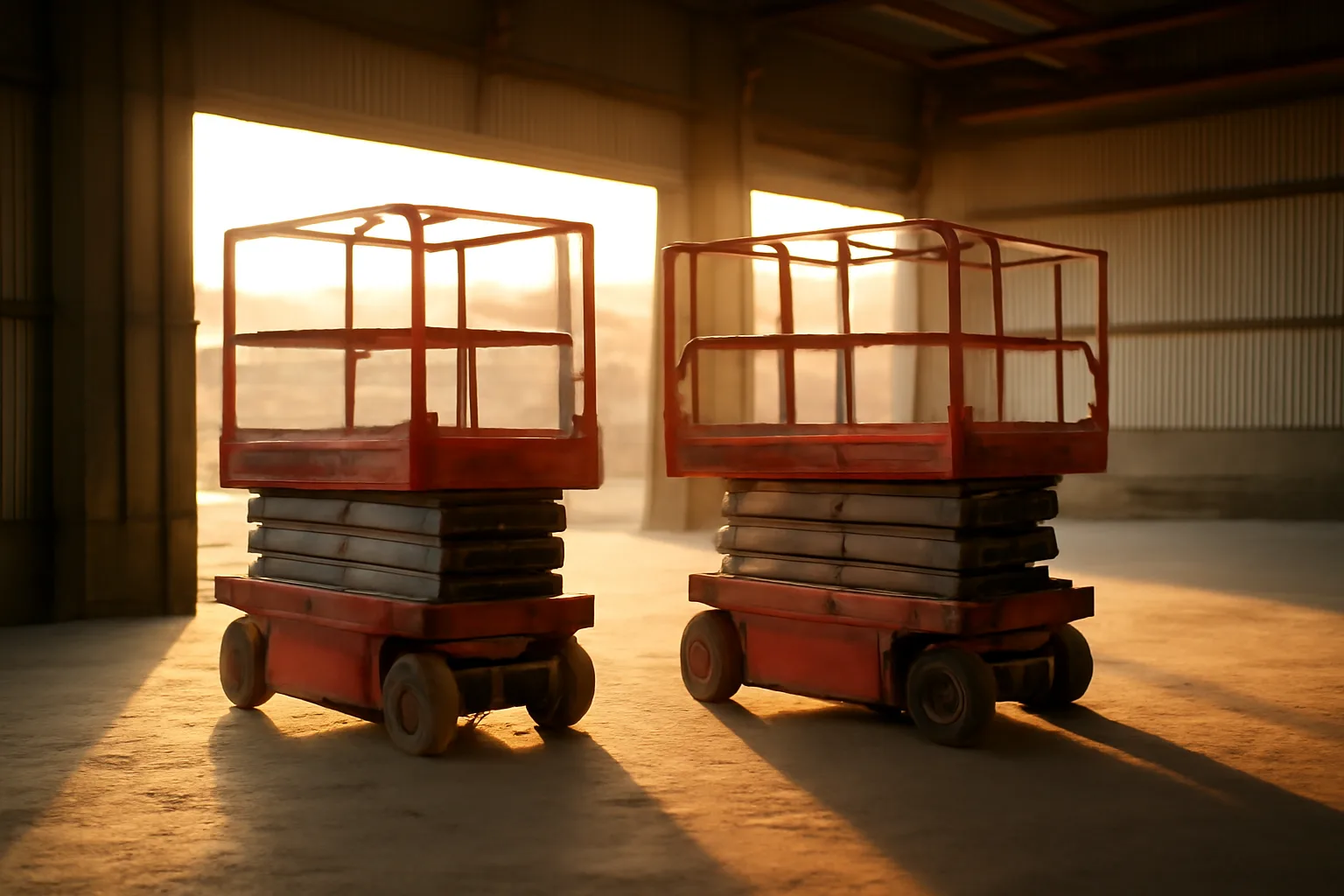
Scissor lift rental is a local hire business. You own mobile elevated work platforms and you let other people use them for a day, a week, or a month. You are not selling labor. You are not running a crane bay. You rent a machine that rises on a stacked linkage and holds the platform level.
Most of the work is physical and it repeats. You inspect decks, gates, pothole guards, and emergency lowers. You charge battery packs or you fuel diesel. You chase late returns. You photograph tire cuts before the truck leaves. The money comes from utilization, not from a famous paint color.
People type scissor lift rental when they need height for a short job. Drywall crews, electricians, painters, school facility techs. They want a 19-foot electric slab unit that fits a standard doorway, or a rough-terrain unit that can sit on packed dirt. Your job is the right platform height, a contract that assigns duties, and a machine that will not fold someone into a lawsuit.
This sits under commercial equipment leasing, not under a federal occupation. States tax the rental. Cities license the yard. OSHA cares how the machine gets used on a construction site. Those are three different piles of paper. Mix them up and you waste a quarter.
I'd treat it as a small fleet first. Two to six common machines is a real start. A glass showroom is a waste of money.
How do you start scissor lift rental?
You start scissor lift rental by doing five things in order. Form a state entity. Get tax IDs. Buy insurance that lists serial numbers. Put a small fleet on the ground. Write a rental agreement that assigns inspection and training duties. There is no federal license to wait on.
Pick an entity your bank and your insurer will actually accept. The U.S. Small Business Administration lays out the LLC, partnership, and corporation tradeoffs on its business structure page. [9] Then register that entity with your secretary of state and with any city that taxes a rental yard. [10] Get an EIN from the IRS before you open the operating account. Applying for an EIN is a free service offered by the Internal Revenue Service. [6]
Buy machines you can move and service locally. I would start with the electric slab widths contractors already request. A giant rough-terrain unit looks serious and then sits. Finance only what a local market can keep busy. Hire even one employee and the Fair Labor Standards Act applies to wages and overtime. [13]
Write the contract before the first pickup. Spell out who inspects, who trains, who pays for damage, and when the clock starts on a late return. State paths differ. If California is your market, use a state walkthrough instead of a national myth. Same idea for how to start scissor lift rental in Colorado, Arizona, and Connecticut. Confirm every fee with the board that cashes the check. Nobody can promise you an approval date.
Do you need a license to rent scissor lifts?
No federal occupational license exists for scissor lift rental. You still need ordinary business paper. That usually means entity registration, a sales tax or seller's permit, and often a city or county business tax certificate. Some states add a dealer license if you also sell machines as new inventory. Confirm with your secretary of state and your revenue department. [10]
Do not confuse operator training with a shop license. OSHA requires training for people who work on scaffolds. It does not mail you a rental company card. [3] A pitch that sells a "national scissor lift rental license" is a myth. Walk away.
Dealer rules and pure rental rules are two different piles. If you only rent, many states leave you under general business and sales tax statutes. Take new units as a branded dealer and OEM agreements, plus sometimes a state dealer board, enter the picture. I would not assume you need a motor vehicle dealer plate for off-road lifts. Ask the state in writing.
Alabama is not California. Colorado is not Connecticut. Use the local paper path, such as scissor lift rental license in Alabama, California, or what you actually need in Colorado. Render every fee as confirm with that board. I will not invent a current charge or a processing clock.
What OSHA rules apply to rented scissor lifts?
OSHA treats most scissor lifts on construction sites as mobile scaffolds, not as boom-type aerial lifts. The general scaffold rule is 29 CFR 1926.451. Extra rules for mobile scaffolds sit in 1926.452(w). Boom platforms sit in 1926.453, which is a different text. [1][2][4]
OSHA requires fall protection on scaffolds more than 10 feet above a lower level under 29 CFR 1926.451(g)(1). The regulation says "each employee on a scaffold more than 10 feet (3.1 m) above a lower level shall be protected from falling to that lower level." [1] Guardrails on a properly set scissor lift are the usual method. That does not make a renter bulletproof if they defeat a gate or stand on the midrail.
1926.452(w) adds mobile-scaffold limits. Surfaces have to support the load. Wheels need locks. You do not treat the unit like a passenger elevator unless the manufacturer designed it for travel with people on the platform. [2] OSHA's booklet OSHA 3150, A Guide to Scaffold Use in the Construction Industry, is the readable version of the same duties. [5]
You cannot OSHA-proof a customer. You can refuse to dispatch without a documented conversation about a competent person, ground conditions, and overhead power. I'd put that refusal right in the contract. If your own techs service machines on a jobsite, those techs are your employees under the same rules.
What training does OSHA require for scissor lift users?
OSHA scaffold training sits in 29 CFR 1926.454. The employer of the person on the platform holds the duty. If your customer is the construction employer, that customer trains its people. If your own staff erect, move, or repair the unit on site, you train your staff. [3]
1926.454(a) says the employer shall have each employee who performs work while on a scaffold trained by a person qualified in the subject matter to recognize the hazards associated with the type of scaffold being used and to understand the procedures to control or minimize those hazards. That is the sentence. It is not a laminated wallet card from a website. [3]
Industry practice also points at ANSI/SAIA A92.24 for MEWP training and A92.22 for safe use. Those are consensus standards, not a federal license. OSHA can still reach a bad program through the general duty clause in section 5(a)(1) of the OSH Act. [15] I'd keep sign-in sheets, the outline you taught, and the model numbers covered.
I would not rent to a walk-in who has never seen a control box and will not name a competent person. That lost day rate is cheaper than a tip-over. Offer a short orientation at pickup. Record it. Do not pretend a 12-minute video replaces 1926.454.
What business paper do you file in the first year?
First-year paper is boring and it is the actual path. State formation documents. An EIN. A sales tax permit. A local business license if your city requires one. Bank resolutions. Insurance binders that list equipment. UCC filings if a lender has a lien. Inspection logs. A rental contract you actually use. [6][9][10]
The SBA 10-step start guide is a decent checklist for the generic pieces: structure, registrations, federal and state tax IDs, and basic compliance. It will not tell you how to rent a 26-foot slab lift. Use it for the entity stack, then switch to your state revenue department. [16]
Have 10 or fewer employees and OSHA's injury-log rule in 29 CFR 1904.1 gives a partial exemption from keeping the OSHA 300 Log, unless you are in a specifically covered industry or OSHA asks. Construction employers are not in that easy chair. Read 1904.1 and 1904.2 before you skip the log. [11] Confirm with OSHA if your NAICS and headcount put you in or out.
Depreciation is real money. IRS Publication 946 treats many construction assets as 5-year property under GDS (class life 6 years in the construction asset class). [7] Section 179 and bonus rules change. I will not invent a 2026 dollar cap. Open the current Pub 946 and confirm the limit before you file Form 4562.
Beneficial ownership reports at FinCEN have moved more than once. Confirm the live FinCEN BOI rule before you file or skip. Do not trust a blog from last winter.
How do you handle sales tax on scissor lift rental?
Most states tax the rental of tangible personal property. A scissor lift is tangible. You usually collect sales or use tax on the hire charge, then remit it on the state's schedule. Some states tax delivery. Some do not. Confirm with your department of revenue. I will not invent a rate.
Get the permit before the first invoice. Your formation papers do not replace it. The SBA registration guide flags state tax accounts as a separate step from the secretary of state filing. [10] Charge tax the way the state defines the taxable base, not the way a national chain's website looks.
Resale certificates come up when a contractor claims the rental is for resale. In a lot of states that certificate is the wrong tool for a jobsite lift. Ask the revenue department for the rental-specific rule. Keep exemption certificates on file if the state allows a real exemption. A verbal "we are tax exempt" is not a file.
Operate across a state line and nexus can follow the machine. That is a fact pattern for a state tax lawyer, not a slogan. I would start in one state, master that return, then expand. For a Colorado-only plan, read the Colorado board and setup notes next, then confirm the Department of Revenue form names yourself.
What insurance do scissor lift rental shops actually buy?
You buy a stack, not a single "rental policy." Commercial general liability for the yard and the operations. An inland marine or equipment floater that lists make, model, serial number, and value. Commercial auto if you deliver. Hired and non-owned auto if staff use personal trucks. Workers' compensation once you have employees. An umbrella if a broker can actually place one on this class.
I would not open with a homeowner policy and a handshake. A financed fleet without a lender loss-payable endorsement is how people get surprised. Name additional insureds the way general contractors ask, but read the extra wording. Blanket additional-insured endorsements are cleaner than 40 certificates with custom novels.
Damage waivers are a product, not magic. Sell a waiver and write what it excludes. Tire and glass and overload and disappearance are the usual fights. Keep the pre-rent photos. Nobody has a public national data set on average scissor lift physical-damage premiums. Brokers quote from your loss history, yard address, and radius. Get two quotes. The cheap binder that excludes rented equipment is a waste of money.
Have staff and workers' comp becomes a state statute issue. Federal OSHA recordkeeping is a different statute. Do not treat an insurance certificate as OSHA compliance. [11]
Do you need a USDOT number to haul scissor lifts?
You need a USDOT number when your truck or combination meets FMCSA's commercial motor vehicle test in interstate commerce. FMCSA sets that test at a gross vehicle weight rating, gross combination weight rating, gross vehicle weight, or gross combination weight of 10,001 pounds or more. [8] Confirm the live wording on FMCSA's "Do I Need a USDOT Number?" page before you assume you are under it.
A compact electric 19-foot unit on a light trailer may stay under that line. A rough-terrain diesel plus a heavy trailer often does not. Weigh the combination. Use the door-sticker GVWR, not a guess. Intrastate rules can run stricter than you want. Ask your state patrol motor carrier desk.
Haul the machine and cargo securement is not optional. FMCSA's cargo securement rules in 49 CFR 393 Subpart I require the load to be secured so it cannot shift or fall. [14] Chains, binders, and a winch strap that looks pretty in a photo are not the same thing. I would write a load-out checklist and fire anyone who rolls with one strap on a 7,000-pound lift.
A CDL is a separate question. It depends on GVWR, air brakes, and state class. Plenty of small shops deliver with a non-CDL truck and stay legal. Plenty of others quietly cross 26,001 pounds and hope. Don't hope.
How should you price scissor lift rental?
Price from your local competitors and your real costs. There is no official federal day rate. Trade groups publish surveys you can buy. Those surveys are not a statute. I have not seen a clean, public, machine-by-machine national series that you can paste into a rate card. Anyone who quotes one number for the whole country is selling comfort.
Build the rate from utilization. If an $18,000 used electric unit sits 3 days in 7, your idle days have to live inside the 4 busy days. Add delivery, damage waiver, environmental fees only if your state lets you, and tax. Weekly rates should undercut 4 day rates or contractors will just book days.
I'd post a simple card: 19-foot electric, 26-foot electric, one rough-terrain size. Hide the 14-footnote novel. Put overtime hours and dirty-machine cleaning in writing. Match the nearest honest yard, then beat them on pickup hours and how fast you replace a dead unit. Racing a national chain to the bottom is how small fleets die.
Revisit rates every quarter. Batteries, tires, and a single hydraulic leak will teach you more than a blog.
What machines should you buy first?
Buy the boring machines first. A 19-foot electric slab and a 26-foot electric slab cover a huge share of indoor calls. Add one rough-terrain unit when you are turning away outdoor work, not before. Skip the 60-foot curiosity. It photographs well and then lives under a tarp.
New versus used is a cash question. Used units from major OEMs are fine if you buy a service history and you budget a full inspection. I would not buy a no-title orphan off a random lot. Check the emergency lowering, pothole protection, scissor pins, and charger. If you cannot get parts in your town, you do not own a rental asset. You own a sculpture.
Diesel rough-terrain units bring EPA nonroad engine rules. EPA's Tier 4 nonroad diesel program is the current emissions frame for most new nonroad engines. [12] That matters when you buy new, when a city job spec says Tier 4, and when you try to work in a port or public project with engine language. Confirm the engine plate, not the dealer's adjective.
Two to six units is enough to learn dispatch. A 20-unit binge in month one is how people meet their banker under stress. Indoor storage beats a dirt lot that sandblasts cylinders.
What records should you keep on each scissor lift?
Keep a file per serial number. Pre-delivery inspection. Customer pre-use sheet. Repair invoices. Hour-meter or key-on time. Battery water logs on flooded packs. Annual inspection against the manufacturer's interval. Photos at every outbound and inbound. The contract and the damage waiver signed on the same day as pickup.
OSHA 3150 and 1926.451 both assume inspections happen. Competent-person language shows up throughout the scaffold standard. [1][5] If you cannot show a paper trail, you will argue from memory. Memory loses.
Hour meters lie when they break. That is why shops add simple telematics on even a tiny fleet. If you want a small 2 to 6 machine bundle, ScissorPath sells a $179 one-time telematics kit. It is optional. Contracts and insurance still matter more than a map pin.
Keep training records for your own techs under 1926.454. Keep customer orientation notes even if the legal duty sits with their employer. [3] Store the files where a claims adjuster can reach them on a Sunday. A binder in a truck is not a system.
What first-year mistakes waste money?
The expensive mistakes are predictable. Buying odd platform heights nobody requests. Signing a 5-year yard lease before you have utilization. Skipping the floater policy. Letting a renter leave without photos. Hiring a driver before you have enough deliveries to keep that wage busy. Paying for a national franchise sticker that does not move a single local drywall bid.
Another waste is treating ANSI marketing as a substitute for 29 CFR 1926.451 and 1926.454. The CFR is the enforceable text on a construction site. [1][3] Another waste is hauling overweight without reading the FMCSA 10,001-pound line. [8]
I'd spend first-year cash on two clean electric units, a used box truck or trailer you can secure to 49 CFR 393, a real inland marine policy, and a lawyer to mark up one rental contract. [14] Not on wrap lighting. Not on a custom app.
Want that optional kit later? Use /start. ScissorPath is an independent publisher, not a law firm and not a rental shop. Confirm licenses, tax, and timing with the board that actually issues the paper. This guide stays useful if you never click a thing we sell.
Frequently asked questions
What is scissor lift rental?
It is a local equipment hire business. You own scissor lifts and rent them by the day, week, or month to contractors and facilities teams. You collect a hire fee, inspect the machine, and assign duties in a contract. It is not a federal occupation and it is not the same as running boom lifts under 29 CFR 1926.453.
How do you start scissor lift rental?
Form a state entity, get a free IRS EIN, obtain a sales tax permit, buy insurance that lists serial numbers, purchase a small common fleet, and write a rental contract. Train your own staff under 29 CFR 1926.454. Confirm local business licenses with the city. There is no federal rental license to apply for.
Is there a federal scissor lift rental license?
No. Federal OSHA regulates how scaffolds get used on covered jobsites. The IRS issues EINs. FMCSA issues USDOT numbers when you meet the commercial motor vehicle test. None of those is a national license to rent lifts. State entity filings and state tax permits are the paper that actually starts the shop.
Do my customers need a license to operate a rented scissor lift?
OSHA does not issue an operator license card for scissor lifts. The construction employer must train people who work on scaffolds under 29 CFR 1926.454. Some owners and general contractors add their own site cards. You should still refuse a renter who cannot name a competent person or will not take a short orientation.
Can I run scissor lift rental from my driveway?
Sometimes, until zoning, neighbors, or your insurer stop you. Many cities treat a rental yard as a commercial use. Delivery trucks and after-hours returns draw complaints. Check zoning and the local business tax certificate before you park the second machine. A cheap industrial bay is usually calmer than a residential driveway.
Do I need a CDL to deliver scissor lifts?
Only if the truck or combination falls into a CDL class, often at 26,001 pounds GVWR, or if the vehicle has air brakes that your state treats that way. Separate from the CDL, a USDOT number can apply at 10,001 pounds in interstate commerce. Weigh the combination and read the door sticker. Confirm with your state motor carrier desk.
Should I buy electric slab lifts or diesel rough-terrain lifts first?
Electric slab units first. A 19-foot and a 26-foot electric cover most indoor calls and they fit a small trailer. Buy one rough-terrain unit after you are already turning outdoor work away. New diesels also drag EPA nonroad Tier 4 questions onto public jobs. Confirm the engine plate before you bid those sites.
How often should a rental scissor lift be inspected?
Do a documented check before every outbound and after every inbound. Require the user to do a pre-use check. Follow the manufacturer's periodic inspection interval and 29 CFR 1926.451 competent-person rules on construction use. If a unit sat through a freeze or a flood, inspect it again before it earns another dollar.
Do I charge sales tax on scissor lift rental?
In most states, yes, because the lift is tangible personal property. Delivery and damage waivers may or may not be taxable. Get the state permit before the first invoice and follow that department's base. Do not copy a national chain's invoice line by line. Confirm exemptions in writing and keep the certificate.
What happens if a renter wrecks the machine?
Your contract and your photos decide the fight. Charge the renter under the damage clause unless a paid waiver actually covers that cause. Notify the inland marine carrier if the loss is large. Do not wait a month. Overload, missing gates, and forklift forks through a pack are common. None of that is a mystery if you shot the outbound walkaround.
How many scissor lifts do I need to start?
Two to six common units is enough to learn dispatch, charging, and damage control. One machine means every service day is a total outage. Twenty machines in month one usually means debt with no utilization data. Buy what local contractors already request, not what looks large on a brochure.
Is a scissor lift an aerial lift under OSHA?
Usually no on a construction site. OSHA puts most scissor lifts under the scaffold rules in 29 CFR 1926.451 and 1926.452(w). 29 CFR 1926.453 covers extensible and articulating boom aerial lifts. Training, fall protection, and movement rules differ. Read both texts before you write your orientation sheet.
Sources
- OSHA 29 CFR 1926.451 General requirements for scaffolds: Fall protection is required for each employee on a scaffold more than 10 feet above a lower level.
- OSHA 29 CFR 1926.452 Additional requirements for specific scaffolds: Mobile scaffolds, the category OSHA uses for most scissor lifts, have extra rules in 1926.452(w).
- OSHA 29 CFR 1926.454 Training requirements: The employer must have each employee who works on a scaffold trained by a qualified person.
- OSHA 29 CFR 1926.453 Aerial lifts: Boom-type aerial lifts are regulated separately from mobile-scaffold scissor lifts.
- OSHA 3150 A Guide to Scaffold Use in the Construction Industry: OSHA's employer-facing scaffold guide restates inspection, fall protection, and competent-person duties.
- IRS Apply for an Employer Identification Number (EIN) Online: Applying for an EIN is a free service offered by the Internal Revenue Service.
- IRS Publication 946 How To Depreciate Property: Many construction assets use a 6-year class life and 5-year GDS recovery period.
- FMCSA Do I Need a USDOT Number?: A USDOT number is required for interstate CMVs at 10,001 pounds GVWR/GCWR/GVW/GCW.
- U.S. Small Business Administration Choose a business structure: SBA outlines LLC, partnership, and corporation options for new firms.
- U.S. Small Business Administration Register your business: Businesses register with the state and often need separate state tax and local licenses.
- OSHA 29 CFR 1904.1 Partial exemption for employers with 10 or fewer employees: Employers with 10 or fewer employees can be partially exempt from OSHA injury logs unless an exception applies.
- EPA Final Rule: Control of Emissions of Air Pollution from Nonroad Diesel Engines and Fuel: EPA's nonroad diesel rule is the federal emissions frame for most new nonroad diesel engines, including many rough-terrain lifts.
- U.S. Department of Labor Fair Labor Standards Act: The FLSA sets federal minimum wage, overtime, and recordkeeping duties when you hire employees.
- FMCSA Cargo Securement Rules: 49 CFR 393 Subpart I requires cargo to be secured so it cannot shift or fall during transport.
- OSH Act Section 5 Duties: Section 5(a)(1) requires employers to furnish a workplace free from recognized hazards likely to cause death or serious harm.
- U.S. Small Business Administration 10 steps to start your business: SBA's 10-step guide sequences structure, registration, and tax ID tasks for a new firm.