Last updated 2026-08-19
TL;DR
Scissor lift rental is short-term hire of powered platforms. OSHA usually treats scissor lifts as mobile scaffolds under 29 CFR 1926 Subpart L, not aerial lifts. Start with an entity, a free IRS EIN, state tax accounts, insurance, one inspected machine, and a written contract. Confirm licenses with your state. No single federal rental license exists.
What is scissor lift rental?
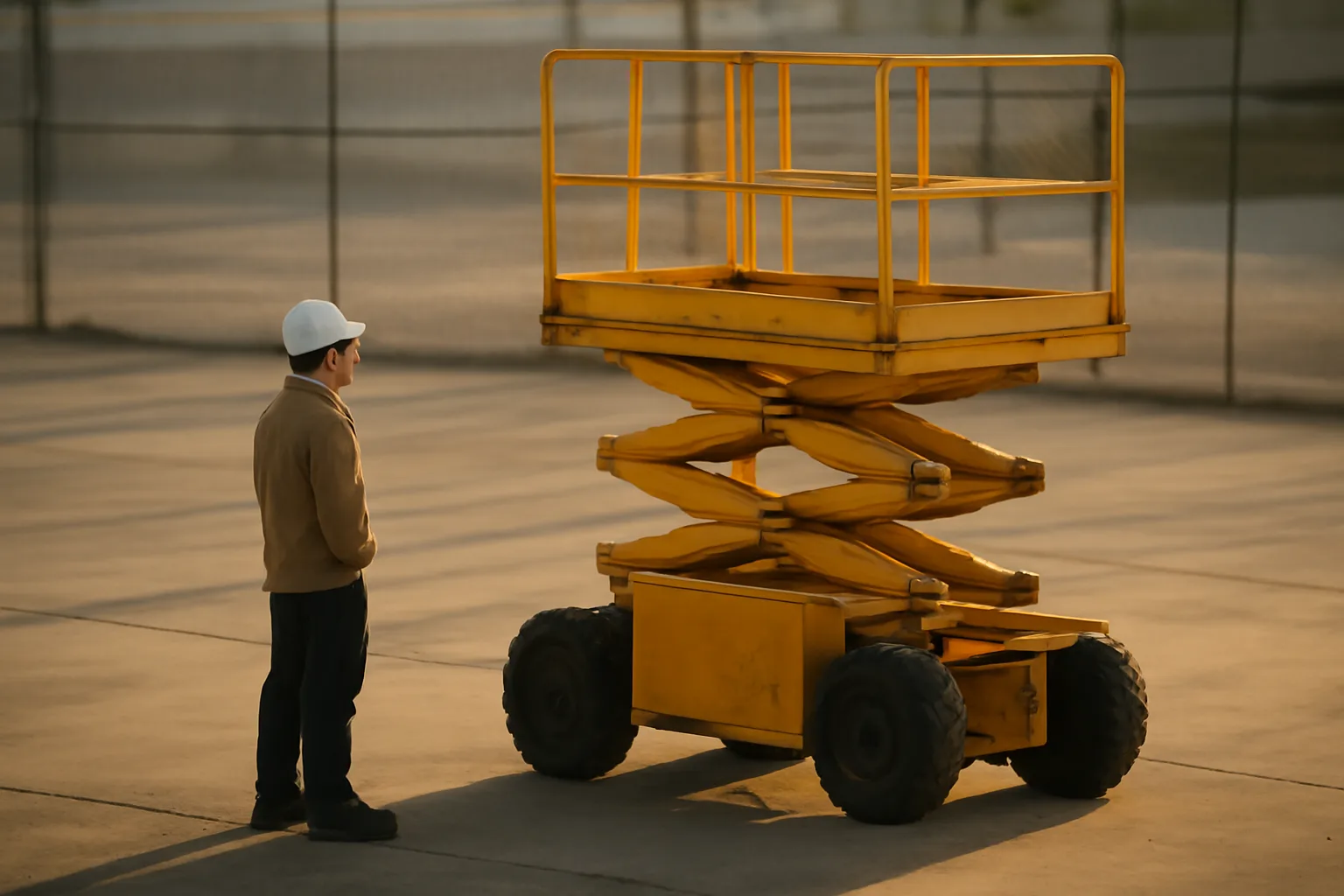
Scissor lift rental is the short-term hire of a self-propelled platform that rises straight up on crossed supports. You own or finance the machine. A contractor, plant, or store pays by the day, week, or month, then brings it back. That is the whole product.
It is not a construction company. It is not a card mill. You rent machinery. Most yards land in Census NAICS 532412, construction and related machinery rental and leasing.[15]
A boom reaches out. A scissor goes up. People blur the two on the phone and then send you the wrong machine. Indoor slab work, racking, retail resets, and light build-outs eat most 19-foot electric units. Rough-terrain diesels earn their keep only if your local calls are actually outside. Buy what the last ten jobs asked for, not what looks tough on a dealer lot.
OSHA often parks scissor lifts under the mobile scaffold rules in 29 CFR 1926.452, not under the vehicle-mounted aerial lift rule in 1926.453.[1][2] That split changes the inspection and training language you put in a rental packet. Get it wrong and you hand a renter the wrong checklist.
You make money on days on rent and on machines that come home whole. You lose money on unpaid damage, no-show deliveries, and iron that sits. Scissor lift rental is a utilization business dressed up as yellow paint.
How do you start scissor lift rental?
You start by forming an entity, getting a free IRS EIN, opening the state tax accounts that apply to rental receipts, binding insurance, and putting one legal machine on a written contract. Then you confirm zoning and any dealer or rental license with the state board. There is no national rental card.
Paper first. Iron second. I would not wire money for a used lift until the entity exists and an insurer will schedule the serial number.
Pick a structure your CPA can file without groaning. Most tiny yards use an LLC. The SBA explains the common choices without selling you one.[3] Register that entity with your state. Apply for the EIN on the IRS site. The IRS charges no filing fee for that application.[4] Call your department of revenue and ask, plainly, whether rental of tangible personal property needs a seller's permit. Many states tax equipment rental. Confirm the current rate with them. Do not copy a rate from a forum post.
Quote general liability and an equipment floater before you buy. If you will have employees, add workers' compensation as your state requires. Then shop machines. Read hour meters. Get a recent inspection. Walk away from a seller who cannot produce a serial history.
Write a contract that names the operator, the inspector, the damage rules, and who is the employer of the people on the platform. You can own the lift and still not control the job. Do not let your form pretend you do.
A legal place to park and a trailer that can handle the weight come next. A two-machine start can live in a storage condo. A glass storefront cannot pay for itself on one 19-foot unit.
State paths diverge fast. If you want a board-level walk-through, use a real state page such as how to start scissor lift rental in California instead of a national myth checklist.
Do you need a federal license to rent scissor lifts?
No. The United States does not issue a scissor lift rental license. The SBA says licenses and permits come from federal, state, and local agencies based on what you actually do, and it points you at state and local tools rather than one federal card.[5]
What you may still need, on the facts, is ordinary business paper. Entity registration. A sales-tax or seller's permit if your state taxes rental receipts. A city business license or occupancy permit. A dealer or equipment-rental license in states that wrote one. A contractor license if you also staff, erect, or operate the lift as construction work. A USDOT number if you haul interstate over the commercial-vehicle weight line.
Alabama, Alaska, Arizona, Arkansas, California, Colorado, and Connecticut do not share a form. Read the state page, then call the board and confirm the current fee. Scissor lift rental license in California is the kind of write-up that names an actual agency. A consultant selling a "national MEWP rental license" is selling air.
Federal rules still touch you. OSHA cites hazardous work. IRS wants the EIN and the income. FMCSA cares if you become a carrier. None of that is a rental license.
What OSHA rules cover a rental scissor lift?
OSHA does not license rental yards. OSHA cites employers who expose workers to hazards. If your people maintain, deliver, or demonstrate lifts, 29 CFR 1926 applies on construction sites and Part 1910 applies in general industry.
On construction, Subpart L is the text most inspectors reach for. 29 CFR 1926.452 is the specific-types section that includes mobile scaffolds, the bucket OSHA has long used for many scissor lifts.[1] 29 CFR 1926.453 is the aerial lift rule. It is written around vehicle-mounted elevating and rotating work platforms.
The aerial-lift scope sentence is narrow. 29 CFR 1926.453(a)(1) says aerial lifts acquired on or after January 22, 1973 shall conform to the ANSI standard for vehicle-mounted elevating and rotating work platforms, ANSI A92.2-1969, including the appendix.[2] A slab scissor is usually not that machine. Treat it as a scaffold unless a state plan or counsel tells you otherwise.
Inspection is not optional language. 29 CFR 1926.451(f)(3) requires a competent person to inspect scaffolds for visible defects before each work shift, and after any occurrence that could affect structural integrity.[6] You cannot do that inspection from your yard when the lift is 80 miles away. The using employer has to. Put that duty in the contract.
1926.20 also says the employer starts and runs an accident-prevention program, and that only employees qualified by training or experience operate equipment and machinery.[7] State-plan states can write stricter rules. California is the obvious example. Confirm with the state plan, not a group chat.
| Rule | What it usually covers | Typical trigger |
|---|---|---|
| OSHA 1926.452 | Mobile scaffolds, many scissor lifts | Construction use of a scissor |
| OSHA 1926.453 | Vehicle-mounted aerial lifts | Boom or vehicle-mounted platforms |
| OSHA 1926.451(f)(3) | Shift inspection by a competent person | Every shift the platform is used |
| OSHA 1926.454 | Scaffold user training | Employees who work on the platform |
What training do you have to give operators?
You train your own people. The using employer trains the people who ride the platform. Those are two different jobs.
29 CFR 1926.454(a) says: "The employer shall have each employee who performs work while on a scaffold trained by a person qualified in the subject matter to recognize the hazards associated with the type of scaffold being used and to understand the procedures to control or minimize those hazards."[8]
That sentence does not say "IPAF card." It does not say "four-hour video." It names a qualified person, this type of scaffold, the hazards, and the controls.
I still want a renter to show a current MEWP card that matches ANSI/SAIA A92.24 practice. General contractors speak that language. It does not replace a site briefing on holes, wind, and power lines.
Train your techs on pothole protection, rail locks, batteries, and emergency descent. Train drivers on chained loads and height. Keep an outline and a sign-in sheet. If you have employees, read 29 CFR 1904.1 before you decide you are "too small for logs." Employers with 10 or fewer employees through the prior year are often excused from keeping OSHA 300 logs unless OSHA or BLS asks, but confirm the current text and whether a separate industry rule in 1904.2 also applies to your NAICS.[9]
Do not sell "OSHA certification." You can document training. OSHA certifies almost nothing in this niche.
What tax and entity paper do you file first?
File the entity with the state. Get the EIN on IRS.gov. The IRS describes the online EIN application as a free service and warns that other sites charge for it.[4]
The SBA tax-ID guide tells you to get the federal EIN and then whatever state accounts your activity needs.[10] Ask revenue, in writing if they will answer that way, whether scissor lift rental is taxable, whether delivery fees are taxable, and whether an occasional sale is different from a regular yard. I cannot print your rate. Rates move. Confirm with the board.
Hire anyone and you add withholding, unemployment insurance, and Form I-9. USCIS publishes the current I-9 and the instructions.[11] Pay at least the federal FLSA minimum wage, and your state wage if it is higher.[12]
A bookkeeper who has filed rental depreciation will save you more than a new wrap on the trailer. I would spend on that person before I spent on a logo.
When do you need a USDOT number or a CDL?
You need a USDOT number when you operate a commercial motor vehicle in interstate commerce. FMCSA treats a vehicle or combination at 10,001 pounds or more (GVWR, GCWR, GVW, or GCW) as a CMV for that registration question, among other triggers.[13]
A pickup plus trailer plus a compact scissor crosses 10,001 pounds faster than new owners expect. Weigh the combination. Do not guess from a brochure.
A CDL is a higher line. Federal CDL rules generally hit a combination at 26,001 pounds GCWR when the towed unit is more than 10,000 pounds, or a single vehicle at 26,001. Confirm your exact setup on FMCSA's CDL materials. State endorsements can add more.[14]
Intrastate-only hauls can still need a state DOT number. Ask the state motor carrier desk. If customers always haul, write that into the contract so a renter's overloaded pickup is not your mystery.
I would rather lose a same-day delivery than run overweight without the number. Tickets and out-of-service orders erase a weekend rental.
What insurance actually matters in year one?
I would not open the gate without general liability and scheduled equipment coverage. There is no honest national premium I can print. A two-machine driveway yard and a 40-unit lot are different markets. Use a broker who already writes rental fleets.
Ask for CGL with room to add GCs as additional insureds. Ask for inland marine or a floater on the serial numbers. Add hired and non-owned auto if employees run errands. Put true auto liability on the haul truck. Add workers' compensation when state law says you must. Loss-of-use coverage is nice if you can stand the deductible.
Watch the care, custody, or control exclusion. Renters wreck platforms. CGL may not want that claim. The equipment policy is what pays for a dropped scissor.
Hold certificates from any subhauler. Match limits to what local GCs print on vendor packets. I have no single limit that is "enough" in every city, and anyone who quotes one without seeing your contracts is guessing.
What paperwork should leave with every machine?
Send this stack or keep the machine.
A signed rental agreement. A condition report with photos, the hour meter, and the serial. The operator manual for that model, not a cousin. A daily inspection sheet tied to the 1926.451(f)(3) shift rule.[6] A load and fall-protection reminder. Emergency lowering steps. An after-hours phone. Proof of your insurance and a blank additional-insured request if they asked. A delivery ticket with the site address and ground notes.
The using employer still owns the 1926.454 training duty.[8] Your packet does not finish that job. It proves you handed them the hazards in writing.
Take a deposit that hurts a little. Photograph every rail and tire. Hour and location data settle "who wrecked it" fights on a two-to-six machine fleet. ScissorPath sells a $179 one-time 2-6 Machine Telematics Kit for yards that want that log without a monthly leash. You can also run a notebook. I have. I would not go back to it once a renter disputes a crushed rail.
If hydraulic work happens in your shop, used oil is regulated. EPA's used-oil FAQ for businesses is the practical starting point, then confirm your state used-oil rules.[16]
How much money does a tiny fleet take?
Nobody publishes a clean federal series for "start a scissor lift rental." Used electric 19-foot machines trade in a private market that moves with batteries and hours. I will not invent a sticker. Get three asking prices you can verify in person. Subtract transport and a battery pack you may need. Ignore the respray.
Cash you will still spend if the lift is cheap: the state entity fee (confirm it), the EIN (free on IRS.gov), the first insurance down payment, a trailer or truck that is legal for the weight, a legal place to park, a way to take cards, and hose and tire money.[4][13]
Labor is the sleeper. If you hire a clerk or a tech, use current BLS wage tables for your metro rather than a national blog number. I would stay owner-operated until the second machine is busy most weeks.
If a lender wants a plan, write days on rent per month. Do not write "the market is huge." Census NAICS 532412 is the industry box, not a demand forecast.[15]
Where do new yards waste cash?
Wraps. Custom software. A third showroom lift before you have repeat callers.
Also this: buying a rough-terrain diesel because it looks serious, then parking it while every call is for a 19-foot electric. Match the phone.
Skipping the condition report to "be easy." You will eat a chewed rail.
Paying a consultant for a federal license that does not exist.[5]
Signing a forever GPS subscription for two machines when a written hour log, or a one-time kit, would do.
I would spend on insurance, a legal trailer, and one clean used lift. I would not spend on a launch party.
How do state rules change the path?
They change the path a lot. Sales tax, dealer licenses, home-occupation rules, and state OSHA plans do not copy each other.
California runs a state OSHA plan and its own Title 8 text. Colorado, Arizona, Alabama, Alaska, and Connecticut each have their own revenue and licensing desks. Some states register equipment dealers. Some only want a seller's permit. Some cities will not let lifts live in a driveway.
Use a state guide, then call the board and confirm the current form. Start with how to start scissor lift rental in Arizona, scissor lift rental license in Colorado, how to start scissor lift rental in Alabama, scissor lift rental license in Connecticut, how to start scissor lift rental in Alaska, or how to start scissor lift rental in Colorado.
Cross a state line and you pick up nexus questions plus possible interstate FMCSA duties.[13] Never treat a blog fee table as current.
What should you confirm before you buy iron?
Call or write these desks and keep the notes.
State revenue: is lift rental taxable, and on what base? City planning: can you store and dispatch from this address? The state licensing board: is a dealer or rental license required, and what is the current form and fee? State OSHA or the on-site consultation program: any state-plan twist on Subpart L? Your insurer: will they schedule this serial? Your bank: will they title a used lift the way the seller thinks?
Do not accept a verbal "you are fine" from a clerk who will not give a name. Confirm variable facts with the board. Nobody here can promise an approval or a processing time.
ScissorPath is an independent publisher, not a law firm and not a rental company. After you read the board site, the structured checklist lives at /start. Use it as a list, not as permission.
Frequently asked questions
What is scissor lift rental?
It is short-term hire of a self-propelled platform that rises vertically. You own or finance the machine and charge by the day, week, or month. Most small yards sit in Census NAICS 532412. It is equipment rental, not a construction contract and not an OSHA license mill.
How do you start scissor lift rental?
Form an entity, get a free IRS EIN, open state tax accounts if rental receipts are taxable, bind liability and equipment insurance, then put one inspected machine on a written contract. Confirm any dealer, rental, or occupancy license with your state and city. There is no federal rental license.
Is a scissor lift an aerial lift under OSHA?
Often no. 29 CFR 1926.453 is written for vehicle-mounted elevating and rotating work platforms. Many scissor lifts fall under the mobile scaffold rules in 29 CFR 1926.452. State plans can differ. Hand renters the scaffold inspection and training language unless counsel or the state plan says otherwise.
Do I need an EIN to rent lifts?
If you form an entity or hire anyone, yes, get an EIN. Apply on IRS.gov. The IRS treats that application as a free service and warns that other sites charge for it. Sole proprietors without employees sometimes use a Social Security number, but most yards should just get the EIN.
Can I run scissor lift rental from my driveway?
Only if zoning and any home-occupation permit allow stored equipment and truck traffic. Many cities do not. Confirm with planning before you buy iron. Neighbors and HOA rules sink more driveway yards than OSHA does. A storage condo is the usual backup.
Do renters need a license to operate a scissor lift?
OSHA does not issue an operator license. 29 CFR 1926.454 requires the using employer to train people who work on the scaffold. GCs often ask for a MEWP card that follows ANSI/SAIA A92.24 practice. Your contract should make the using employer responsible for trained, authorized operators.
How often must a rental scissor lift be inspected?
29 CFR 1926.451(f)(3) requires a competent person to inspect scaffolds for visible defects before each work shift and after any event that could affect integrity. You inspect at handover. The using employer inspects each shift on site. Annual and frequent inspections also belong in your shop file.
Do I have to charge sales tax on scissor lift rental?
Many states tax rental of tangible personal property. Some tax delivery separately. Some exempt resale or out-of-state use. There is no single federal sales-tax rule here. Confirm the current base and rate with your department of revenue before you send the first invoice.
What NAICS code is scissor lift rental?
Most yards use 532412, Construction, Transportation, Mining, and Forestry Machinery and Equipment Rental and Leasing, on the Census NAICS 2022 detail page. Banks and insurers sometimes want that box. It is a statistical label, not a license, and it is not a forecast of demand.
Do I need a CDL to deliver a scissor lift?
Not always. FMCSA's USDOT CMV line is often 10,001 pounds in interstate commerce. A CDL generally starts at a much higher combination or single-vehicle weight, commonly 26,001 pounds with extra towed-unit rules. Weigh the truck, trailer, and lift. Confirm the exact setup with FMCSA and your state.
Are there federal rental rates I must charge?
No. The federal government does not set scissor lift rental rates. Price from your local day-week-month comps, your insurance, and your real utilization. Anyone quoting a required national rate is inventing one. Write days on rent, not hope, into any lender packet.
What is a competent person on a scissor lift?
Under OSHA construction rules, a competent person can identify hazards and has authority to correct them. 29 CFR 1926.451(f)(3) puts the shift inspection on that person. Your yard tech can be competent for handover. The using employer still needs someone competent on the job each shift.
Can I rent scissor lifts to homeowners?
You can if your insurer and contract allow it. Homeowner operators still need training and a safe surface. Many yards refuse consumer rentals because indoor slabs, overhead lines, and unpaid damage get ugly. If you do it, raise the deposit and keep the same inspection packet you give contractors.
Does OSHA certify my rental yard?
No. OSHA does not certify scissor lift rental companies. It enforces workplace standards and can cite employers who expose workers. You document training, inspections, and maintenance. Do not advertise an "OSHA certified yard." That phrase is a red flag to people who have read the standards.
Sources
- OSHA 29 CFR 1926.452 Additional requirements applicable to specific types of scaffolds: OSHA's scaffold standard includes specific requirements for mobile scaffolds, the category commonly applied to many scissor lifts on construction sites.
- OSHA 29 CFR 1926.453 Aerial lifts: The aerial lift rule applies to vehicle-mounted elevating and rotating work platforms designed to ANSI A92.2-1969, which is a narrower category than typical slab scissor lifts.
- U.S. Small Business Administration, Choose a business structure: SBA describes common legal structures (including LLC) for new firms and leaves the choice to the owner and tax adviser.
- IRS, Apply for an Employer Identification Number (EIN) Online: Applying for an EIN on IRS.gov is a free IRS service; third-party sites may charge for the same filing.
- U.S. Small Business Administration, Apply for licenses and permits: SBA states that licenses and permits come from federal, state, and local agencies based on business activity, with no single federal license for general equipment rental.
- OSHA 29 CFR 1926.451 General requirements: 29 CFR 1926.451(f)(3) requires a competent person to inspect scaffolds for visible defects before each work shift and after any occurrence that could affect structural integrity.
- OSHA 29 CFR 1926.20 General safety and health provisions: Construction employers must initiate accident-prevention programs and allow only qualified employees to operate equipment and machinery.
- OSHA 29 CFR 1926.454 Training requirements: The employer must have each employee who works on a scaffold trained by a qualified person on that scaffold type's hazards and controls.
- OSHA 29 CFR 1904.1 Partial exemption for employers with 10 or fewer employees: Employers with 10 or fewer employees throughout the previous calendar year are generally partially exempt from routine OSHA injury-log keeping unless asked to keep records.
- U.S. Small Business Administration, Get federal and state tax ID numbers: SBA advises getting a federal EIN and then any state tax ID numbers the business activity requires.
- U.S. Citizenship and Immigration Services, Form I-9: Employers must complete Form I-9 to verify identity and employment authorization for each hire.
- U.S. Department of Labor Wage and Hour Division, Minimum wage: Covered employers must pay at least the federal FLSA minimum wage, and a higher state minimum if one applies.
- FMCSA, Do I need a USDOT number: A USDOT number is required for interstate operation of a commercial motor vehicle, including combinations at 10,001 pounds or more.
- FMCSA, Commercial Driver's License: Federal CDL rules apply to higher-weight commercial motor vehicles, commonly including combinations at 26,001 pounds GCWR with a heavy towed unit.
- U.S. Census Bureau, NAICS 2022 detail for 532412: NAICS 532412 is Construction, Transportation, Mining, and Forestry Machinery and Equipment Rental and Leasing, the usual industry code for scissor lift rental.
- U.S. EPA, Managing Used Oil: Answers to Frequent Questions for Businesses: EPA regulates used oil generated by businesses and provides handling and disposal guidance for shops that generate it.