Last updated 2026-08-19
TL;DR
Scissor lift rental is short-term hire of platforms that rise on stacked supports. Start with an entity, a free IRS EIN, state tax permits, insurance, and delivery gear that matches FMCSA weight rules. OSHA treats most scissor lifts as scaffolds, so training and guardrails matter more than a mythical federal rental license. Confirm every state fee with the board that bills you.
What is scissor lift rental?
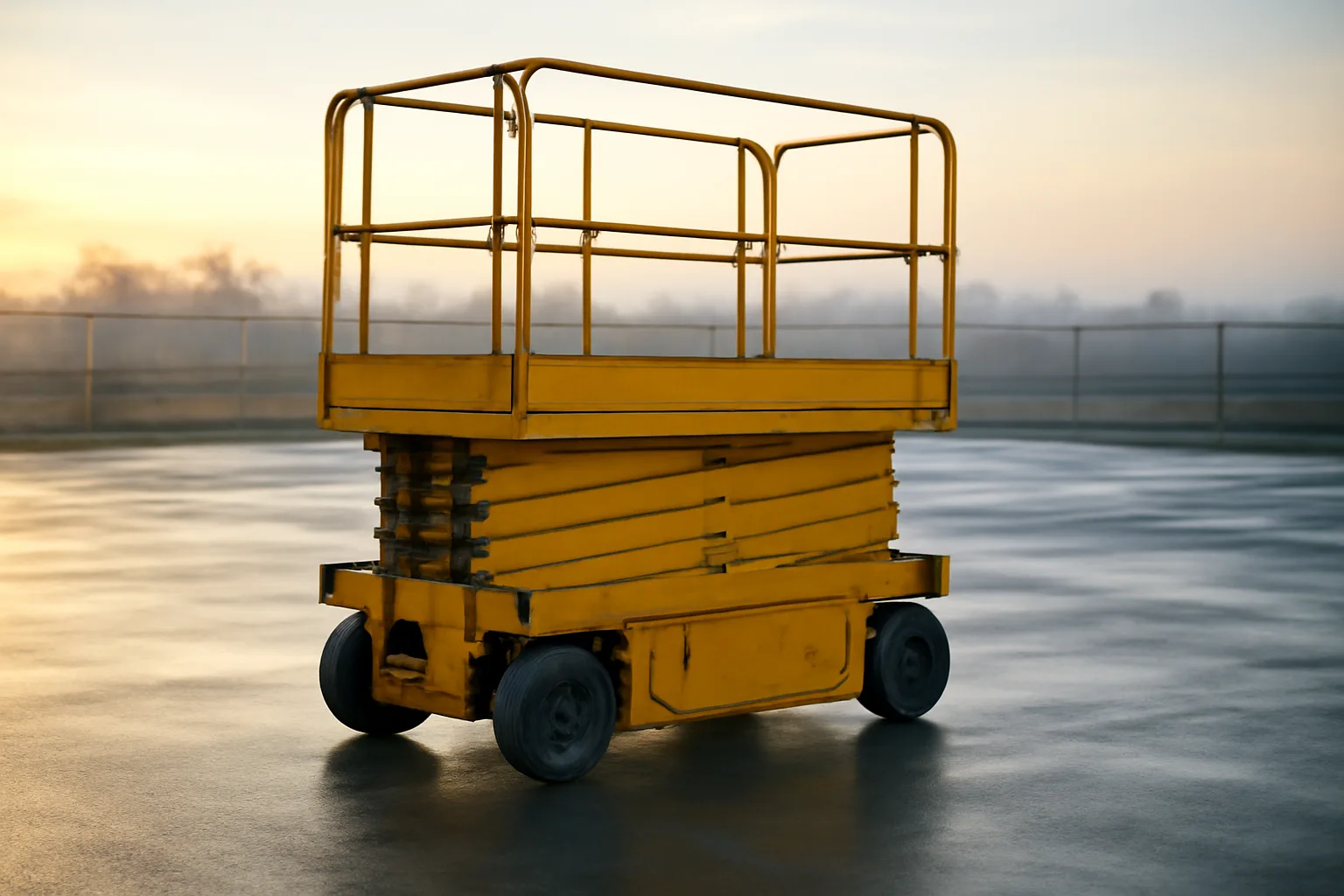
Scissor lift rental is the short-term hire of a mobile platform that rises straight up on crossed supports, usually by the day, week, or month. You are renting a machine. You are not selling a construction trade, and you are not the renter's employer unless you put your own operator on that platform.
Most calls in this trade are electric slab units for finished floors, or rough-terrain units with diesel or dual fuel for dirt. Small shops live on 19 ft, 26 ft, and 32 ft class machines. A boom lift is a different tool. It reaches out. A scissor lift mostly goes up.
People type scissor lift rental when they need height for drywall, racking, gym lights, or warehouse pipe. They want a unit that fits a doorway, holds two workers plus tools, and does not chew the floor. Your job is a clean machine, a real contract, and a delivery plan that matches the weight of the iron.
This is not a licensed profession at the federal level. It is an equipment business that sits next to construction. OSHA still cares, because once someone stands on the platform the workplace rules for scaffolds and elevating platforms apply [4][5]. Your rental form does not erase that.
Utilization pays the note. Idle iron does not. I would not romanticize the rest.
How do you start scissor lift rental?
You start scissor lift rental by standing up a real business, then putting insured machines on a written contract. Form an LLC or corporation with your state, get a free IRS EIN, and open a business bank account [6][10]. Add the state permit for renting tangible personal property. Names for that permit change by state. Buy general liability and equipment coverage before the first unit leaves. Then buy or finance a tiny fleet you can keep charged, inspected, and delivered.
After that, the work is operations. Photograph every outgoing machine. Log hours. Do a function test. Get a signature on damage and a training acknowledgment. Decide how you deliver. A one-ton truck and a mid-size trailer can quietly become a commercial motor vehicle if the weights line up [9].
I would not launch with a dozen units. Two to four machines teach you the call mix. A 19 ft electric is the usual first call in remodel markets. A mid-size rough-terrain only earns its keep if outdoor contractors already want it.
There is no federal rental board to wait on. You do wait for insurance binders, tax accounts, and payroll accounts if you hire. Confirm entity fees with your secretary of state. Nobody honest can quote every state's bill from memory, and I will not fake it.
Sequence I would actually run: entity, EIN, bank, insurance quotes, tax permit, first two machines, a contract reviewed by a lawyer who has seen equipment leases, then a delivery plan that matches FMCSA math [8][12]. Then you answer the phone.
Do you need a special license to rent scissor lifts?
No federal scissor lift rental license exists. You need ordinary business paper, tax accounts, and, if you roll heavy, driver credentials. That is the whole national picture. The myth of a single OSHA rental card is a sales pitch.
What you do need depends on how you operate. A state seller's permit or rental tax account shows up in most states because short-term hire of tangible property is usually taxable. A city or county business license is common. Zoning matters if you store machines at a house. If you also supply an operator who performs the customer's work, some states treat that as contracting. Confirm that line with the contractors board in your state, not with a forum post.
Driver licenses are the other real gate. A Class B CDL applies to a single vehicle with a GVWR of 26,001 pounds or more. A Class A CDL applies when the combination is 26,001 or more and the towed unit is 10,001 or more [8]. Plenty of first-year shops never hit those numbers. Plenty do, the week they buy a heavier trailer.
I would not pay a website that sells an "OSHA certified rental company" plaque. That plaque does not bind OSHA. Spend the money on insurance and a lawyered contract instead.
What OSHA rules apply to a rented scissor lift?
OSHA's construction scaffold rules are the main federal text for scissor lifts on building sites, and the aerial-lift rule covers a narrower set of boom-type platforms [1][4]. Employers must train people who work on scaffolds. Guardrails, inspections, and tip-over controls stay mandatory even though the machine is rented [3][5].
The training duty is blunt. 29 CFR 1926.454(a) says: "The employer shall have each employee who performs work while on a scaffold trained by a person qualified in the subject matter to recognize the hazards associated with the type of scaffold being used and to understand the procedures to control or minimize those hazards." [3] That sentence names the employer of the person on the platform. If you only rent the machine, that is usually the customer. If you staff the operator, that is you.
Mobile scaffold rules still control how the unit sits on the ground. 29 CFR 1926.452(w)(2) says scaffold casters and wheels "shall be locked with positive wheel and/or wheel and swivel locks, or equivalent means, to prevent movement of the scaffold while the scaffold is used in a stationary manner." [2] Fall protection on construction scaffolds generally starts at 10 feet above a lower level, with the exact method depending on the scaffold type [4]. OSHA's scissor lift fact sheet walks through tip-overs, collapses, and electrical contact as the failure modes that keep showing up in investigations [5].
Aerial-lift text is easy to misread. 29 CFR 1926.453 is written around vehicle-mounted elevating and rotating work platforms and still points back to older ANSI A92.2 design language for those machines [1]. A scissor lift is not the same product as a boom. State-plan states add their own pages. California's Title 8 section 3646 sets operating instructions for elevating work platforms, including use in line with the manufacturer [11]. Confirm the plan-state text if you sit outside federal OSHA.
Industry practice also follows ANSI/SAIA A92.22 (safe use) and A92.24 (training). Those are copyrighted standards, not free law. Dealers usually offer familiarization. Familiarization is not a magic card. It is a walk-around on that model.
What business paper do you file before the first machine leaves?
File the entity, the federal tax ID, the state tax account, and the local permission to operate, then bind insurance. That order keeps you from buying iron you cannot legally rent. The SBA's register-your-business guide is a decent federal map of the same stack, even though it will not list your city's fee [10].
The IRS EIN is the easy win. The Service says, "Applying for an EIN is a free service offered by the Internal Revenue Service. Beware of websites on the Internet that charge for this free service." [6] Use the IRS page. Do not buy a reseller. You will also need a responsible party with a taxpayer identification number on the application [6].
State tax paper is where people stall. Most states tax short-term equipment rental. Some fold it into sales tax. Some run a dedicated rental tax. Filing frequency is a board question, not a blog number. If you later add a second state, you inherit that state's account and any renewal cycle. California shops should read the real renewal path before they assume a seller's permit runs on autopilot (scissor lift rental renewal in california). Florida and Georgia shops hit the same kind of local tax rhythm, just on different forms (scissor lift rental renewal in florida, scissor lift rental renewal in georgia).
Local paper is zoning, a business license, and sometimes a home-occupation rule if the yard is a driveway. I would not skip the zoning call. Neighbors complain about trailers. Cities enforce after the complaint, not before.
| Step | Paper | Who confirms the current fee |
|---|---|---|
| Entity | Articles or certificate | State secretary of state |
| Federal tax ID | EIN | IRS online EIN application [6] |
| Rental or sales tax | Seller's permit or equivalent | State revenue department |
| Local leave-to-operate | Business license, zoning | City or county |
| Highway use | USDOT and CDL if weights hit | FMCSA and state DMV [8][12] |
Income tax is ordinary business income. IRS Publication 334 is the small-business tax guide you actually hand a new bookkeeper [13]. Depreciation lives in Publication 946, and construction-class assets often sit on a 5-year MACRS schedule, but rental fleets can land in more than one class. Confirm the class with a CPA and the current Pub 946 tables before you model cash tax [7].
How much money does a first scissor lift rental fleet take?
An honest first-year budget is insurance plus two to four machines plus a delivery rig plus a cash buffer for dead weeks. I will not invent a national startup total. Machine prices move with hours, batteries, and the used market. New compact electrics from the major OEMs are typically five figures. Used units swing harder than anyone's blog admits. Get three dealer quotes and a week of auction comps.
The line items that actually surprise people are not the lift. They are the charger circuit, the trailer brakes, the first insurance audit, and the month a battery pack dies. Shop buildout is a common waste. A clean slab, a hose, and a lock beat a branded counter in year one.
Tax treatment is not a down payment plan. Publication 946 explains how MACRS runs and what "placed in service" means [7]. Section 179 and bonus rules change by statute year. Confirm the dollar cap with the IRS publication for the year you place the asset. I will not quote a stale cap and pretend it is 2026 law.
Working capital matters more than paint. A two-machine shop can look busy on Instagram and still miss payroll if both units sit through a rain month. Nobody publishes a clean public utilization series for tiny independent fleets. National houses do not hand you their internal number in a form you can copy. Price your idle time like it is real.
I would keep the first checkbook boring. Two electrics you can charge overnight. One trailer you can legally tow. Insurance paid annual if the carrier will do it. No custom wrap. No third location.
Do you need a CDL or USDOT number to deliver lifts?
You need a CDL when the vehicle class hits the federal weight tests, and you may need a USDOT number when you operate a commercial motor vehicle in interstate commerce [8][12]. Plenty of scissor lift rental deliveries stay under those lines. The mistake is guessing instead of reading the door sticker and the trailer plate.
49 CFR 383.91 classifies commercial motor vehicles by weight. Class B is any single vehicle with a GVWR of 26,001 pounds or more. Class A is a combination with a GVWR of 26,001 or more where the towed unit is 10,001 or more [8]. GVWR is the rating, not what the scale said this morning. If your truck is plated at 26,000 even, you are playing inches from a CDL.
A commercial motor vehicle under 49 CFR 390.5 includes a vehicle or combination used on a highway in interstate commerce with a GVWR of 10,001 pounds or more, among other tests [9]. That 10,001 figure is how a modest trailer suddenly puts you in FMCSA registration territory. Interstate is broader than people think. Crossing a state line with a rented lift for a customer is the clean case. Intrastate rules still exist, and many states want their own DOT number even when you never leave the state. Confirm with your state patrol or DMV, not with a Facebook group.
FMCSA's getting-a-USDOT-number page is the federal starting point if the CMV definition fits [12]. I would put the truck GVWR, trailer GVWR, and combined rating on a card in the cab. Then I would ask a transportation lawyer or a sharp insurance desk to sanity-check it before the first out-of-state drop.
What insurance do you actually need in year one?
You need general liability, an equipment floater (often sold as inland marine), and commercial auto if you deliver. Workers' compensation arrives the day you have an employee, on the timetable your state sets. Umbrella coverage is optional until a broker shows you a hole you cannot sleep with.
I would not buy a cheap general-liability-only policy and tell myself the renter's insurance covers the machine. It often does not. Theft from an open jobsite is a real claim. So is a tip-over that damages a lobby floor. Ask the carrier, in writing, how they treat rental to homeowners, rental without an operator, and rental with your operator. Those three answers change the price.
General contractors will ask for certificates of insurance. Learn to issue them without drama. Additional insured wording is a negotiation, not a slogan. Do not sign a customer contract that makes you the jobsite safety manager unless you mean it and your policy agrees.
Premiums are not a national number I can quote honestly. They move with garage location, driver records, radius, and whether you rent to DIYers. Get three quotes. The cheapest quote that excludes the way you actually work is a waste of money.
Who has to train the person standing on the platform?
The employer of the person on the platform carries the OSHA training duty on a construction site [3]. If you only rent the machine, that employer is usually the customer. If your employee operates it, the duty is yours. Rental shops still have a practical job: familiarize the renter on that model, hand over the manual, and refuse the unit when the user is clearly unready.
I would put a short orientation on every outbound. Controls, e-stop, pothole protection, wind and ground limits, no standing on rails, no moving with the platform up unless the manufacturer allows it. Photograph the walk-around. Keep the signed sheet. That paper will not beat a willful OSHA citation against the employer, but it shows you were not reckless with the handoff [5].
Do not sell a plastic "certified operator" card as if it were a license. OSHA does not run a consumer wallet-card program for scissor lift rental. Qualified-person training is about content and the work, not a logo. State-plan rules can add detail, which is why a California operator packet should track Title 8 as well as the federal scaffold text [11][4].
If a customer asks you to supply a trained operator, stop and re-read your insurance and your contractor-license line. That job is no longer a naked equipment rental.
What should a first-year scissor lift rental fleet look like?
A first-year fleet should match the calls you can already hear, not the catalog. In most remodel and facility markets that means two or three electric 19 ft units and, if the phone actually asks, one 26 ft electric. Add a rough-terrain only when outdoor GCs are already booking you. Batteries, tires, and chargers will teach you more than a sixth machine will.
| Electric slab | Rough-terrain | |
|---|---|---|
| Typical call | Indoor slab, stores, schools | Dirt, unfinished pad |
| Power | Batteries you charge every cycle | Diesel or dual fuel |
| Year-one pain | Chargers, floor loading, tire marks | Fuel, mud, higher buy-in |
| My bias for a first four-pack | Default yes | Only with booked outdoor demand |
Hour meters stop stupid fights. Customers claim the unit was already worn out. You claim they ran it hard. A written hour log at checkout and return is the minimum. If you want GPS and hours on a tiny fleet without building a software stack, ScissorPath sells a $179 one-time 2-6 Machine Telematics Kit. A clipboard still works if you actually fill it out.
I would standardize on one OEM family if I could. Parts and familiarization get easier. Mixing every leftover auction orphan looks cheap on day one and expensive on Saturday when a tiller motor is unique.
Skip the 40-plus-foot unit until you have a customer who has paid you for that height twice. Wide machines also fail doorway math. Measure the jobs you are really being offered.
What records should you keep so disputes stay boring?
Keep a file per machine and a file per contract. The machine file is serial number, proof of ownership, inspection sheets, repairs, hour log, and photos. The contract file is the signed rental agreement, the orientation sheet, the outbound and inbound condition photos, and any certificate of insurance you collected.
Inspect on a written checklist every outbound and every return. Function-test lift, lower, steering, brakes, pothole guards, and emergency lowering. OSHA's scissor lift guidance treats inspection and keeping safety devices in place as basic employer controls, and you should act like those devices will be blamed first [5]. If a renter asks you to defeat a tilt alarm, the answer is no.
Tax records sit beside the shop records. Invoices, exemption certificates, and the state return belong in one place. Publication 334 is the IRS tour of what a small firm is supposed to keep for income and expenses [13]. Keep them longer than you think. Audits do not honor your closet system.
I would also keep a delivery weight card, CDL copies if anyone holds one, and the insurance binder with the policy numbers on the first page. Boring files close claims. Heroic memory does not.
How do state tax accounts and renewals differ after you open?
They differ in the name of the tax, the filing rhythm, and whether a city adds its own bite. The federal layer stays stable: EIN, income tax, and employment tax if you hire [6][13]. Everything under that is local. Confirm the current form and fee with the board that sends the bill. Do not trust a national checklist for a renewal date.
A shop that later adds Arizona or Colorado work is not doing "the same paper twice." It is opening a new tax account with a new calendar (scissor lift rental renewal in arizona, scissor lift rental renewal in colorado). Alabama and Connecticut are the same lesson in different buildings (scissor lift rental renewal in alabama, scissor lift rental renewal in connecticut). Read the state page before you send a machine across a line for a long-term drop.
Some cities license the location, more than the entity. If you move the yard, you may need a new local license even when the state tax account stays put. I would calendar every account the day it opens, with a 30-day warning. Late fees are a dumb way to spend rental gross.
What would I skip in year one?
I would skip the giant rough-terrain that looks good in a dealer photo. I would skip a leased retail counter. I would skip paid EIN mills, fake OSHA company cards, and any software that costs more per month than a battery tender.
I would also skip renting to homeowners until the insurer says yes in writing. DIY claims are messy. The machine still works the same. The story after a fall does not.
What I would do is narrower. Two or three electrics. A legal tow package. A contract a lawyer has actually read. Photos every time. A tax account you file on time. A delivery plan that respects the 10,001 and 26,001 pound lines [8][9]. That is a real first year.
If you want a start checklist in one place, use /start. ScissorPath is an independent publisher, not a law firm and not a rental shop. It will not file your permits or promise an approval date.
Frequently asked questions
What is scissor lift rental?
It is short-term hire of a mobile platform that rises vertically on stacked supports, usually by the day, week, or month. You rent the machine. The renter's employer still owns most jobsite safety duties. It is an equipment business, not a federal trade license.
How do you start scissor lift rental?
Form an entity, get a free IRS EIN, open a bank account, file the state tax permit for equipment hire, bind liability and equipment insurance, then buy two to four machines you can inspect and deliver. Write a real rental contract. Check truck and trailer GVWR before you haul. Confirm every state fee with the board that bills you.
Do I need an OSHA certification to rent out scissor lifts?
No. OSHA does not issue a national rental-company license or a required consumer wallet card. Construction employers must train people who work on scaffolds under 29 CFR 1926.454. You should still familiarize each renter on that model and keep the signed walk-around. Paid plaques do not bind OSHA.
Is a scissor lift an aerial lift under OSHA?
Usually not in the way people mean. OSHA's 1926.453 aerial-lift rule is written around vehicle-mounted elevating and rotating platforms. Most scissor lifts on construction sites are handled through the scaffold rules in 1926.451 and 1926.452, plus OSHA's scissor lift fact sheet. Boom lifts are the closer aerial-lift case.
Can I run scissor lift rental from my driveway?
Only if zoning, the HOA, and your insurer allow stored machines and trailer traffic. Many cities treat that as a commercial yard. Neighbors complain. I would call planning and the carrier before the first unit sits overnight. A cheap industrial pad is often less painful than a zoning fight.
Do I have to charge sales tax on a scissor lift rental?
In most states, short-term hire of tangible personal property is taxable unless a valid exemption applies. The account name varies. Filing rhythm varies. Confirm the current rate, exemptions, and due dates with your state revenue department. Keep exemption certificates. Do not copy another state's rule.
How many machines should I buy in year one?
I would start with two to four. A pair of 19 ft electrics covers a lot of remodel calls. Add height or rough-terrain only when the phone already asks. Extra iron looks like growth and acts like a note you service in the rain. Utilization, not unit count, pays the year.
Do I need a CDL to tow a scissor lift?
Only if the vehicle class hits federal tests. Class B is a single vehicle at 26,001 pounds GVWR or more. Class A is a combination at 26,001 or more with a towed unit at 10,001 or more, per 49 CFR 383.91. Read the door sticker and trailer plate. Confirm odd state rules with the DMV.
Who inspects a rented scissor lift?
You should inspect at every outbound and return. The renter's employer should inspect before use on the site. OSHA expects safety devices to stay in place and the unit to be fit for work. Keep photos and a signed checklist. If someone asks you to defeat a tilt or pothole system, refuse the rental.
Can I rent scissor lifts to homeowners?
Often yes as a matter of ordinary commerce, and often no as a matter of insurance appetite. Ask the carrier in writing before you advertise to DIYers. Falls from a platform still happen on a house job. Your contract will not impress a claims adjuster if the policy excluded personal use.
Do I need a contractor license to rent scissor lifts?
Naked equipment rental is not contracting in most states. If you supply an operator who performs the customer's construction work, some boards treat that as a contractor activity. Confirm with your state contractors board. Do not assume a rental tax permit covers both.
Should I add boom lifts in the same first-year shop?
Only if you already have boom calls and the insurance desk is comfortable. Booms cost more, haul heavier, and bring a different OSHA text (1926.453). They also need more yard room. I would stabilize scissor lift rental first. Mix later, when the books are dull and positive.
Sources
- OSHA 29 CFR 1926.453 Aerial lifts: Federal aerial-lift rule for vehicle-mounted elevating and rotating work platforms, including ANSI A92.2-1969 design reference
- OSHA 29 CFR 1926.452 Additional scaffold requirements: Mobile scaffold caster and wheel lock requirement in 1926.452(w)(2)
- OSHA 29 CFR 1926.454 Scaffold training requirements: Employers must have each employee who works on a scaffold trained by a qualified person
- OSHA 29 CFR 1926.451 General scaffold requirements: General construction scaffold rules, including fall protection that generally applies 10 feet above a lower level
- OSHA Publication 3842 Scissor Lifts fact sheet: OSHA guidance on scissor lift hazards including tip-overs, collapses, and the need to inspect and keep safety devices in place
- IRS Apply for an EIN online: Applying for an EIN is a free IRS service and paid third-party sites are unnecessary
- IRS Publication 946 How to Depreciate Property: MACRS class lives and placed-in-service rules for depreciating business equipment, including construction-class assets
- 49 CFR 383.91 Commercial motor vehicle groups: Class B CDL at 26,001 pounds GVWR single vehicle; Class A when combination is 26,001 or more and towed unit is 10,001 or more
- 49 CFR 390.5 Definitions (commercial motor vehicle): CMV definition includes certain highway vehicles in interstate commerce with GVWR of 10,001 pounds or more
- U.S. Small Business Administration Register your business: Federal overview that new firms register the entity, obtain tax IDs, and obtain required state and local licenses
- Cal/OSHA Title 8 section 3646 Operating Instructions (Elevating Work Platforms): California state-plan operating rules for elevating work platforms, including manufacturer-instruction duties
- FMCSA Getting a USDOT Number: Federal starting point for USDOT number registration when operating a commercial motor vehicle
- IRS Publication 334 Tax Guide for Small Business: IRS small-business guide to income, expenses, and records for firms that are not corporations in the publication's scope