Last updated 2026-08-20
TL;DR
Scissor lift rental is a time-and-delivery business. You own inspected MEWPs and hire them out. No federal rental license exists. You register a business, get a free IRS EIN, collect state sales tax where required, train your people, and follow OSHA plus ANSI A92 duties. Confirm local licenses and fees with the board that actually issues them.
What is scissor lift rental?
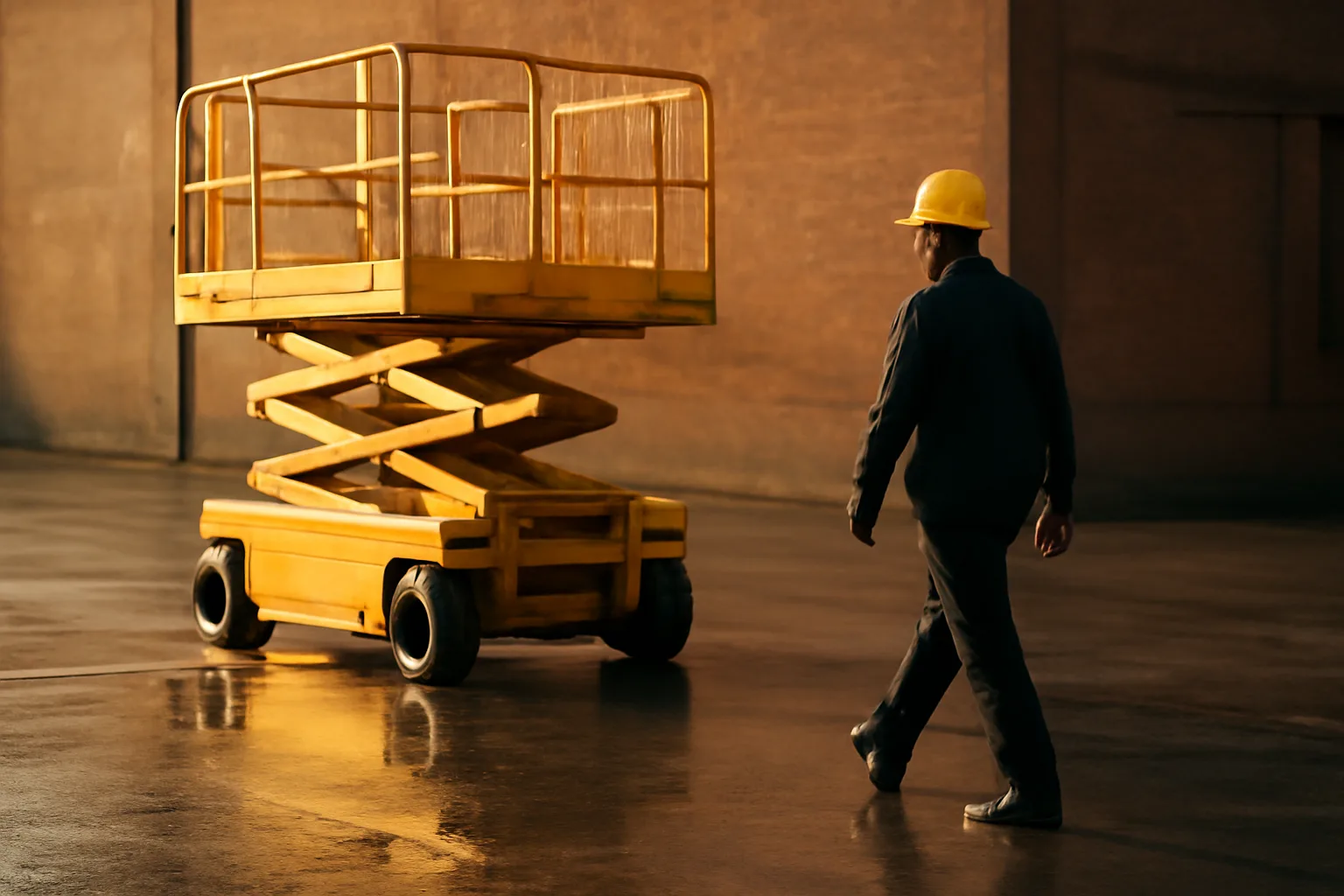
Scissor lift rental is a hire business. You keep mobile elevating work platforms (MEWPs) ready, then let a contractor, plant crew, or (less often) a homeowner take one for a day, a week, or a job. They pay for time, delivery, and sometimes fuel or a damage waiver. You keep title, inspections, and the next renter in mind.
That is the product. It is not a federal franchise and it is not a contractor license by itself. You are renting tangible equipment, the same family of trade as boom lifts, forklifts, and light earthmovers. Census NAICS files most of this work under construction and related machinery rental, but your city clerk will not care about the code. They will care whether you have a local business license and a sales tax permit.
A scissor lift raises a platform on stacked, crossed supports. Indoor electric slabs fit warehouses and finished floors. Rough-terrain diesel units go on dirt and uneven pads. Both are MEWPs under the current ANSI A92 family. OSHA still splits the language. Vehicle-mounted aerial lifts sit in 29 CFR 1926.453. Many scissors on construction sites get treated as mobile scaffolds under 1926.451 and 1926.452. [1][2][4]
The renter's employer usually holds the worksite safety duty. You still hold owner duties: a machine that works, manuals on board, guardrails that latch, and a contract that says who operates it. If you send a driver, that person is your employee problem, not the renter's.
People new to this often think the hard part is the first machine. The hard part is paper, yard discipline, and saying no to a renter who wants to tow a 26-foot slab behind a half-ton with a ball hitch that is already tired.
How do you start scissor lift rental?
You start scissor lift rental the way you start any equipment yard, then you stack MEWP rules on top. Form an entity your state recognizes, get an Employer Identification Number from the IRS, open a bank account in the business name, and ask the city or county what license a rental yard needs at your address. There is no national scissor permit. Anyone who sells you one is selling a story.
The SBA's register-your-business walkthrough is the right first map. It sends you to the state corporation office, the state tax agency, and local licensing. Fees and names change by county. Confirm them with the board that prints the receipt. Do not trust a blog fee table, including this one, for a dollar amount you will actually pay. [6]
Buy or finance machines only after you know where they will sit at night. A paved slab with power for chargers beats a muddy lot and a generator. Write a rental contract a local construction lawyer has actually read. Set a delivery radius you can keep when it rains. Price delivery as its own line. Bundling delivery into the day rate hides the cost until diesel spikes.
Hire slowly. Year one is you, a part-time mechanic, and a flatbed or rollback you either own or rent. I would not staff a showroom. I would not buy embroidered polos. I would spend money on a battery charger that works, jack stands rated for the machine, and a written pre-delivery inspection sheet you keep for every outing.
Then you stay legal on the road. If the truck, trailer, and lift combination hits the federal commercial-motor-vehicle line in interstate work, you need a USDOT number before you chase that out-of-state drywall crew. [7]
What licenses and paper do you actually need?
You need a state business registration, a tax account if you will have employees or collect sales tax, and whatever local business license your city or county posts for a rental yard. You do not need a federal "aerial lift dealer" card. OSHA does not license rental companies. ANSI does not either.
Get the EIN yourself on IRS.gov. The Service says, "Applying for an EIN is a free service offered by the Internal Revenue Service. Beware of websites on the Internet that charge for this free service." That sentence is the whole policy. If a helper site wants $79 to "expedite" an EIN, close the tab. [5]
Sales tax is the paper people skip, then pay for twice. Many states tax the rental of tangible personal property. California's CDTFA Publication 46 walks lessors through when a lease or rental is taxable and when a resale certificate is real. Florida taxes the privilege of renting tangible personal property under chapter 212. If you deliver into several states, you may owe nexus questions you should take to a CPA, not a Facebook group. [11][15]
Zoning is local. A residential driveway full of 32-foot scissors will draw a complaint. Ask planning before you pour a pad. Fire codes can limit indoor charging of large battery packs. Confirm that with the fire marshal, not a forum.
State renewal cycles are their own pile. If you already hold a seller's permit or a local yard license, the renewal path is state-specific. Readers who need that paper next usually start with California renewal paper, Florida renewal paper, or Arizona renewal paper. None of those pages can quote your fee for you. The board that cashed your last check can.
Do you need an OSHA or ANSI certificate to rent scissors?
No federal card says you may rent scissors. OSHA writes duties for employers at the worksite. ANSI A92.20, A92.22, and A92.24 (the current design, safe-use, and training set that SAIA maintains) tell manufacturers, owners, users, and operators who does what. A four-hour "certification" slideshow does not replace either body of rules. [12]
OSHA's construction aerial-lift rule says, "Only authorized persons shall operate an aerial lift." That line is about the person on the platform, not about your right to own the machine. Scaffold training at 29 CFR 1926.454 is broader: "The employer shall have each employee who performs work while on a scaffold trained by a person qualified in the subject matter to recognize the hazards associated with the type of scaffold being used and to understand the procedures to control or minimize those hazards." If a scissor is treated as a scaffold on that site, that sentence is the one a compliance officer will read. [1][3]
Your yard still needs a training plan for your own people. Drivers who load machines. Techs who override descent valves. Anyone who demonstrates a lift to a renter. A laminated wallet card from an online mill is weak evidence. A record that names the machine class, the trainer, the date, and the hands-on evaluation is what I would keep.
General industry work (a plant, a warehouse, a store reset) can pull in 29 CFR 1910.67 for vehicle-mounted elevating work platforms. That standard is a poor fit for a typical slab scissor, but it is why you should not tell a factory safety manager that "OSHA does not cover scissors." Hand them the section and let their counsel decide. [14]
What insurance do rental yards actually carry?
Expect commercial general liability, an equipment floater (inland marine) on the fleet, auto on every truck that leaves the yard, and workers' compensation once you have employees your state counts as employees. Many general contractors will not let you through the gate without a certificate that names them as additional insured and shows an umbrella on top.
I will not quote a premium. Nobody honest can. Limits, deductibles, loss history, where you deliver, and whether you rent to homeowners all move the number. Confirm with a broker who already writes rental fleets, then confirm the certificate language with the GC's risk desk.
A damage waiver is not insurance. It is a contract term that may waive some of your repair bill if the renter pays a fee and follows the rules. Some states police how you sell waivers. Call a waiver "insurance" and you may have just volunteered for an insurance-department problem. Have counsel read the clause.
Do not cheap out on the floater and then "self-insure" a $40,000 rough-terrain unit you still owe the bank on. That is how year-one yards vanish after one rollover. And do not buy a policy that excludes "rented to others" and then rent to others. Read the form.
How much money does a first-year scissor lift rental shop take?
Nobody publishes a clean national starter budget that survives contact with your county. Machine prices move with steel, batteries, and whether the unit is new under ANSI A92.20 or an older A92.6 design. Dealer quotes shift by mast, deck extension, and non-marking tires. I will not invent an MSRP.
What I would actually spend first: two or three common indoor slabs (the 19-foot and 26-foot class most drywall and electrical crews already know), one charger per electric machine plus a spare, a rollback or a trailer your truck is rated to tow, jacking equipment, and a fence. I would not buy a 60-foot boom "to have something tall." You will insure it all year and rent it twice.
Used machines can be fine if the annual inspection is real, the manuals ride with the unit, and the safety decals match the language ANSI now expects users to see. A cheap scissor with a bent scissor pack is not a deal. You will pay a shop more than you "saved."
Cash also walks out the door as deposits on a yard lease, first insurance bind, and the weeks you wait for a customer who pays on 45-day terms. If you cannot float payroll and the note without that invoice, you are not ready. Factoring rental invoices is legal. It is also how your margin disappears.
Telematics help once you have more than one machine in the wild. Hour meters that only live on the lower control box get ignored. If you want a cheap way to see hours without a dealer portal, ScissorPath sells a $179 one-time 2-6 Machine Telematics Kit. You do not need it to operate legally, and this guide works if you never buy it.
What training must you give renters and your own techs?
Train your employees. That duty is not optional. 29 CFR 1926.454 requires scaffold users to be trained by a qualified person on the hazards of that scaffold type. 1926.453 requires authorized operators on aerial lifts. ANSI A92.24 is the training standard the industry now writes into safe-use programs. SAIA publishes how those A92 pieces fit together. [3][1][12]
Renters are a different story. Their employer is usually the one OSHA will cite if an untrained painter goes up. Your contract should say the renter will provide trained operators and will not remove guardrails. You can still refuse a handoff when the person in the parking lot cannot find the emergency lower. I would refuse. A crushed machine and a lawsuit cost more than one lost day rate.
Do a familiarization on that model when you deliver. Familiarization is not full training. It is "here is the pothole protection, here is the descent override, here is the weight chart." Log it. Skip the log and you will not remember who you showed six months later.
Techs need extra time on energy isolation. Electric scissors store energy in batteries and in raised structures. A platform that is "down enough" is still a crush zone. I want a written lockout step before anyone reaches into a scissor pack. That is my rule, not a statute number.
Can you haul scissor lifts without a USDOT number?
Sometimes. FMCSA says you must have a USDOT number if you operate a commercial motor vehicle in interstate commerce and the vehicle (or combination) has a gross vehicle weight rating, gross combination weight rating, gross vehicle weight, or gross combination weight of 10,001 pounds or more. A one-ton truck, a trailer, and a 26-foot scissor clear that line on a regular Tuesday. [7]
Intrastate-only work can still trigger a state DOT number. Confirm with your state motor carrier office. Do not guess from a forum post dated 2014.
A CDL is a higher threshold. Interstate CDL rules generally attach at 26,001 pounds GVWR or GCWR, or when you tow a trailer over 10,000 pounds behind a truck that puts the combination over 26,001, plus the passenger and hazmat cases. Read the FMCSA CDL page and then your state DMV supplement. I would not let a new driver "just run it over to the next county" in a combo they have not weighed. [8]
Weight ratings live on the door jamb and the trailer VIN plate, not in your memory of what the last guy hauled. Cross a state line with a CMV and no USDOT number, and the citation is the cheap part. The out-of-service order in a customer's driveway is the expensive part.
What taxes apply when you rent a scissor lift?
Most states treat a short-term rental of a scissor lift as a taxable rental of tangible personal property. The tax is usually on the rental charge, sometimes on delivery, sometimes not. California's Publication 46 is the lessor-focused walkthrough I would actually open. Florida's section 212.05 is the statute that sets the taxable privilege, including licenses and leases of tangible personal property. Other states rhyme with those two. Confirm the rate and the exemptions with the state that will audit you. [11][15]
Resale certificates matter if you buy a machine tax-free and then rent it. Some states allow that when you will collect tax on the rentals. Some want tax at purchase. Get this wrong and you will write a large check plus interest. A CPA who already files for rental houses is cheaper than a sample-period assessment.
If you later add a location, your permit list grows. Colorado renewal paper and Georgia renewal paper are the kind of state-level paper path people look for after the first year, not before they have a seller's permit at all.
Income tax is ordinary. Depreciation on equipment is real. Section 179 and bonus rules change. I am not your tax advisor. File on time. Keep the inspection logs with the asset file so a buyer, a lender, or an examiner can see the machine was more than a serial number.
What should first-year operations look like?
Quiet. A good first year in scissor lift rental is boring paper and clean batteries. You run a pre-delivery inspection every time: rails, gate, emergency lowering, pothole protection, tires or non-marking wheels, horn, function tests through the full elevating cycle, and a look under the chassis for leaks. You do not skip it because the last renter "only had it two days."
ANSI's safe-use standard expects frequent and annual inspections on a defined cycle. The annual should be someone who knows the model, not your cousin with a grease gun. Keep the report with the serial number. When you sell the machine, that file is part of the value.
Set a written rule for who you will not rent to. I would not rent to a cash stranger with no jobsite and no proof of a trained operator. I would not deliver onto a grade the machine's manual forbids. Saying no is an operations skill.
Billing should be same-week, not "whenever we remember the hour meter." Photograph the hour meter and the four corners of the machine at checkout and check-in. That habit ends most "it was already dented" fights.
BLS counted 5,486 fatal work injuries in 2022, and 865 of those were falls, slips, and trips. You will not fix national numbers. You can keep a renter off a machine with a broken gate. That is the job. [10]
Indoor electric or rough-terrain first?
If your phones will ring from remodelers, electricians, and warehouse work, buy indoor electric slabs first. They fit standard doors, they do not soot a finished floor, and crews already know the 19-foot and 26-foot silhouettes. If your phones will ring from site superintendents on dirt, you need rough-terrain, foam-filled tires, and a conversation about gradeability that the manual, not your optimism, wins.
Mixing both on day one splits parts, training, and insurance questions. I would pick one lane for six months. Then add the other when a real customer is willing to sign a standing order.
Rough-terrain diesel units also drag emissions and fuel rules into the yard. EPA nonroad diesel tiers apply to the engine the manufacturer installed. You do not "tune" a rental scissor into compliance. You buy a legal machine and you keep the emissions label intact. If a local air district has extra idling or fleet rules, confirm those with that district.
Do not start with a one-off exotic width or a 40-plus-foot electric just because a dealer had it on the pad. Odd machines sit. Sitting machines still need batteries watered and brakes checked.
How do you keep machines legal after you buy them?
Keep the manufacturer's manual with the machine. Replace missing decals with the current ones for that serial range. Do not weld on a homemade gate and call it a modification. ANSI and the makers treat unauthorized modifications as a way to void the design compliance you are advertising to the renter.
OSHA's scaffold rule generally requires fall protection at 10 feet, and many scissor designs rely on guardrails as that protection. A renter who folds a rail down to get closer to a joist has just changed the machine. Your contract should forbid it. Your delivery photo should show the rail up. 29 CFR 1926.451 is the text a citation will quote. [2]
Cal/OSHA writes its own operating instructions for elevating work platforms in Title 8. If you send a machine into California, that is the state book, not a suggestion. Confirm the current section text with DIR before you tell a renter "OSHA federal is enough." [13]
Annual inspections, frequent inspections, and a repair hold tag you actually honor will do more for legality than a new logo wrap. When a limit switch fails, the machine stays home. Renting it anyway is how you fund a lawyer.
State boards do not mail you a gold sticker that says the scissor is legal. They mail you tax and entity renewals. For the annual dance on those, see paths like Alabama renewal paper and Connecticut renewal paper. Confirm dates with the agency letter, not with a memory of last July.
Where do new scissor lift rental yards waste money?
They buy too many unique models. They paint the office. They pay a lead vendor for "contractors in your area" who already have a national account. They skip the sales-tax permit and then spend the tax money. They let friends take a machine over the weekend with no contract.
Another waste is operator "certification" mills you never watch. If the trainer cannot name A92.24 or 1926.454, keep looking. [3][12]
Youth labor is a quiet way to get a federal problem. DOL's Hazardous Occupations Order 7 bars most minors from power-driven hoisting apparatus. A 17-year-old after-school lot kid is not your scissor operator and is not your delivery driver for the lift. Fact Sheet 43 is the document to read before you write that job posting. [9]
I would also skip custom software in year one. A shared spreadsheet, meter photos, and a bank that lets you take cards will run a three-machine yard. Software becomes worth it when you cannot remember which serial is at which site.
Last, they believe a national myth that one license unlocks every state. It does not. Entity, tax, motor carrier, and yard licenses stack. If you want the kit path we publish after you have that stack in mind, use /start. Confirm every fee with the board that collects it. ScissorPath is an independent publisher, not a law firm and not a service company.
Frequently asked questions
What is scissor lift rental?
It is a hire business. You own inspected scissor lifts (MEWPs), keep them legal, and charge for time plus delivery. The renter's crew operates the machine on their site. You are not selling a federal license and you are not, by that fact alone, a construction contractor. Confirm local business and tax permits with the boards that issue them.
How do you start scissor lift rental?
Register an entity, get a free EIN on IRS.gov, ask the city what a rental yard needs, open tax accounts, write a real contract, and buy common machines you can inspect. Add USDOT or CDL credentials only if your truck-and-trailer weights and lanes trigger them. There is no national scissor rental card. Confirm fees locally.
Do I need a federal license to rent scissor lifts?
No. OSHA does not license rental yards. ANSI does not issue a permit to rent. You still need state entity papers, tax accounts, and any local business license your city requires. Motor carrier numbers depend on weight and interstate work. Confirm each item with the agency that prints the permit.
Is a scissor lift an aerial lift under OSHA?
Often no. 29 CFR 1926.453 describes vehicle-mounted aerial devices such as extensible and articulating booms. Many construction scissors are treated as mobile scaffolds under 1926.451 and 1926.452. General industry may look at 1910.67. Read the section that matches the site. Do not argue from a brochure.
Who has to train the person on the platform?
Usually the renter's employer. OSHA training duties attach to the employer of the person doing the work. Your yard still trains its own drivers and techs, and ANSI A92.22/A92.24 expect safe-use and familiarization discipline from owners and users. Put the split in the contract, then refuse unsafe handoffs.
Do I need a USDOT number to deliver machines?
If you operate a CMV in interstate commerce at 10,001 pounds GVWR, GCWR, GVW, or GCW or more, FMCSA says you need a USDOT number. Many pickup-plus-trailer-plus-scissor combos meet that line. Intrastate rules differ. Weigh the combination and confirm with FMCSA and your state carrier office.
Is an IRS EIN really free?
Yes if you apply on IRS.gov. The IRS says applying for an EIN is a free service and warns about sites that charge for it. Third-party "expedite" fees are optional and usually pointless. You still need the EIN before you hire or open many bank and tax accounts.
Can a teenager operate a rental scissor at my yard?
Generally no for the hoisting work. DOL Hazardous Occupations Order 7 restricts minors from power-driven hoisting apparatus. Do not put a 16- or 17-year-old on the platform or on delivery of the lift as a workaround. Read WHD Fact Sheet 43 and your state youth-employment rules before you hire.
Do states charge sales tax on scissor lift rental?
Many do, because a short-term hire is a rental of tangible personal property. California's Publication 46 and Florida statute 212.05 are two primary texts. Rates, delivery tax, and resale-certificate rules differ. Confirm with the state department of revenue that will audit the returns.
How often should a rental scissor be inspected?
Do a pre-delivery check every outing. Follow the manufacturer plus ANSI frequent and annual inspection cycles. Park any machine with a failed safety function. Keep the annual report with the serial number. There is no single OSHA "sticker date" that replaces those records.
Should I buy used or new scissors in year one?
Used is fine if manuals, decals, and a real annual inspection come with the serial number. New A92.20 machines cost more and reduce arguments about old rail designs. I would not buy a wreck with a bent scissor pack to "save" money. Get a quote from more than one dealer and ignore round national averages.
Do I need workers' compensation as a solo owner?
It depends on your state and whether you have employees, leased labor, or owner exemptions. Some states let a true solo skip coverage. The first helper, even "just on Saturdays," can change that. Confirm with your state workers' compensation agency and the carrier before you hand someone a set of keys.
What is a MEWP?
Mobile elevating work platform. It is the ANSI A92 term that now covers scissors, booms, and related machines. Design is A92.20, safe use is A92.22, training is A92.24. Older scissors may still carry A92.6 markings. Your manual and serial plate tell you which design the unit was built to.
Can I run scissor lift rental from my house?
Only if zoning, HOA rules, and fire rules allow commercial equipment, charging, and truck traffic at that address. Most do not. A complaint from a neighbor is how you meet code enforcement. Ask planning and the fire marshal before the first machine arrives. Confirm, do not assume a home-occupation permit covers a fleet.
Sources
- OSHA 29 CFR 1926.453 Aerial lifts: OSHA construction aerial-lift rule covers vehicle-mounted aerial devices and requires that only authorized persons operate an aerial lift.
- OSHA 29 CFR 1926.451 General requirements for scaffolds: OSHA scaffold standard sets general construction scaffold duties, including fall protection provisions commonly applied when scissors are treated as scaffolds.
- OSHA 29 CFR 1926.454 Training requirements (scaffolds): Employers must have each employee who works on a scaffold trained by a qualified person on that scaffold type's hazards and controls.
- OSHA 29 CFR 1926.452 Additional requirements applicable to specific types of scaffolds: OSHA publishes additional construction rules for specific scaffold types, including mobile scaffolds often used to classify scissor lifts.
- IRS Apply for an Employer Identification Number (EIN) online: Applying for an EIN on IRS.gov is a free IRS service; the IRS warns against websites that charge for it.
- U.S. Small Business Administration, Register your business: SBA directs new firms to state, tax, and local registration steps rather than a single federal operating license.
- FMCSA, Do I need a USDOT number?: A USDOT number is required for qualifying CMVs in interstate commerce at 10,001 pounds GVWR/GCWR/GVW/GCW or more.
- FMCSA, Commercial Driver's License: Federal CDL requirements apply to drivers of commercial motor vehicles, including combinations at the 26,001-pound threshold and related cases.
- U.S. DOL WHD Fact Sheet 43, Child Labor in Nonagricultural Occupations: Hazardous Occupations Order 7 restricts minors from most work with power-driven hoisting apparatus.
- U.S. BLS, National Census of Fatal Occupational Injuries in 2022: BLS counted 5,486 fatal work injuries in 2022, including 865 fatal falls, slips, and trips and 2,066 transportation incidents.
- California CDTFA Publication 46, Leasing and Rental of Tangible Personal Property: California explains when leases and rentals of tangible personal property are subject to sales or use tax.
- Cal/OSHA Title 8 section 3648, Operating Instructions of Elevating Work Platforms: California sets state operating instructions for elevating work platforms that apply in addition to federal rules.
- OSHA 29 CFR 1910.67 Vehicle-mounted elevating and rotating work platforms: OSHA general-industry standard addresses vehicle-mounted elevating and rotating work platforms.
- Florida Statutes section 212.05 (2023), Sales, storage, use tax: Florida imposes sales tax on the privilege of renting, leasing, or letting tangible personal property.