Last updated 2026-08-20
TL;DR
Scissor lift rental is the short-term hire of self-propelled vertical work platforms, usually electric slab or rough-terrain units. You start by forming a state entity, getting a free IRS EIN, collecting local tax permits, placing insurance on the machines, and keeping OSHA scaffold training and inspection records. There is no national rental license. Confirm every fee and form with your state corporation office and tax agency.
What is scissor lift rental?
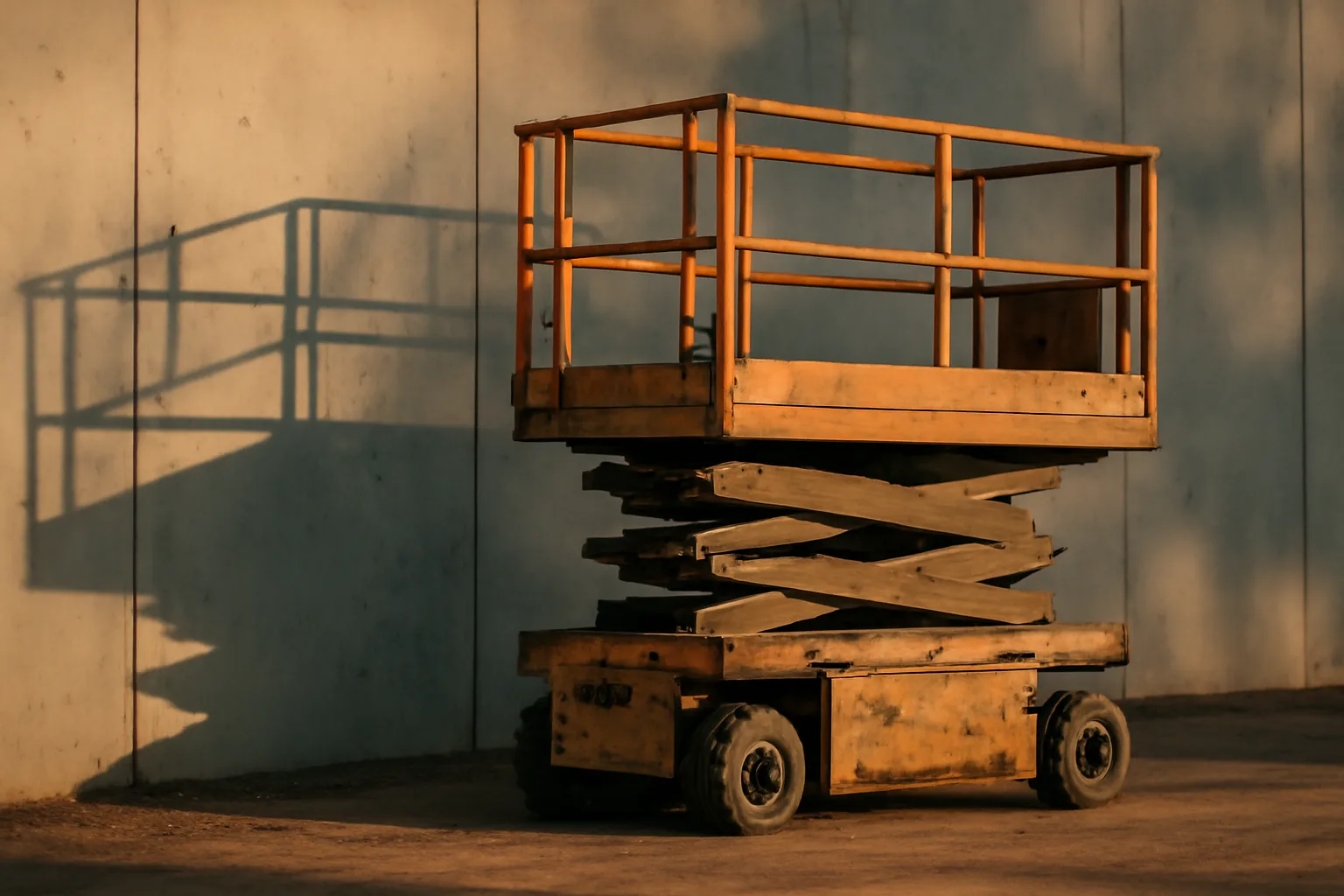
Scissor lift rental is the short-term hire of a self-propelled platform that goes straight up and down on stacked supports. You are renting a machine. You are not selling a crew, unless you add an operated-equipment line and take on that labor and insurance load.
Most contracts run by the day, the week, or a 4-week month. The customer signs, shows insurance, and either hooks up a trailer or pays you to deliver. Indoor finish work wants a narrow electric slab unit. Outdoor site work wants a rough-terrain unit with real tires and, often, a diesel engine.
People blur this with boom lift rental. A boom reaches out. A scissor lift does not. OSHA writes boom-type aerial lifts under 29 CFR 1926.453. [4] Many scissor lifts on construction sites sit under the scaffold rules in 29 CFR 1926 Subpart L, including the mobile scaffold paragraph at 1926.452(w). [1]
That split is not academic. Guardrails are the primary fall system on a scaffold-class scissor lift once the platform is more than 10 feet up. [2] Boom work is a harness conversation. Mix the two in your training packet and you will train people for the wrong machine.
Rental is a paper trade that happens to involve steel. The unit is the simple part. The hard part is the contract, the certificate of insurance, the delivery truck, and the 6 a.m. call that the batteries died. Once you take repeat money from the public, your state treats you as a business. File like one on day one.
How do you start scissor lift rental?
You start scissor lift rental by forming a state entity, getting a free IRS EIN, picking up the local business and sales-tax permits your city and state actually issue, placing insurance that names the units, and building a written training and inspection file before the first machine leaves. There is no federal scissor lift rental license.
Here is the order I would use.
Pick a structure first. Most small shops file an LLC so the units do not sit in a personal name. Confirm the form and the current filing fee with your secretary of state. Do not copy a fee off a blog. The SBA register-your-business guide is the straight federal overview of why state registration comes first. [8]
Get an EIN next. The IRS does not charge a fee to apply for an EIN online. [7] Banks and insurers will ask for it.
Then call your state revenue department and ask if rental of tangible personal property is taxable. In most states it is. You collect tax on the hire charge. You do not invent a rate.
Buy insurance before you take a deposit. General liability, an equipment floater, and commercial auto if you deliver. Workers' comp if you have employees. Limits and forms are state and carrier questions. For the certificate language jobsites actually demand, see what rental insurance papers jobsites ask for.
Write the contract and the daily inspection sheet. Then train your people. OSHA requires scaffold training for employees who work on the platform. [3] Your techs count.
You can start from a fenced lot and a one-ton truck. You cannot start from a handshake.
Do you need a federal license to rent scissor lifts?
No. The federal government does not issue a scissor lift rental license. You still need ordinary business paper, plus the safety file OSHA can request on a construction employer.
What people call a license is usually a stack: state entity, local business tax certificate, seller's permit or sales-tax account, and sometimes a contractor license if you also perform work. Rental alone is not contracting in most states. Confirm that line with your contractor board before you advertise that you install too.
If you operate commercial motor vehicles, federal motor carrier rules can apply. 49 CFR 383.5 treats a combination of 26,001 pounds or more, with a towed unit over 10,000 pounds, as a commercial motor vehicle. [9] That is a CDL fact, not a rental-license fact.
Diesel fleets can pick up engine and portable-equipment rules in some states. Those are environmental registrations, not a national rental card. Confirm with the state air board that has jurisdiction over your yard.
OSHA still expects a construction employer to initiate and maintain accident-prevention programs that meet Part 1926. [6] That is a duty, not a wallet card. Anyone selling a single federal rental permit is selling smoke.
What OSHA rules actually apply to scissor lifts?
On construction sites, OSHA scaffold rules are the ones that usually bind a scissor lift. 29 CFR 1926.451 sets general scaffold duties. 29 CFR 1926.452 adds rules for specific types, including mobile scaffolds. [1][2] Boom-type aerial lifts have their own section at 1926.453. [4]
OSHA 29 CFR 1926.451(g)(1) sets the scaffold fall trigger at 10 feet. The text says: "Each employee on a scaffold more than 10 feet (3.1 m) above a lower level shall be protected from falling to that lower level." [2]
Capacity is not a suggestion. 1926.451(a)(1) requires the scaffold and its parts to hold their own weight and at least 4 times the maximum intended load, with listed exceptions. [2] 1926.451(b)(2) also sets a general minimum platform width of 18 inches, with listed exceptions. [2] If a renter stacks drywall to the rails, that is your problem the moment your contract is sloppy.
Mobile scaffold rules at 1926.452(w) cover locking wheels, staying square, and when anyone may ride a moving unit. [1] Read that paragraph before you write a clause that says they can drive it raised. Many manufacturer manuals are stricter than OSHA. Follow the tighter rule.
General industry is messier. 29 CFR 1910.67 covers vehicle-mounted elevating and rotating work platforms. [5] It is not a clean one-to-one map onto every slab scissor lift in a warehouse. Do not pretend it is. If your customers are factories rather than builders, get a competent safety person to map the right Part 1910 duties. I would not guess from a forum post.
What training records do you have to keep?
You keep a file that shows each employee who works on a scaffold was trained by a qualified person on that type of scaffold and on how to control its hazards. OSHA writes that duty in 29 CFR 1926.454(a). [3]
The regulation says: "The employer shall have each employee who performs work while on a scaffold trained by a person qualified in the subject matter to recognize the hazards associated with the type of scaffold being used and to understand the procedures to control or minimize those hazards." [3]
That is an employer duty. It is not a laminated card from a big-box store. If you have no employees and you never step on the platform, the 1926.454 hook is thinner. The moment you hire a yard tech, it is not.
1926.454 also calls for retraining when the work changes or when you see someone has lost the plot. [3] Separate from the scaffold section, 1926.21(b)(2) tells a construction employer to instruct each employee in the recognition and avoidance of unsafe conditions. [12] I would retrain after any tip, any rail damage, and any new model you add.
ANSI/SAIA A92.24 is the syllabus most insurers recognize. It is not a substitute for OSHA. I would pay for that class for anyone you send to demonstrate a machine. I would skip a three-day offsite seminar in year one.
Keep sign-in sheets, the trainer's name, the model covered, and the date. Paper in a binder beats a memory.
What insurance do first-year rental shops buy?
First-year shops buy general liability, inland marine (an equipment floater) on the units, commercial auto if a truck moves machines, and workers' compensation once they have employees. There is no single federal limit. Jobsites invent their own.
A $1 million per occurrence liability policy is the common ask, not a law. Some general contractors want $2 million and they want to be additional insured on your policy, the renter's policy, or both. Read how additional insured wording gets used on lift jobs before you sign their exhibit.
The floater is what pays when a unit disappears or gets dropped off a trailer. Liability does not replace a crushed 32-ft electric. See inland marine versus general liability for a small fleet.
Renter insurance matters as much as yours. Make them send a certificate before the machine moves. Their auto policy on a pickup is not inland marine on your lift. Details live in renter-supplied certificates for scissor lift rental.
I would not cheap out on rented-equipment coverage to save a few hundred dollars in premium. I would cheap out on branded shirts and a reception desk.
Confirm required coverages with your state insurance regulator and with the carrier that will write a new rental risk. Some standard business policies quietly exclude equipment rented to others. Ask that question out loud.
How do you move and deliver machines without a CDL mess?
You deliver with the license that matches the actual truck and trailer weight, not the license you wish you had. Many 19-ft electrics ride on a light trailer behind a one-ton and stay under CDL thresholds. A loaded rough-terrain unit on a tag trailer often does not.
49 CFR 383.5 treats a combination of 26,001 pounds or more, inclusive of a towed unit over 10,000 pounds, as a commercial motor vehicle. [9] Weigh the truck, the trailer, and a representative machine. Do not guess from a brochure.
If you cross the CMV line, you pick up CDL, medical card, and possibly USDOT number duties. Confirm current forms with FMCSA and your state driver agency. I will not quote a processing time. Those change.
Commercial auto is a separate policy problem from yard liability. See delivery auto versus yard liability.
I would start with customer pickup on a ball hitch for the small electrics and add a proper rollback only when the math pays. A dump-trailer delivery is how people bend scissor stacks.
Tie-down points are on the machine for a reason. Use them. A strap across a rail is how rails fail and how claims start. If you never leave the yard, write the highway risk onto the customer so it is not a surprise.
What taxes and local paper hit a new rental yard?
A new yard usually needs a state entity filing, an EIN, a state sales-tax or seller's permit, and whatever local business tax certificate the city or county sells. Some places add a use-tax account on equipment you bought out of state.
The SBA tax ID guide is the federal map of why you often hold both a federal EIN and a state revenue number. [11] The IRS also explains when an EIN is required, including most entities with employees. [10]
Sales tax on rentals is a state question. Plenty of states tax the rental of tangible personal property. A few treat some short-term hires differently. I cannot give you a 50-state matrix that stays true. Call the revenue department and ask about short-term rental of equipment. Get the answer in writing.
Property tax on the fleet shows up after you own the units. Assessor rules differ. Budget for it so year two is not a shock.
Zoning is the sleeper. A residential driveway with two lifts and a gooseneck will draw a complaint. Confirm yard use with planning before you pour gravel.
I would spend a morning at the city counter and the state revenue site before I spent a morning on Marketplace. The machine is easy to buy. The permit is slow if you start late.
Electric slab or rough terrain for year one?
For year one I would buy electric slab units if my customers work indoors or on finished concrete. I would buy rough-terrain only if the phone is already ringing from framers and site-work crews. Mixing both on day one doubles parts, trailers, and excuses.
Electric slab units need chargers, a place to plug in, and a battery plan. They do not need diesel exhaust fluid. Rough-terrain units need fuel, more maintenance time, and sometimes state air-board paper. They also chew ramps.
| Need | Electric slab | Rough terrain |
|---|---|---|
| Typical floor | Finished concrete | Dirt or gravel |
| Power | Battery | Diesel or dual fuel |
| Delivery weight | Lower | Higher |
| Year-one headache | Dead batteries | Fuel and emissions paper |
Common working heights in small fleets are 19 ft, 26 ft, and 32 ft. Those are manufacturer marketing numbers, not OSHA classes. Match the platform height to the work, not to your ego.
I would start with two or three used 26-ft electrics from a dealer that will still sell parts, not with a single 40-ft trophy machine. Nobody has a clean national used-price index. Hours, batteries, and region swing auction results. Get three local quotes and walk away from a unit with mystery hour meters.
What first-year costs are real versus a waste of money?
Real first-year costs are the machines, insurance, a trailer or truck that is legal, a fence or yard, the entity and tax accounts, and enough cash to wait on slow-pay contractors. Training and inspection time is a cost even if you do it yourself.
Waste of money: a custom wrap on a 12-year-old 19-ft, a full dispatch suite, and a leased storefront on a highway when a fenced industrial lot would do. Also waste: buying every height class so you have it. Idle steel is a loan payment.
If you leave machines on jobs overnight, hour meters and a geofence stop more arguments than a second invoice clerk. ScissorPath sells a $179 one-time 2-6 Machine Telematics Kit for that narrow job. I would not spend more on yard software in month one.
I would fund a spare charger and a spare set of rails before I funded a brand film. Customers remember a dead machine. They do not remember your color grade.
Premiums and taxes move. Confirm current insurance quotes and filing fees with the carrier and the board. Anyone who publishes a single startup total for the whole country is guessing.
Keep six months of loan payments in cash if you finance. Rental is lumpy. January can be quiet. Your bank is not.
How do rental contracts and customer insurance work?
A usable contract names the unit, the serial, the rate, the rental period, who delivers, who insures, what damage means, and when overtime starts. It also says the renter will not remove guardrails or exceed the rated load.
Hold-harmless language is common. It is not magic. Your own liability policy still needs to allow rented-equipment operations. Pair the contract with the certificate process in renter-supplied certificates for scissor lift rental and the limit talk in what a $1 million policy actually covers.
I would not hand over a machine on a text message. I would not accept a photo of an expired certificate. Call the producer listed on the cert if the job is large.
Customer-owned pickup should transfer highway risk in writing. Your delivery should list site conditions. Soft ground and a stuck rough-terrain unit is a rescue invoice, not a free favor, if you wrote it that way.
Late fees only work if you invoice on time and you actually collect. Write a simple daily overtime rate. Then use it.
This is not legal advice. Have a lawyer in your state read the form once. That one-hour bill is cheaper than a homemade PDF you found on a forum.
What inspections and daily checks are required?
Do a documented pre-delivery check and teach the renter to do a daily check. Brakes, rails, gate, emergency stop, descent, tires or pothole guards, hydraulics, and the function of the level alarm if the unit has one.
OSHA's construction employer duties include initiating and maintaining programs that meet Part 1926. [6] Manufacturer annual inspections are in every serious manual I have read, and ANSI/SAIA A92.20 and A92.22 expect periodic inspection. Follow the manual even when a job is just one day.
1926.451 use rules bar overloaded or damaged scaffolds. [2] Tag out a bent rail. Do not rent it at a discount.
I would photograph the unit at every outbound and inbound. Four corners, platform, control box, serial plate. Phone photos in a dated album beat a debate about who cracked the pothole guard.
Keep service receipts with hours. Buyers and insurers both ask. So will you, two years later, when a pump dies.
If a customer calls with an alarm they cannot clear, stop the work over the phone. A stuck lift with someone on it is an emergency, not a billing event.
What should you confirm with your state board before you advertise?
Confirm entity filing fees, assumed-name rules, and good-standing questions with your secretary of state. Confirm sales-tax collection on equipment rental with your state revenue agency. Confirm yard zoning with the city or county planner. Confirm contractor-license borders with the contractor board if you also offer labor.
Confirm CDL and USDOT questions with your state driver agency and FMCSA if your truck and trailer can cross 26,001 pounds. [9] Confirm workers' comp with the state fund or the agency that regulates it once you hire.
I cannot give you a live fee, a quota, or a processing time that stays true. Those belong to the board that stamps the form. Ask them. Get a name and a date.
Walk the paper in that order. A start checklist lives at /start. ScissorPath is an independent publisher, not a law firm and not a service company.
Do not advertise that you are fully licensed nationally. That phrase is a myth. Advertise the models you actually own and the towns you can reach by dinner.
Frequently asked questions
What is scissor lift rental?
Scissor lift rental is short-term hire of a self-propelled vertical platform, usually by the day, week, or month. You rent the machine, not a construction crew. Indoor work uses electric slab units. Outdoor work uses rough-terrain units. It is a different product from boom lift rental because the platform does not reach out over an edge.
How do you start scissor lift rental?
Form a state entity, apply for a free IRS EIN, open the sales-tax and local business accounts your state and city actually require, buy liability and equipment insurance, and stand up OSHA training and inspection records. There is no national rental license. Confirm every fee with the board that issues the form. Buy machines after the paper, not before.
Is a scissor lift an aerial lift under OSHA?
Often no on construction sites. OSHA writes boom-type aerial lifts at 29 CFR 1926.453. Many scissor lifts fall under scaffold rules in 1926 Subpart L, including mobile scaffolds at 1926.452(w). General industry uses a different part and is less clean. Read the manual and the section that matches the site. Do not train boom procedures on a scissor lift.
Do customers need a license to run a rented scissor lift?
Federal OSHA does not issue an operator license for a scissor lift. The renter's employer still has to train employees who work on scaffolds under 1926.454. Some owners demand an ANSI/SAIA A92 card before the gate opens. Put a training warranty in your contract. Do not tell customers that a rental receipt is a license. It is not.
Can you start scissor lift rental with one used machine?
Yes. One clean used 26-ft electric and a legal trailer is a real start if the paper is done. It is a fragile start. One breakdown is a 100 percent outage. I would rather own two mid-hour units than one pretty flagship. Confirm title, serial, and charger condition before you wire the money.
Do you need a CDL to deliver a scissor lift?
Only if the truck, trailer, and load meet commercial motor vehicle thresholds. 49 CFR 383.5 uses 26,001 pounds for many combination vehicles when the towed unit is over 10,000 pounds. Weigh the real combination. A small electric on a light trailer may stay under. A loaded rough-terrain unit often does not. Confirm with your state driver agency.
Is rental income subject to sales tax?
In many states, yes, because you are renting tangible personal property. Some states treat certain terms or resale certificates differently. There is no honest national rate. Ask your state revenue department about short-term equipment rental and keep their answer. Charge what they tell you to charge. Do not copy a neighboring state's rule.
Do you need fall arrest on a scissor lift?
On many construction scissor lifts with proper guardrails, the scaffold standard uses those rails as fall protection above 10 feet under 1926.451(g)(1). Boom lifts are different. Manufacturer rules and owner site rules can still demand a harness. Follow the tighter of OSHA, the manual, and the site. Do not remove rails to get closer to the work.
How long does OSHA scaffold training last?
29 CFR 1926.454 does not print an expiration date like a driver's license. It does require retraining when the work, the equipment, or the employee's knowledge changes, and when you see hazards they no longer handle. I would refresh at least when you add a new model or after any incident. Keep the dated roster.
What insurance certificates do jobsites ask for?
Most want a certificate showing general liability, often $1 million per occurrence, plus additional insured status, and sometimes a waiver of subrogation. They may also want auto and workers' comp. Their exhibit is not a statute. Compare it to what your carrier will actually endorse. Ask before the machine is on a truck.
Can you run this from a farm or home lot?
Only if zoning and your insurer allow commercial equipment traffic. A quiet rural lot can work. A cul-de-sac will not, once trailers show up at dusk. Ask planning and ask the carrier about a home-based premises. I would get that yes in writing before I gravel a driveway.
Electric or diesel for a first fleet?
Pick the work you already know. Electric slab if the calls are warehouses and interiors. Diesel rough-terrain if the calls are dirt sites. I would not split the first three units across both families. Batteries and chargers are enough of a parts problem for year one.
What happens if a renter overloads the platform?
You can get a damaged stack, a tip, and an OSHA problem on the employing contractor. 1926.451(a)(1) expects a 4 times strength factor, not a 4 times abuse plan. Your contract should void misuse and bill repair. Photos at checkout are how you prove the rails were straight when it left.
Sources
- OSHA 29 CFR 1926.452 Additional requirements applicable to specific types of scaffolds: Mobile scaffolds, the category that covers many construction scissor lifts, are regulated at 1926.452(w)
- OSHA 29 CFR 1926.451 General requirements for scaffolds: Scaffolds must support their own weight plus 4 times the maximum intended load, platforms are generally at least 18 inches wide, and fall protection applies more than 10 feet above a lower level
- OSHA 29 CFR 1926.454 Training requirements: Employers must have each employee who works on a scaffold trained by a qualified person, and must retrain when warranted
- OSHA 29 CFR 1926.453 Aerial lifts: Boom-type aerial lifts are written under 1926.453, a different section from scaffold-class scissor lifts
- OSHA 29 CFR 1910.67 Vehicle-mounted elevating and rotating work platforms: General industry has a separate vehicle-mounted elevating work platform standard that does not map one-to-one onto every warehouse scissor lift
- OSHA 29 CFR 1926.20 General safety and health provisions: Construction employers must initiate and maintain programs necessary to comply with Part 1926
- IRS Apply for an Employer Identification Number (EIN) online: The IRS does not charge a fee to apply for an EIN online
- U.S. Small Business Administration Register your business: Businesses generally need to register with state or local government to operate legally
- 49 CFR 383.5 Definitions (commercial motor vehicle): A combination of 26,001 pounds or more that includes a towed unit over 10,000 pounds is a commercial motor vehicle
- U.S. Small Business Administration Get federal and state tax ID numbers: Businesses often need both a federal EIN and a state tax ID number
- OSHA 29 CFR 1926.21 Safety training and education: Construction employers must instruct each employee in the recognition and avoidance of unsafe conditions