Last updated 2026-08-19
TL;DR
Scissor lift rental is a local equipment business. You own or finance lifts and rent them by the day or week. No federal rental license exists. You file ordinary business paper and follow OSHA rules on the machines. Confirm every permit with your city and state board. Year one is registration and dispatch, not a national certificate.
What is scissor lift rental?
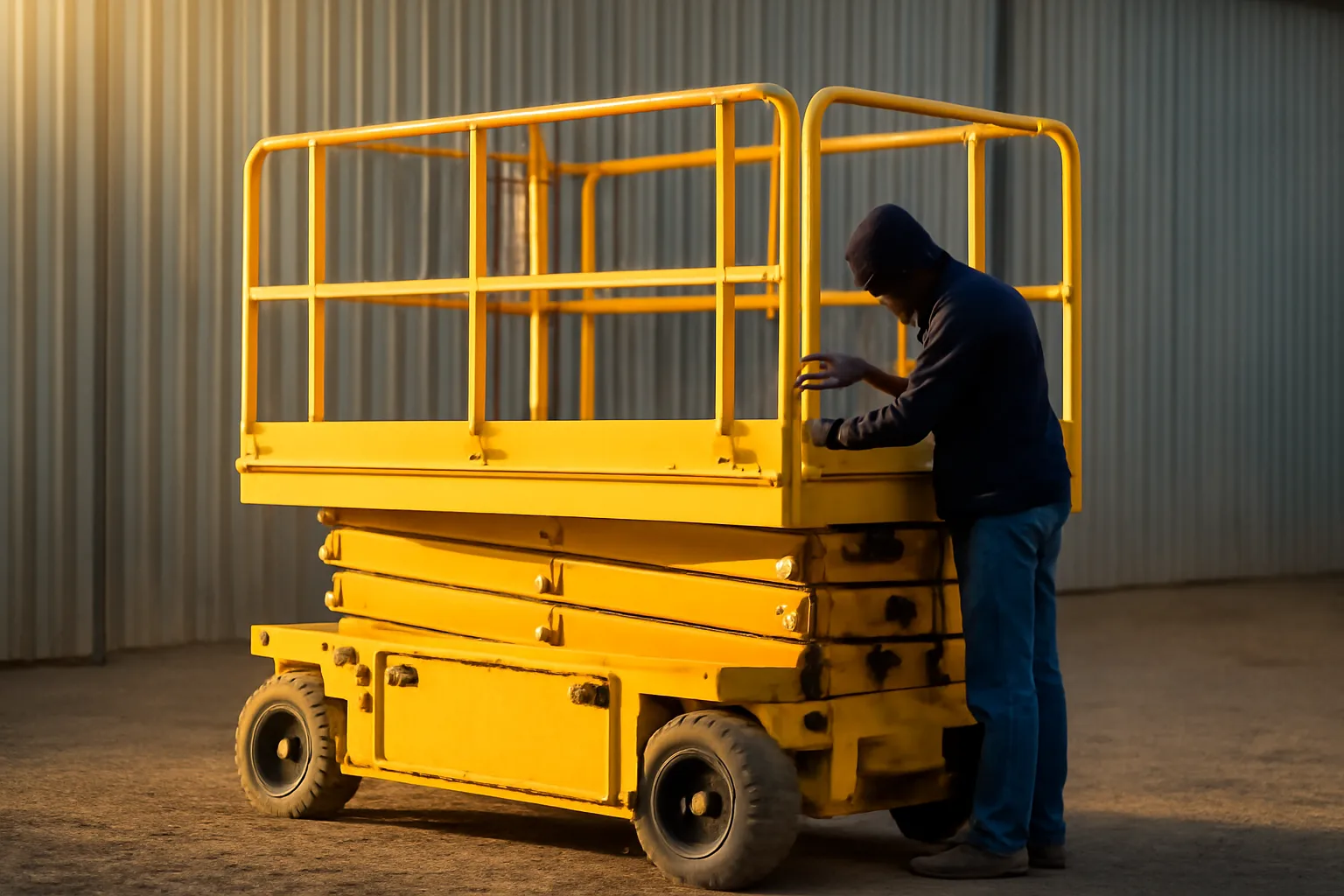
Scissor lift rental is a local equipment business. You own or finance scissor lifts and you rent them out for a set term. The platform rises straight up over the chassis. That is the product. You are not selling a federal ticket.
Most first yards keep electric slab units for warehouses and one rough-terrain diesel for dirt. Delivery is a separate line if you haul. Damage time and cleaning show up in the contract. None of that needs a national board to stamp you.
People treat this like a licensed trade. It is not. OSHA writes rules for how employers use equipment. It does not charter rental companies.[1] The customer still has to put a trained person on the platform. You still have to release a machine that works, with rails and manuals in place. Those duties stay split even when a salesman wants them blurred.
A scissor lift is not a boom lift. The deck stays over the base. Inspectors on construction sites often run these units under 29 CFR 1926 Subpart L scaffold rules, not only the aerial lift text in 1926.453.[1][3] Learn that split early. It changes how you talk about rails, gates, and harnesses.
If you are still choosing the work itself, scissor lift rental vs nearby career is the honest fork. Renting is inventory and dispatch. Operating on a job is a different paycheck.
Start with two to six machines, not a brochure fleet. Park them where a thief has to work. Keep serial numbers in a spreadsheet. National average rate posts are usually unsourced junk. Pull three local rate sheets in one afternoon and you will know your market better than any of them.
How do you start scissor lift rental?
You start by forming a legal entity, getting a free EIN from the IRS, and asking your city and state what they tax and license for equipment rental. Then you buy insured machines, write a rental contract, and set a yard process for inspection and delivery.[6][7]
That is the sequence I would actually use. Website last. Vinyl wrap last.
Step one is the entity. An LLC or a corporation is what most people file with the secretary of state. The IRS lists common structures and how they are taxed.[11] Confirm the current filing fee with your state. I will not quote a fee here because states change them.
Step two is the EIN. Do it on IRS.gov. Do not pay a random site.[6]
Step three is tax permits. Many states tax the rental of tangible personal property. That is a department of revenue question, not a Facebook group question. The SBA license page is blunt that requirements rest on what you do and where you do it.[7]
Step four is insurance and the first machines. Bind coverage before the first unit hits your lot. I cannot give you an honest national premium. Underwriters price yards by radius, driver record, and whether you deliver.
Step five is the operating file. Daily inspection sheets. Manufacturer manuals in the box. A training policy for your own people. A contract that names who operates and who insures what.
If you want a narrower walkthrough of early choices, scissor lift rental guide 12 sits next to this one. Do not wait for a fictional rental board to approve you. No such federal board exists. If a coach sells you a national certificate as the gate, walk away. Confirm every item with the agency that actually issues it.
Is there a national scissor lift rental license?
No. No U.S. federal license titled scissor lift rental exists.
OSHA regulates workplaces and equipment use. It does not charter rental companies.[10] The IRS wants tax IDs. FMCSA cares if you drive commercial vehicles. Your state wants entity filings and often a sales tax permit. Your city may want a general business license. None of those is a special lift rental card.
The myth survives because operator training cards (the ANSI and SAIA A92.24 style evaluations) get sold next to business-in-a-box pitches. An operator qualification is not a company license. Keep those papers in different folders.
Call the city clerk and the state department of revenue before you buy steel. Some cities add a second-hand dealer rule. Some ban home-occupation parking of machines at a house. That local call saves more money than any course.
Federal paper you may actually touch is ordinary. An EIN. Maybe a CDL if your truck and trailer cross the weight line in 49 CFR 383.5.[8] Maybe OSHA injury logs if your headcount leaves the small-employer band in 29 CFR 1904.1.[5] Short list. Real list.
Skip anyone who says the government will not let you rent a lift until you buy their packet. Ask them for the statute number. They will not have one.
What business paper do you actually file first?
File the entity, then the EIN, then tax permits, then local licenses. That order matches how banks and insurers underwrite you.
The IRS EIN page states, "Applying for an Employer Identification Number (EIN) is a free service offered by the Internal Revenue Service. Beware of websites on the Internet that charge for this free service."[6] Read that sentence to anyone who tries to bill you for an EIN.
Responsible party rules matter. The IRS requires the true principal to be named on the application.[6] Do not put a nominee on the form because a guru said to.
Sales tax on rentals is the item people miss. If your state taxes equipment rental, you collect it on the invoice and file on the state's calendar. Confirm the rate and the filing frequency with the revenue department. I will not invent either.
Hire anyone, and you add payroll accounts and workers' compensation as your state defines them. OSHA's routine injury log rules change once you leave the small-employer band. 29 CFR 1904.1 says if you had "ten (10) or fewer employees at all times during the last calendar year, you do not need to keep OSHA injury and illness records" unless you are told in writing to do so.[5] Construction work has extra wrinkles. Read the section. Do not assume you are exempt from reporting a severe injury.
| Paper | Issuer | What to confirm |
|---|---|---|
| Entity filing | State secretary of state | Current form and fee |
| EIN | IRS | Free application on IRS.gov |
| Sales or use tax permit | State revenue department | Whether equipment rental is taxable |
| Local business license | City or county clerk | Home-occupation and parking rules |
| CDL or medical card | State DMV | Weight of your real combination |
| Written safety program | You, against OSHA text | 1926.451, 1926.454, 1910.67 |
Confirm every row with the board that issues it. Fees move. Forms get renamed. A printed number in a blog is not a filing.
What OSHA rules apply to rented scissor lifts?
OSHA rules attach to employers and workplaces, not to a rental license. If your people maintain, deliver, or demonstrate lifts, you are an employer with duties. If the customer's people occupy the platform, that employer has duties too.
For construction, 29 CFR 1926.451 sets general scaffold requirements that inspectors often apply to scissor lifts as mobile scaffolds.[3] 29 CFR 1926.454 requires training. The text is plain: "The employer shall have each employee who performs work while on a scaffold trained by a person qualified in the subject matter to recognize the hazards associated with the type of scaffold being used and to understand the procedures to control or minimize those hazards."[2]
29 CFR 1926.453 is the aerial lift standard. It points at ANSI A92.2-1969 design language for vehicle-mounted devices and includes a belt and lanyard line for work from an aerial lift.[1] Boom lifts and scissor lifts are not the same argument. Do not copy a boom-lift fall-protection paragraph onto a scissor-lift handout without reading both standards.
General industry shops (plants, warehouses) also have 29 CFR 1910.67 for vehicle-mounted elevating and rotating work platforms.[4]
The OSH Act sits underneath all of it. Section 5(a)(1) says each employer shall furnish employment "free from recognized hazards that are causing or are likely to cause death or serious physical harm to his employees."[10] Your rental contract does not erase that. It can allocate who trains, who inspects daily, and who calls for service.
Keep a one-page map of which standard you think applies to which job type. Construction site. Warehouse. Your own shop. Hand that map to counsel before the first claim, not after.
Do renters or the yard train the operator?
The employer of the person on the platform is the one 1926.454 points at.[2] That is usually the renter, not you. You still should not hand keys to someone who is clearly unready. That is a lawsuit problem. It is also a general duty problem if your own people are on site.[10]
Here is what I would do: require a named operator on the contract, give the manual and the decals, walk the ground controls, and keep a delivery ticket that the receiver signed. I would not sell a 15-minute certification as if it replaced the renter's training duty. That product is how yards get pulled into claims.
ANSI and SAIA A92.22 (safe use) and A92.24 (training) are the industry documents larger rental firms write their programs against. They are copyrighted standards, not free OSHA text. Buy the current edition from SAIA if you are writing a real program. Confirm the year with SAIA. I will not pretend I can reprint them.
Employ drivers and techs, and you train them on load securement, battery charging, and the specific models you own. 29 CFR 1926.20 says the employer shall initiate programs needed to comply, and that only employees qualified by training or experience shall operate equipment and machinery.[12]
Keep renter education and employee training in separate files. Mix them and a wallet card becomes exhibit A.
What insurance and tax items hit in year one?
Expect commercial auto if you deliver, inland marine or scheduled equipment on the lifts, general liability, and workers' compensation if you have employees. Bind them before the first rental. I cannot honestly quote a national premium. Two yards ten miles apart get different numbers.
On tax, the EIN is free.[6] Income tax follows your entity.[11] Sales tax on the rental stream is state law. Property tax on the fleet is often local assessor law. Fuel and highway use taxes show up if you run heavier trucks.
Depreciation is the quiet first-year fact. IRS Publication 946 explains that you can depreciate machinery and equipment (not land).[9] Construction assets generally fall in the 5-year GDS class under MACRS. Confirm the asset class in Pub 946 Table B-1 before you file. Your CPA should read the table, not a tweet.
Do not buy a huge shop building in month one unless you already have the utilization. A rented fenced lot with cameras is enough for a first fleet. A 39-year recovery period on nonresidential real property is a long wait for basis to come back.[9]
Refundable deposits and damage waivers have tax and contract treatment that varies. Confirm with your CPA and your state. I have no clean national rule to give you.
Finance the units, and the lender will UCC-file. That is normal. Do not advertise a machine as free and clear when it is not.
Do you need a CDL to haul scissor lifts?
Sometimes. It depends on weights, not on the word scissor.
49 CFR 383.5 defines a commercial motor vehicle to include a combination with a gross combination weight rating or gross combination weight of 26,001 pounds or more, inclusive of a towed unit with a GVWR or GVW over 10,000 pounds.[8] A single vehicle at 26,001 pounds GVWR can also be a CMV.
A compact electric scissor on a light trailer behind a one-ton may stay under. A rough-terrain machine on a tag trailer behind a dump truck often does not. Weigh the combination. Use the door-sticker GVWRs. Do not guess.
State DMVs issue CDLs under federal minimum standards. Confirm class and endorsements with your state. Stay under the threshold, and you may still need a medical card or a non-CDL state class. Ask the DMV, not a forum.
Never deliver, and this whole section shrinks. Many tiny yards are pickup only. That is a valid way to start. You lose some customers. You also lose a stack of auto claims.
More on hauling choices sits in scissor lift rental guide 18. I would rather lose a delivery fee than fake a weight ticket.
What do first-year operations actually look like?
First-year operations are dispatch, inspection, charging or fuel, and collections. That is the job. Marketing is a smaller slice than people want.
Every outbound machine needs a documented pre-delivery check. Functions. Leaks. Rails. Gate. Decals. Tires or pothole protection. The manual in the box. Every return needs the same plus a damage sheet. Keep the paper for the life of the claim window in your contract.
Batteries die because renters leave the machine on. Diesel units come back with water in the fuel if they sat. Budget technician time. If you cannot turn a wrench, pay someone who can before you buy the fourth machine.
Hours and location matter once you have more than a couple units. A cheap GPS and hour meter kit stops the it-only-ran-two-days argument. ScissorPath sells a $179 one-time 2-6 Machine Telematics Kit if you want that on a small fleet. You can also buy trackers elsewhere. The point is the hour meter, not the logo.
Utilization is the number that decides if you eat. Nobody has a good public dataset for a two-machine backyard yard. Trade association surveys exist for large rental houses and they do not describe you. Track your own days out.
Compare process notes with scissor lift rental guide 24 if you are still choosing a first mix of slab versus rough terrain. Start boring. Boring yards stay open.
How should you price and track a small fleet?
Price from local competitors and from your real cost per available day, not from a national blog. Pull the rate card of the nearest national branch and the nearest independent. Sit between them only if your delivery and uptime deserve it.
Cost per available day is purchase (or lease), interest, insurance, storage, maintenance, and the days the machine actually can go out. A machine in the shop is not inventory. It is a hole.
Do not discount month one to chase reviews. You will attract the renter who beats machines. Require a card on file. Charge a reasonable security hold if your processor and state law allow it. Confirm card surcharge rules with your state and your processor.
Write late fees and cleaning fees in the contract before the first outing. After-the-fact fees start fights.
For more pricing texture, scissor lift rental guide 36 is the next stop. Keep your own spreadsheet either way.
Do not build a 40-page rate book in month one. Day rate, week rate, month rate, delivery by zone, and a damage matrix is enough. Add height classes when a paying customer repeats the ask.
What paper should stay in the machine and the file?
In the machine: the manufacturer operator manual, current decals, a blank daily inspection card, and your after-hours number. If the manual is missing, reprint it from the OEM. A lift with no manual is a gift to a plaintiff's lawyer.
In the file: bill of sale, serial numbers, hour readings at purchase, insurance schedule, maintenance log, rental contract, delivery ticket, and photos at out and in. Keep the training records for your own employees under 1926.454 and 1926.20.[2][12]
Finance the fleet, and the lender will UCC-file on the units. That is normal. Do not sell a machine that still has a lien without paying it off.
Keep a one-page note naming the competent person for your shop. 1926.451 expects scaffold work (including a lot of scissor lift use) to happen under a competent person.[3] For your techs, write the names down.
Local fire rules can apply to indoor charging and to diesel or LP storage. Confirm with the fire marshal if you charge a row of electric units in a metal building. That call is free.
A longer document checklist lives in scissor lift rental guide 48. Paper you can find beats paper you meant to print.
What is a waste of money in year one?
A waste of money is a national license package, a wrap on a truck you do not own, and a third machine before the first two show paid days.
Paying a website to file your EIN is also a waste. The IRS does that at no charge.[6]
Buying every height class on day one is a waste. A 19-foot electric and a 26-foot electric cover a brutal share of indoor calls. Add rough terrain when a real customer asks twice.
Training theater is a waste if you are selling wallet cards to renters as if OSHA issued them. Keep training honest and tied to the standard.[2]
Fancy yard software can wait. A shared inbox, a calendar, and serialized inspection PDFs will run a six-machine book. Upgrade when the calendar breaks.
If you want a side-by-side of early spend choices, scissor lift rental guide 60 is useful. For a career fork, stay with scissor lift rental vs nearby career.
ScissorPath is an independent publisher, not a law firm and not a service company. The start page is at /start. Confirm every fee and form with the board that issues it. Nobody here can approve you, and nobody should promise a processing time.
Frequently asked questions
What is scissor lift rental?
It is a local business that owns scissor lifts and rents them for a set term. You are renting a machine whose platform rises straight up over the chassis. You are not selling a federal license. The renter's employer still has to train the person on the platform, and you still have to hand over a fit machine with its manual and guards.
How do you start scissor lift rental?
Form an entity with your secretary of state, get a free EIN on IRS.gov, then ask your city and state revenue office what they license and tax for equipment rental. Bind insurance before the first unit arrives. Write a contract, an inspection sheet, and a delivery ticket. Confirm every fee with the issuing board. There is no national rental card to wait on.
Do I need a special federal license to rent scissor lifts?
No. No federal scissor lift rental license exists. OSHA regulates workplace use of the equipment. The IRS wants a tax ID. Your state and city handle entity filings, tax permits, and local business licenses. Operator training cards are not a company charter. Ask any seller of a national certificate for the statute number.
How much does an EIN cost for a new rental yard?
Zero dollars if you apply with the IRS. The IRS says applying for an EIN is a free service and warns that websites charge for that free filing. Use IRS.gov or Form SS-4. Confirm you are naming the true responsible party. Do not pay a third-party site to type the same form.
Who has to train the person who operates the rented lift?
29 CFR 1926.454 points at the employer of the person on the scaffold or lift, which is usually the renter. You should still refuse a clearly unready operator and document the handoff. Do not sell a short wallet-card class as if it replaced the renter's duty. Train your own drivers and techs under 1926.20.
Are scissor lifts treated as aerial lifts or as scaffolds?
Both texts can show up. 29 CFR 1926.453 is the aerial lift standard and leans on older ANSI A92.2 language. Many construction inspections treat scissor lifts as mobile scaffolds under 1926.451 and 1926.454. General industry also has 1910.67. Read the job, then pick the standard. Do not copy boom-lift harness rules blindly.
Do I need a CDL to deliver a scissor lift?
Only if your truck, trailer, and load meet the commercial motor vehicle definition in 49 CFR 383.5. A common tripwire is a combination at 26,001 pounds GCWR with a towed unit over 10,000 pounds. Weigh the real combination and ask your state DMV. Pickup-only yards can skip this until they start hauling.
What insurance should a first-year yard carry?
Plan on general liability, scheduled equipment or inland marine on the lifts, commercial auto if you deliver, and workers' compensation if you have employees. Bind coverage before the first rental. I will not invent a national premium. Two yards in the same county get different numbers. Ask an agent who already writes equipment rental.
Can I run scissor lift rental from my house?
Sometimes, if zoning and the lease allow outdoor storage and customer pickup. Many cities ban home-occupation parking of commercial machines or limit second-hand dealer activity. Call the clerk and the zoning office before you buy steel. A rented fenced lot is often cleaner than fighting a neighbor complaint in month two.
How many machines should I start with?
Two to six is a real start. A 19-foot electric and a 26-foot electric cover a lot of indoor calls. Add rough terrain when a paying customer repeats the ask. A third machine before the first two show paid days is how people run out of cash. Track days out yourself. Public utilization surveys describe big houses, not you.
Is sales tax due on scissor lift rental charges?
Often yes, because many states tax the rental of tangible personal property. Some exempt resale or certain job types. Filing frequency and the rate are state questions. Confirm with your department of revenue before you send the first invoice. Do not copy another state's rule from a forum post.
How long can I depreciate a scissor lift?
IRS Publication 946 lets you depreciate machinery and equipment (not land). Construction assets generally sit in the 5-year GDS class under MACRS. Confirm the asset class in Table B-1 with your CPA before you file. A shop building, if you buy one, is a much longer recovery period (commonly 39 years for nonresidential real property).
Do I need OSHA 300 logs in year one?
29 CFR 1904.1 gives a partial exemption if you had 10 or fewer employees at all times last calendar year, unless OSHA or BLS tells you in writing to keep records. Severe-injury reporting can still apply. Construction has extra wrinkles. Read 1904 and confirm with counsel. Headcount is a real threshold, not a vibe.
What should stay in the scissor lift when it leaves the yard?
The OEM operator manual, readable decals, a blank daily inspection card, and your after-hours number. Photograph the machine at outbound and inbound. Keep the signed delivery ticket in the file with the contract. A missing manual is a preventable claim problem. Reprint it from the manufacturer if the box is empty.
Sources
- OSHA 29 CFR 1926.453 Aerial lifts: Aerial-lift design text references ANSI A92.2-1969 and includes belt and lanyard language for work from an aerial lift.
- OSHA 29 CFR 1926.454 Training requirements: The employer must have each employee who works on a scaffold trained by a qualified person to recognize and control those hazards.
- OSHA 29 CFR 1926.451 General requirements for scaffolds: Subpart L general scaffold rules (including competent-person expectations) are the construction text inspectors often apply to scissor lifts.
- OSHA 29 CFR 1910.67 Vehicle-mounted elevating and rotating work platforms: General industry has a separate standard for vehicle-mounted elevating work platforms.
- OSHA 29 CFR 1904.1 Partial exemption for employers with 10 or fewer employees: Employers with 10 or fewer employees at all times in the last calendar year generally need not keep routine OSHA injury and illness records unless told in writing.
- IRS Apply for an Employer Identification Number (EIN) online: Applying for an EIN is a free IRS service; the true responsible party must be named.
- 49 CFR 383.5 Definitions (FMCSA / eCFR): A CMV includes a combination at 26,001 pounds GCWR or more when the towed unit is over 10,000 pounds GVWR or GVW.
- IRS Publication 946, How To Depreciate Property: Most tangible machinery and equipment (not land) can be depreciated; MACRS GDS classes include 5-year property and 39-year nonresidential real property.
- Occupational Safety and Health Act, Section 5 Duties: Section 5(a)(1) requires each employer to furnish employment free from recognized hazards likely to cause death or serious physical harm.
- IRS Business structures: The IRS describes how sole proprietorships, partnerships, corporations, and LLCs are taxed.
- OSHA 29 CFR 1926.20 General safety and health provisions: Employers must initiate programs needed to comply, and only employees qualified by training or experience may operate equipment and machinery.