Last updated 2026-08-19
TL;DR
Scissor lift rental is a local equipment business. You buy slab or rough-terrain machines and lease them by the day, week, or month. No federal rental license exists. Form an entity, get a free IRS EIN, collect sales tax if your state taxes rentals, buy insurance, and run the fleet under OSHA 29 CFR 1926.451, 1926.452, and 1926.454. Inspections and user training are the paper that matters.
What is scissor lift rental?
Scissor lift rental is the short-term lease of vertical work platforms you own and a contractor uses on a job. You charge by the day, week, or month. You never sell the machine. No federal rental license exists. Local tax, insurance, and OSHA construction rules are the whole path.
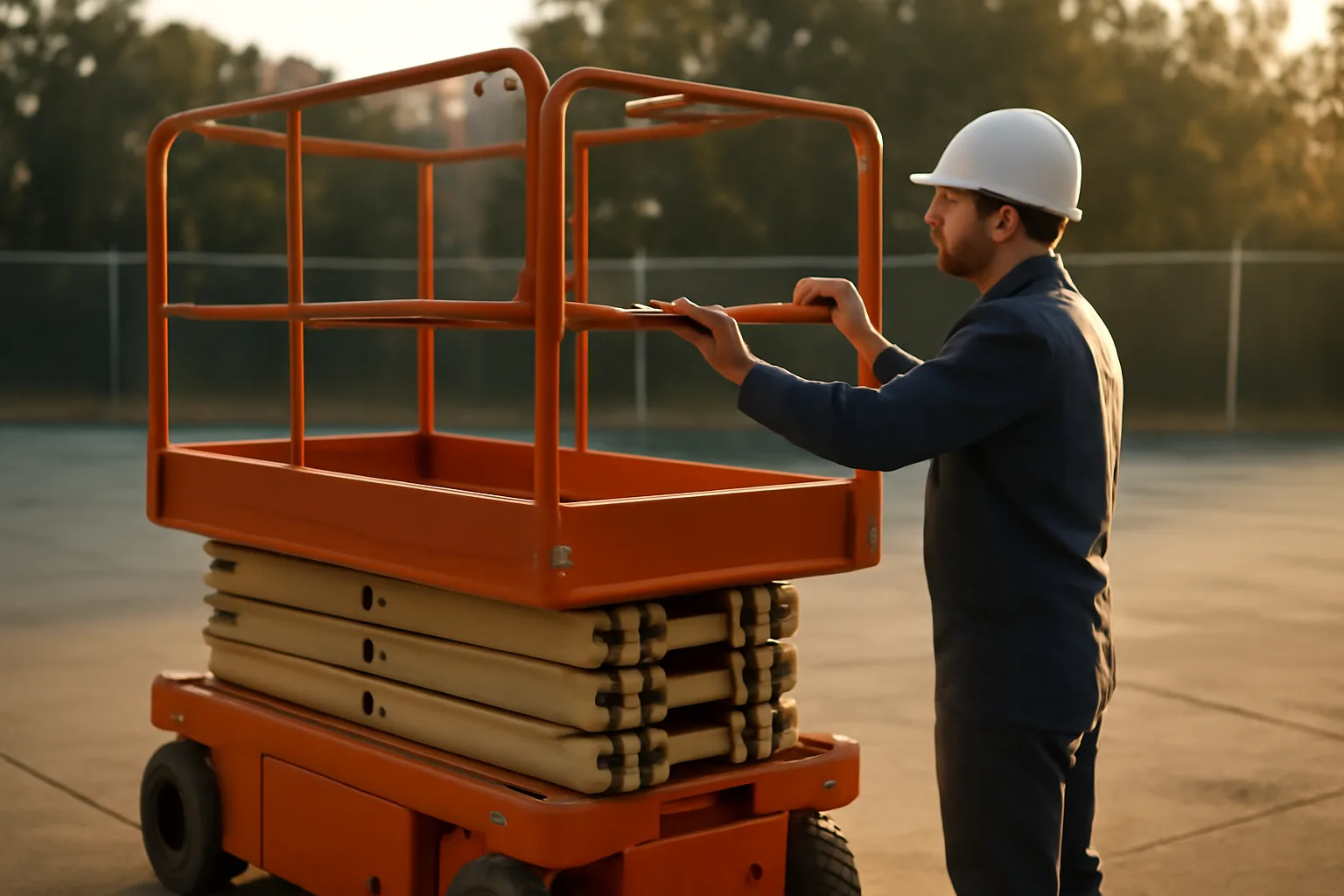
The machine class is simple. Indoor slab lifts are electric, narrow, and live on warehouse floors and finished interiors. Rough-terrain lifts are wider, often diesel or dual fuel, and sit on packed dirt. Both raise a platform straight up. Neither is a boom lift.
That last point is not trivia. OSHA construction rules treat most scissor lifts as mobile supported scaffolds under 29 CFR 1926.451 and 1926.452, not as the aerial lifts listed in 1926.453. [1][2][4] Your jobsite paper follows scaffold training and fall rules, not boom-lift folklore.
You make money on time out, delivery, fuel or charge fees, and sometimes a damage waiver. You lose money on idle iron, unpaid damage, and transport. Utilization is local. A 19-foot electric in a downtown rehab market does not behave like a 40-foot rough-terrain unit in a suburb that just approved three tilt-ups.
People talk about this like it is a franchise kit. It is not. You are a lessor of tangible personal property. New York generally taxes that rental. [12] Florida Statute 212.05 also taxes the lease or rental of tangible personal property. [13] Other states differ. Confirm the tax treatment with the department of revenue that will audit you.
Do not call this passive. Someone has to deliver, inspect, wash, and chase overdue returns. If you cannot do that work or pay for it, do not buy the second machine.
How do you start scissor lift rental?
You start scissor lift rental by forming a business, getting a free IRS EIN, registering where your city or state requires it, binding insurance, writing a rental contract, and putting one or two machines to work under OSHA scaffold rules. That is the whole path. No national rental board hands out a ticket to operate.
The U.S. Small Business Administration lays out the ordinary sequence: structure, EIN, licenses, bank account, then launch. [6] Use it. Do not wait for a special lift rental permit that most states never issue.
Pick an entity your accountant can live with. A single-member LLC is common. It protects nothing if you personally drive the truck and skip insurance. Get the EIN online. The IRS does not charge a fee to apply for an EIN on the online EIN assistant. [5]
Then the local paper. City business tax certificates, county personal property listings on the fleet, and a seller's permit or sales tax ID if your state taxes rentals. Those names change by state. Confirm forms and current fees with the issuing board. I will not invent a processing time.
Buy insurance before the first pickup. You want commercial general liability, an inland marine or equipment floater on the fleet, commercial auto if you deliver, and workers' compensation the day you have an employee.
Write the contract before the first handshake. Name the renter, the machine serial, the rate, the delivery terms, who provides a qualified operator, damage responsibility, and what happens if they keep it an extra week. Then do a written pre-delivery inspection. That packet is your first-year operating system.
If I were starting Monday, I would file entity and EIN this week, call a broker who already writes equipment rental, and buy used iron only after two real customer conversations. Buying a trailer because a forum said so is how you fund a storage problem.
Do you need a license to rent out scissor lifts?
You do not need a federal scissor lift rental license. Most states also skip a special rental-operator ticket for this equipment class. What you do need is ordinary business registration, tax IDs where rentals are taxable, and transport credentials if your truck and trailer cross the CDL or USDOT thresholds.
The national myth is a laminated card from a made-up board. Ignore it. The SBA business guide is about entity choice, EIN, and local registration, not a secret lift license. [6]
California is the exception people usually mean when they say the state makes you do extra. Cal/OSHA Title 8 section 3648 sets operating rules for aerial devices and elevating work platforms. Confirm the exact article that matches your machine with Cal/OSHA before you write a California yard procedure. [11] Other states may fold the same duties into general state-plan rules.
Operator qualification is not your municipal license. It is an employer duty under 29 CFR 1926.454 for people who work on the scaffold. [3] You can refuse to hand keys to someone who cannot show training. That is a contract choice, not a city permit.
Here is the paper map I actually use when someone asks what license I need.
| Paper | What the law actually does | Common myth |
|---|---|---|
| Federal rental license | None for this business type | A national lift ticket |
| IRS EIN | Free online application [5] | A paid federal rental ID |
| Local business tax certificate | City or county, if they tax businesses | Proof you may rent lifts |
| Sales tax permit | Required where the state taxes rentals [12][13] | Optional if you only rent to contractors |
| CDL | Triggered by vehicle GVWR, not by the lift brand [14] | Every delivery needs Class A |
| OSHA 300 log | Partial small-employer exemption in 29 CFR 1904.1 [15] | Every one-person shop keeps a wall log |
Confirm each row with the board that collects the form. Fees move. I will not print a number I cannot source.
What OSHA rules actually apply to scissor lifts?
On construction sites, scissor lifts generally follow OSHA scaffold rules in 29 CFR 1926.451, the mobile-scaffold extras in 1926.452, and the training rule in 1926.454. They are not the boom-style aerial lifts that 1926.453 names. [1][2][3][4] Read the manufacturer manual anyway. The manual is how you prove you knew the wind, slope, and load limits.
29 CFR 1926.451(g)(1) requires fall protection on a scaffold more than 10 feet above a lower level. [1] The rule reads: "Each employee on a scaffold more than 10 feet (3.1 m) above a lower level shall be protected from falling to that lower level." Guardrails on a compliant scissor lift are the usual method. A harness tied to the wrong point is not a personality quirk. It is a problem.
Supported scaffolds with a height to base width ratio of more than four to one must be restrained from tipping. [1] Each scaffold and component must support its own weight and at least 4 times the maximum intended load. [1] Those two numbers surface in every argument after a tip-over. Learn them before you argue.
Mobile-scaffold language in 1926.452 is the piece rental yards skip. Wheels lock. The unit is not a personnel carrier unless the listed riding conditions exist. Employees do not climb the rails. [2] Put those points in your checkout sheet in plain English.
General industry is messier. 29 CFR 1910.67 covers vehicle-mounted elevating and rotating work platforms. [7] A push-around warehouse scissor is not that machine. A truck-mounted platform might be. If your customer is a plant, not a GC, note it in the file and follow the standard that actually fits.
I treat ANSI/SAIA A92.20, A92.22, and A92.24 as the industry safe-use and training practice. I am not going to pretend I can quote a paywalled ANSI text here. If you rent into plants that specify A92, buy the standard and write your familiarization checklist to it.
Who is responsible for operator training, you or the renter?
The employer of the person on the platform is responsible for scaffold training under 29 CFR 1926.454. That is usually the renter, not the rental yard. You still document familiarization on your specific model. Refusing to release a machine to an untrained user is good risk control, not a substitute for their employer's duty. [3]
The training rule is blunt. "The employer shall have each employee who performs work while on a scaffold trained by a person qualified in the subject matter to recognize the hazards associated with the type of scaffold being used and to understand the procedures to control or minimize those hazards." That sentence is 29 CFR 1926.454(a). [3]
Your yard speech is not that training. A 12-minute walkaround covers emergency lowering, slope limits, indoor versus outdoor wind, and where not to clip a lanyard. Keep a signed sheet with the serial number and the date. If you offer a longer class, price it. Do not give away a four-hour course to feel helpful.
Do not sell OSHA certification. OSHA does not license scissor operators the way some people sell cards out of a folding table. You can document that you explained this machine. Their employer still owns the 1926.454 file.
If you put your own employee on a lift to demo or repair, that person is now the employee on the scaffold. Train them. Write it down.
What insurance do first-year rental fleets actually buy?
A first-year scissor lift rental fleet needs commercial general liability, an equipment floater or inland marine policy on the machines, commercial auto if you deliver, and workers' compensation once you have employees. Skip the cheap certificate that only names a pickup truck. The lift is the asset. The jobsite is the lawsuit.
I will not invent a premium. Brokers price this on values, radius, theft controls, and your loss history. Ask for rental-yard endorsements in writing. Ask who pays when a renter leaves a unit in the rain with the deck up. Then read the form.
Damage waivers are not insurance. They are a contract term. Some policies restrict how you sell them. Get that answer before you print a waiver checkbox on the ticket.
Certificates of insurance from renters matter if you require them. Many small painters carry no additional-insured wording that actually reaches you. Decide your minimum in advance. Do not invent it at the tailgate.
The companion pieces on scissor lift rental guide 11 and scissor lift rental guide 17 walk the forms in more detail. For additional-insured fights and renter certificates, use scissor lift rental guide 23. None of those pages replace a licensed broker in your state.
Do you need a CDL or USDOT number to deliver lifts?
You need a CDL when the truck, or the truck and trailer combination, meets federal class thresholds. 49 CFR 383.91 sets the Class B CDL trigger at a GVWR of 26,001 pounds or more for a single vehicle. [14] A light pickup and a small trailer under that combined rating can stay non-CDL. A loaded gooseneck with a rough-terrain unit often cannot. Weigh it. Read the door sticker. Guessing is how people collect tickets.
FMCSA explains CDL classes on its commercial driver license page. [9] Class A is for heavier combinations. Class B is the single heavy vehicle most delivery trucks hit first. Hazardous materials endorsements are a different problem and usually not your scissor-lift day.
A USDOT number is a registration question, not a skill card. FMCSA's guidance on whether you need a USDOT number is the document to read if you cross state lines or otherwise meet the commercial motor vehicle tests. [8] Intrastate-only fleets still face state DOT rules. Confirm with your state carrier desk. I will not invent their fee.
My bias: keep year-one deliveries inside a non-CDL combination if the machines allow it. Pay a towing outfit for the one ugly rough-terrain move. Buying a dump truck on day one to look like a rental company is a waste.
What first-year records should you keep?
Keep a jacket for every rental: signed contract, renter ID, pre-delivery inspection, hour-meter reading, photos of all four sides and the platform, familiarization sheet, and the return inspection. Keep maintenance logs by serial number. Keep tax filings and the insurance policy. That stack wins arguments. Memory does not.
If you have employees, learn 29 CFR 1904. 29 CFR 1904.1 says a company with ten or fewer employees at all times during the last calendar year does not need to keep routine OSHA injury and illness records unless OSHA or BLS tells you in writing to keep them. [15] That is not permission to hide a hospital visit. It is a recordkeeping exemption. Confirm you actually stayed under the headcount.
Inspection paper should match the manual. Daily user checks are the renter's job once the unit is on site. Your job is the handoff and the return. If a limit switch is taped over, you own that the moment you roll it off the trailer again.
Hour meters lie when they are broken. I like a second source of hours. A clipboard works. A cheap GPS puck works. If you want hour meters and geofence alerts without a monthly stack of software seats, ScissorPath sells a $179 one-time 2-6 Machine Telematics Kit that is enough for a tiny fleet.
Keep the photos. A cracked rail that was already cracked is a $0 argument when you have the outbound picture. It is a miserable argument when you do not.
How should you pick the first machines?
Pick the first machines from conversations with real customers, not from a brochure height chart. For most new indoor-trade yards I would start with two electric slab units in the 19 to 26 foot class. They fit vans, they charge on a normal circuit, and painters actually call for them. A brand-new 40-foot rough-terrain as your only asset is a storage bill with a diesel tank.
I will not print a fake average purchase price. Dealer inventory and auction results move. Confirm asking prices on units you can see in person. Pay for a third-party inspection on anything with scissor-stack wear, porous welds, or a control box full of silicone.
Service access matters more than paint. If the only mechanic who will touch that brand sits three counties away, you do not have a fleet. You have a weekend hobby. Stick to common platforms your local shop already stocks parts for.
Indoor electric versus outdoor diesel is also an air question. Diesel or dual-fuel indoors is how you earn a complaint and a sick painter. If a customer swears the warehouse is vented, put the restriction in the contract anyway.
Do not buy attachments you cannot inspect. Pipe racks and panel cradles change load and wind behavior. If you cannot explain the new capacity plate, do not rent the accessory.
Do you charge and remit sales tax on rentals?
Many states tax the rental of tangible personal property, which is what a scissor lift is. New York's tax bulletin on rentals of tangible personal property is the clean example of that rule set. [12] Florida Statute 212.05 taxes the lease or rental of tangible personal property. [13] Your state may exempt resale, exempt some contractors, or tax the delivery separately. Confirm with the revenue department before you print "tax included."
Charging tax and remitting tax are two different jobs. If you collect it, you need the permit and the filing cadence that board uses. I will not invent that cadence.
Out-of-state deliveries create nexus questions I am not going to fake my way through. If you start hauling into a second state, call a state-and-local tax person. A forum thread is not a ruling.
Put the tax line on the contract even when the amount is zero because of an exemption certificate. Keep the certificate. Auditors like paper more than stories about a GC who never pays tax.
What does a clean rental contract need to say?
A clean rental contract names the parties, the machine (make, model, serial), the rate and the clock (day, week, month, and when overtime starts), delivery and pickup, who supplies a qualified operator, site conditions you will not accept, damage and cleaning, late return, and where disputes get filed. Short is fine. Vague is not.
Say that the renter's employer is responsible for 1926.454 training and for site hazard control. [3] Say that your walkaround is familiarization on that serial number, not a license. Say they will not use the lift in wind, on bad ground, or near power lines outside the manual.
Damage language should separate wear from abuse. Tire cuts, crushed rails, burned control boards, and paint overspray are abuse in my book. Worn brushes are wear. Take photos so you are not debating that from memory.
If you sell a damage waiver, define what it does not cover. Theft without a police report, missing chargers, and overload damage are the usual holes. Pair that clause with the policy notes in scissor lift rental guide 29 so you do not waive something your insurer still expects you to chase.
Do not copy a national chain's 18-page form and hope. Their form matches their insurance. Yours needs to match yours. A local construction lawyer who has seen equipment tickets is worth more than a template marketplace.
What first-year costs are real versus wasted money?
Real first-year costs are the machines, insurance, transport, a wash-and-charge setup, tax deposits, and enough cash to survive a slow month. Wasted money is a wrap on a trailer nobody needs to see, a dealer-branded apparel order, and a brand-new high-reach unit you cannot book.
Depreciation is real even when cash is not leaving the account. IRS Publication 946 is the document for how to depreciate property, including the methods and recovery periods the Code allows. [10] Confirm the current year Section 179 and bonus rules in that publication. Those caps change. I will not freeze a year-old limit in this paragraph.
A second wasted item is software you will not open. You need a calendar, invoices, and inspection sheets. You do not need a 40-user dispatch platform for two machines. On theft and hours, start small and only add tools you check every week.
Insurance shopping is not wasted if you actually compare forms. Price-only shopping is. Read scissor lift rental guide 35 and scissor lift rental guide 41 before you bind the cheap quote that excludes rented equipment two counties away.
Want a structured next step after this reference? Start at /start. ScissorPath is an independent publisher, not a law firm and not a rental company. Confirm variable fees with the board that actually collects them.
Frequently asked questions
What is scissor lift rental?
It is the short-term lease of vertical work platforms you own. Customers pay by the day, week, or month and usually supply the operator. You are a lessor of equipment, not a contractor on their job. No federal rental license defines the trade. Tax, insurance, and OSHA scaffold rules do.
How do you start scissor lift rental?
Form an entity, get a free IRS EIN, register locally, bind liability and equipment insurance, write a contract, and put one or two common machines to work. Follow the SBA launch sequence for ordinary paper. Confirm city tax certificates and sales tax permits with the boards that issue them. Do not wait on a national lift license.
Is there a national scissor lift rental license?
No. The United States does not issue a federal license to rent scissor lifts. You still need ordinary business registration, tax IDs where rentals are taxable, and transport credentials if your truck meets CDL or USDOT tests. Operator training sits on the employer of the person on the platform under 29 CFR 1926.454.
Are scissor lifts regulated as aerial lifts or scaffolds?
On construction sites, OSHA treats most scissor lifts as mobile supported scaffolds under 29 CFR 1926.451 and 1926.452, with training in 1926.454. 29 CFR 1926.453 names boom-style aerial lifts. General industry 1910.67 covers vehicle-mounted platforms. Match the standard to the site and the machine, and still follow the manual.
Can I start scissor lift rental with one machine?
Yes. One common electric slab unit is a cleaner start than a lonely high-reach diesel. You still need the same entity, EIN, insurance, and contract. The risk is downtime. When that one machine is in the shop, revenue is zero. I would add a second similar unit before I stretched into a new height class.
Do I need a yard, or can I start from a driveway?
A legal driveway or leased bay can work if zoning and neighbors allow stored equipment and a trailer. Confirm zoning with the city. Theft and jump-starts are worse on a street. I would not build a fenced yard until utilization pays for it. I also would not block a fire lane and call it a business plan.
Who inspects the lift before each rental?
You inspect it before it leaves and when it comes back. The user checks it daily on site per the manual. Write the outbound condition with photos and the hour meter. If you skip the return inspection, you will pay for the next renter's broken gate. Keep the sheets with the contract.
What happens if a renter damages the machine?
The contract decides, then the photos, then the insurer. Charge documented abuse. Do not invent dents that were already in the outbound pictures. A waiver may cover some accidents and still exclude theft, overload, or missing chargers. Read your policy before you promise a waiver that your carrier does not recognize.
Do my employees need OSHA 10 cards to rent lifts?
OSHA 10 is a common orientation card on construction sites. It is not a scissor-lift license and it is not a substitute for 1926.454 scaffold training. If your own people deliver, demo, or repair on a live deck, train them on that machine and write it down. Customer site rules may still ask for OSHA 10. That is their gate, not a federal rental permit.
How do I handle delivery without a CDL?
Stay under the GVWR thresholds in 49 CFR 383.91. A Class B CDL applies to a single vehicle at 26,001 pounds GVWR or more. Use a lighter truck and trailer, or hire a towing outfit for the heavy move. Confirm combination ratings on the actual stickers. Interstate work may also trigger a USDOT number under FMCSA rules.
Are diesel or dual-fuel scissor lifts okay indoors?
Treat indoor diesel or dual-fuel as a no unless the site has a written ventilation plan you believe. Exhaust and carbon monoxide complaints end rentals and start medical bills. Electric slab machines exist for interiors. Put the fuel restriction in the contract so a hurried superintendent cannot talk your driver into a bad drop.
Do I need a manufacturer dealer agreement to rent?
No. Plenty of independent yards rent used iron they bought at auction or from a contractor. You still need parts access and a mechanic who will work on that brand. A dealer agreement can help with warranty and fleet programs. It is not a license, and it is a poor reason to overpay for new machines in year one.
When do I need workers' compensation?
The day you have an employee, and earlier if your state treats certain helpers as employees anyway. Sole-proprietor rules vary. Confirm with the state workers' compensation board and your broker. A 1099 driver who only works your route is a classification fight you do not want to discover after a loading-ramp injury.
What first-year utilization should I plan for?
Nobody has a clean public national utilization series you can take to the bank for a two-machine startup. Treat vendor utilization stories as marketing. Plan cash around idle weeks, not brochure months. Two pre-sold indoor trades in a tight radius beat a theoretical 70 percent fleet average. If the phone is quiet after a month of real calls, you bought the wrong height.
Sources
- OSHA 29 CFR 1926.451 General requirements for scaffolds: Fall protection above 10 feet, 4:1 height-to-base tip restraint, and 4 times maximum intended load for scaffold components
- OSHA 29 CFR 1926.452 Additional requirements applicable to specific types of scaffolds: Mobile scaffold rules that apply to scissor lifts used as supported scaffolds
- OSHA 29 CFR 1926.454 Training requirements: The employer must train each employee who works on a scaffold to recognize and control those hazards
- OSHA 29 CFR 1926.453 Aerial lifts: Aerial-lift construction rule that names extensible and articulating boom platforms, distinct from typical scissor lifts
- IRS Apply for an Employer Identification Number (EIN) online: Businesses apply for an EIN online and the IRS does not charge a fee for that application
- U.S. Small Business Administration 10 steps to start your business: Ordinary federal startup sequence is structure, EIN, licenses, and launch rather than a special equipment-rental license
- OSHA 29 CFR 1910.67 Vehicle-mounted elevating and rotating work platforms: General industry rule for vehicle-mounted elevating work platforms
- FMCSA Do I need a USDOT number: USDOT registration depends on commercial motor vehicle and interstate commerce tests, not on renting lifts as such
- FMCSA Commercial Driver's License: CDL classes are based on vehicle weight ratings and combination type
- IRS Publication 946 How To Depreciate Property: Federal rules for depreciating business property, including methods and recovery periods
- Cal/OSHA Title 8 section 3648 Operating Rules for Aerial Devices: California adds Title 8 operating rules for aerial devices that a California yard must confirm against its machine class
- Florida Statute 212.05 Sales, storage, use tax: Florida taxes the lease or rental of tangible personal property
- 49 CFR 383.91 Commercial motor vehicle groups: Class B CDL applies to a single vehicle with a GVWR of 26,001 pounds or more
- OSHA 29 CFR 1904.1 Partial exemption for employers with 10 or fewer employees: Employers with 10 or fewer employees are partially exempt from routinely keeping OSHA injury and illness records