Last updated 2026-08-19
TL;DR
Scissor lift rental means you own scissor lifts and hire them out, usually without an operator. No federal rental license exists. Form an entity, get a free IRS EIN, open state and city tax accounts, bind insurance, and follow OSHA 29 CFR 1926 Subpart L. Confirm dealer and local rules with the board that issues them. Buy iron after the paper.
What is scissor lift rental?
Scissor lift rental is the trade of owning scissor lifts and hiring them to other people, usually by the day, week, or month, and usually without an operator. You are in equipment rental. You are not a general contractor unless you also send a person to run the machine.
The Census Bureau files this work under NAICS 532412, construction, transportation, mining, and forestry machinery and equipment rental and leasing without operators. [1] That code is how banks, insurers, and statisticians label you. It is not a license.
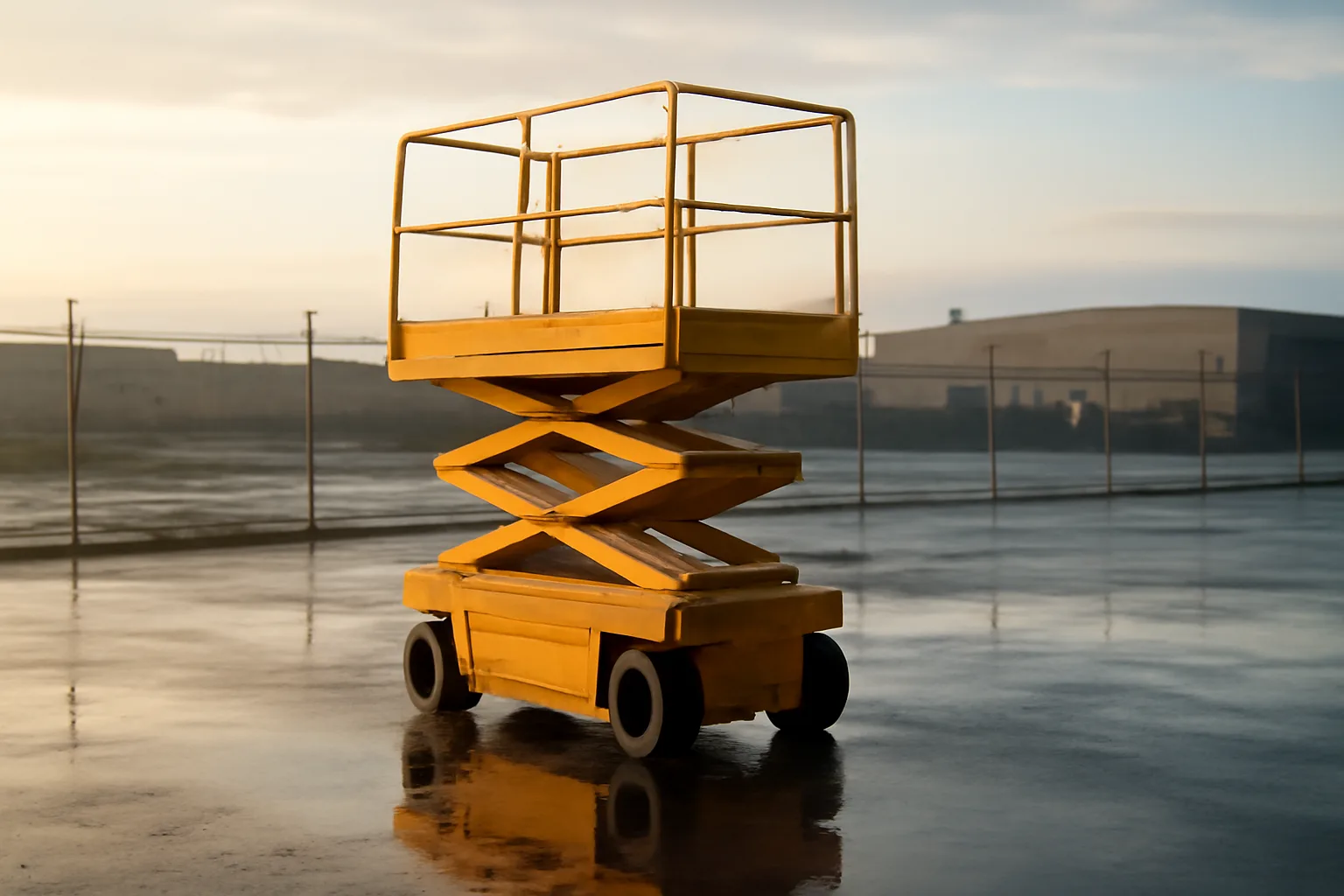
A scissor lift raises a platform straight up on stacked, crossed supports. A boom lift reaches out. Indoor finish work wants a narrow electric slab unit. Dirt and grades want rough-terrain tires and more power. Buy the wrong shape and the phone stays quiet.
Most calls come from drywall, racking, warehouse lights, mechanical rooms, and light exterior work. The customer is usually another business. That one fact drives the contract, the tax treatment, and who holds the OSHA duty to train the person on the platform. [5]
Treat this as a paper business first. The hydraulics are the easy part. The rental agreement, the inspection, and the insurance are where new owners get hurt.
How do you start scissor lift rental?
You start scissor lift rental by forming an entity, getting a free EIN from the IRS, opening the tax accounts your state and city actually collect, binding insurance a jobsite will accept, and writing a rental contract before the first machine leaves. There is no federal rental license to wait on. [7] [10]
Use this order. Read the SBA comparison of sole proprietorship, partnership, LLC, and corporation, then file the entity with your state. [9] Apply for the EIN on IRS.gov. Open a sales-and-use tax account if your state taxes rental of tangible personal property. Most states do. Ask the city or county clerk about a local business tax receipt. Open a bank account in the entity name. Bind commercial auto, general liability, and an equipment floater. Then buy one machine that matches the work in your radius.
Skip the logo, the retail counter, and the wrapped trailer. None of that creates a rental day. A charger, wheel chocks, an honest trailer or ramps, and a written pre-delivery inspection do.
Hiring anyone? Read the federal employment-relationship rules before you call them a contractor. [15] If you will tow or haul across state lines in a commercial motor vehicle, read FMCSA before you buy the truck. [11]
State paper is local paper. California is not Alabama. Read the guide that matches your yard, then confirm every fee with the board that collects it. Start with how to start scissor lift rental in California or how to start scissor lift rental in Alabama if that is your map.
Is there a federal scissor lift rental license?
There is no federal scissor lift rental license in the United States. Anyone selling you one is selling a product you do not need.
OSHA writes safety rules for employers. It does not issue a rental-company ticket. The IRS issues an EIN. It does not license aerial equipment. FMCSA cares if you operate a commercial motor vehicle. It does not care that the cargo is a scissor lift, except as cargo. [11] [12]
What you may need is ordinary business paper. A state entity filing. A state tax account. A local business license. In a few states, an equipment dealer or in-transit permit if you also sell machines or move untitled off-road equipment on public roads. Those rules are not national. Confirm them with the agency that prints the form.
Arizona's license path is not Alaska's. Read scissor lift rental license in Arizona or scissor lift rental license in Alaska, then call the board and ask which account applies to rental of tangible personal property. Do not trust a forum screenshot of someone else's certificate.
I would not pay a packager to "handle federal licensing." That money belongs in a security deposit policy and a spare battery charger.
Which OSHA rules apply to rented scissor lifts?
On construction sites, OSHA treats most scissor lifts as scaffolds under 29 CFR 1926 Subpart L, not as aerial lifts under 1926.453. Aerial lifts in 1926.453 are vehicle-mounted devices such as extensible boom platforms, aerial ladders, articulating boom platforms, and vertical towers. [4] A typical slab or rough-terrain scissor is a mobile scaffold. The extra mobile-scaffold rules sit in 1926.452(w). [3]
The load rule is blunt. OSHA 29 CFR 1926.451 requires each scaffold to support its own weight and at least 4 times the maximum intended load. The text says each scaffold and scaffold component "shall be capable of supporting, without failure, its own weight and at least 4 times the maximum intended load applied or transmitted to it." [2] A renter wants to stack drywall, a generator, and four people on a 500-pound platform? You say no. Write the capacity on the contract.
Training sits on the employer of the person on the platform. 29 CFR 1926.454 says, "The employer shall have each employee who performs work while on a scaffold trained by a person qualified in the subject matter to recognize the hazards associated with the type of scaffold being used and to understand the procedures to control or minimize those hazards." [5] Rent only the machine, and that employer is usually your customer. Send an operator, and that employer is you.
Inspections need a competent person. OSHA defines a competent person as someone capable of identifying existing and predictable hazards who has authority to correct them. [6] I want that person named in your shop, not "whoever is on the truck."
With 10 or fewer employees, you are regularly exempt from keeping OSHA 300 logs, though severe-injury reporting still exists under other sections. Confirm the current text of 1904.2 and 1904.39 before you assume you can skip the binder. [14]
California writes its own elevating-work-platform rules in Title 8. Section 3642 is one of the pages you actually open if the machine will work in that state. [13] Federal Subpart L is not the last word in a Cal/OSHA inspection.
What registrations and tax accounts do you actually open?
Open the accounts that exist. Skip the ones people invent on YouTube.
Federal. The IRS EIN is free on IRS.gov. The Service says, "Applying for an EIN is a free service offered by the Internal Revenue Service." [7] Anyone charging you for the number is reselling a form. You will also file income tax for the entity you chose. Depreciation and expensing live in IRS Publication 946. Construction assets in class 15.0 use a 5-year GDS recovery period. Rental dealers sometimes land in a different class. Confirm the table with your CPA. Do not copy a blog. [8]
State. SBA tells you to register the business with state and local agencies and to get the tax IDs those agencies require. [10] For scissor lift rental that almost always means a sales-and-use tax account, because rental of tangible personal property is taxable in most states. Some states also levy a personal-property tax on the fleet. Rates and filing calendars change. Confirm with the department of revenue. Never treat a national article as your return.
Local. Cities and counties issue business tax receipts, occupancy permits, and sometimes home-occupation rules if you start on a residential lot. A quiet industrial condo beats an HOA fight.
Title and registration of the lift itself is messy. Many scissors are off-road equipment with a manufacturer serial number and no highway title. Some states want an off-highway certificate if you sell later. Some want an in-transit permit when you tow. Confirm with the state DMV or equipment-title desk, not with the dealer sales manager.
| Paper | Who issues it | What to confirm |
|---|---|---|
| Entity filing | State secretary of state | Name, registered agent, annual report |
| EIN | IRS | Free online application only |
| Sales or rental tax | State department of revenue | Whether equipment rental is taxable |
| Local business tax | City or county | Home-occupation limits |
| CDL or USDOT | State DMV and FMCSA | Only if you operate a CMV |
What insurance do jobsites and lenders ask for?
Jobsites and lenders do not ask for a federal rental license. They ask for certificates.
You will see commercial general liability, hired and non-owned auto or a true commercial auto policy, and an inland marine or equipment floater that lists each serial number. Employees mean workers compensation, which is a state statute, not a vibe. Finance a machine and the lender will want to be loss payee on the floater.
I will not quote a national premium. Nobody has a clean public average I trust, and any number I invent would be wrong by next quarter. Two local agents who already write equipment rental will beat one internet form.
Watch the gaps. Theft from an unfenced yard. Damage while the machine is on rent (some floaters go weak once it leaves your control). Transportation. A renter who adds your company as additional insured and then claims your CGL is their project policy. Read the form.
A damage waiver on the contract is a business choice, not insurance. If you sell a waiver, write what it covers and what it does not. Tipping a lift into a hole is not a scuff on the rails.
Umbrella coverage is worth pricing once general contractors start sending 2 million dollar contract requirements. Until then, do not buy limits you cannot explain.
Do you need a CDL to deliver scissor lifts?
Maybe. The trigger is the truck and trailer, not the fact that the cargo is a lift.
FMCSA says you must have a CDL to operate any single vehicle with a GVWR of 26,001 or more pounds, plus other listed combinations and vehicle types. [11] A one-ton pickup under that rating, towing a light trailer, can stay out of Class A if the combination stays under the combination thresholds. A heavy gooseneck plus a diesel rough-terrain unit often does not. Weigh the plated GVWR and GCWR, not your hopeful estimate.
Interstate commercial motor vehicles generally need a USDOT number. Intrastate rules vary. Confirm with your state DMV motor-carrier desk before you advertise "we deliver."
Cargo securement is its own rule set. 49 CFR 393.100 and the sections after it apply when you are in a commercial motor vehicle. [12] Chains, binders, and wheel straps need working load limits that match the machine. A ratchet strap from the hardware aisle is not a plan.
I would rather pay a hotshot with the right plates for the first year than buy a truck that forces a CDL, a medical card, and a drug program you are not ready to run. Delivery revenue is real. Compliance cost is also real.
What belongs in the rental agreement and daily inspection?
If it is not on paper, you did not do it.
The agreement should name the parties, the serial number, the shift (daily, weekly, monthly), the delivery address, who may operate, the platform capacity, indoor versus outdoor limits, and who pays for pickup when the site is not ready. Add a line that the customer is the employer of the operator and is responsible for training under 29 CFR 1926.454 unless you supply the operator. [5] Add a line that the customer will not alter, disable, or remove guardrails or gates.
Inspection is not a vibe check. Walk the rails, gate, pothole protection, emergency stop, descent, tires or wheels, fluid leaks, and function of the controls at the platform and the ground. Photograph hours and any prior scrapes. Have the renter initial the same sheet at delivery and at return.
Keep the manufacturer manual with the machine. Keep your copy of the last inspection in the office. If an injury file appears later, that folder is the whole story.
Hour meters lie when they break. Want hours and a geofence on a tiny fleet? ScissorPath sells a $179 one-time 2-6 Machine Telematics Kit. I would rather have hours and location than another vinyl decal.
Do not rent a machine with a known control fault because "they said they would be careful." That is how you fund someone else's lawyer.
Electric slab or rough terrain for a first fleet?
Buy the machine your zip code already rents. Do not buy the brochure.
Call two contractors and one facility manager. Ask what height they last rented and whether the floor was slab or dirt. If the answers are 19 foot and warehouse, you want a narrow electric scissor. If the answers are 26 foot and mud, you want rough terrain. One answer will dominate. Start there.
| Type | Site | Power | First machine? |
|---|---|---|---|
| Electric slab | Interiors, finished floors | Battery | Usually |
| Rough terrain | Grades, dirt, outdoor | Diesel or hybrid | Only if that is the call volume |
I would not buy a 40-foot rough-terrain scissor as machine one. You will wait on that rental while a 19-foot electric would have gone out twice.
Used iron is fine if you can get service records and a clean serial. Skip flood machines and units with bent rails. A cheap lift with a crooked platform is not cheap.
Chargers, extra batteries on electric units, and a place that is not a dirt driveway matter more than a second color option. Nobody has a public national price series I trust for these units. Read current dealer invoices and auction results the week you buy.
How should you handle operator training versus familiarization?
Do not pretend a 12-minute tailgate is OSHA training.
The employer of the person on the platform must train that person on the hazards of that scaffold type. [5] ANSI A92 also splits dealer familiarization (this model's controls) from operator training (the broader skill). The ANSI books are copyrighted. OSHA's duty is the one a compliance officer will quote.
Here is what I would do. Offer a short, documented familiarization at delivery. Show the emergency lowering, the pothole guards, the slope limits, and the gate. Get a signature. Do not print a wallet card that says "OSHA certified by us" unless you actually run a training program you can defend. That card becomes evidence.
A customer asks you to train their whole crew? Price it as training, name a qualified person, and keep a roster. Or decline and point them to their own competent person. [6] Either path is honest. The mushy middle is not.
Homeowners and one-off DIYers are a different risk. Some shops refuse them. If you accept them, your familiarization and your insurance conversation need to be tighter, not looser.
What first-year costs are real and what is a waste?
Real costs are the machine, the floater, the tax account, the trailer or delivery arrangement, electricity or diesel, wear parts, and your time chasing unpaid invoices. Waste is a storefront, a custom website nobody can find, a third wrap design, and any consultant selling a federal rental license.
Section 179 and bonus depreciation can change the after-tax cost of the first machine. Those figures move by tax year. Read the current IRS Publication 946 with a CPA. I will not quote a limit that may be stale the month you file. [8]
I would spend money on a written contract reviewed by a lawyer who already does equipment rental, on a competent person who will actually fail a machine, and on a way to know where the lift is. I would not spend money on embroidered polos in month one.
Credit. Net-30 for a general contractor you just met is how small fleets die. Card or ACH on delivery is boring and it works. Deposits should be large enough that a missing gate or a dead battery is not your donation.
Nobody publishes a clean national average for scissor lift rental rates that I trust. Ask two local competitors what they charge for a 19-foot electric this month. Then decide if you can live on that number after fuel, repairs, and idle days.
Where do you confirm state rules before you buy machines?
Confirm with the board that collects the money. Not with a national myth, and not with this page alone. ScissorPath is an independent publisher, not a law firm and not a rental shop.
Minimum calls. Secretary of state (entity). Department of revenue (rental tax). City clerk (local license). State DMV or motor-carrier desk (tow vehicle, off-highway permits). Your workers-comp rating bureau if you will have employees. If you will work on public jobs, the public-works or contractor board in that state, because some bid packets assume you are a contractor when you are not.
Use a state guide as a map, then verify. How to start in Colorado and the Colorado board page are starting points, not certificates. Same for Connecticut, Arkansas, and California licensing.
Want a single checklist that walks this paper path in order? Use /start after you have read the OSHA and IRS pages yourself.
Buy the lift after the accounts exist. A machine with no tax ID and no floater is not a business. It is a liability with tires.
Frequently asked questions
What is scissor lift rental?
It is owning scissor lifts and hiring them out, usually without an operator, to contractors and facilities. Census NAICS 532412 is the statistical home for heavy equipment rental without operators. You are in the rental trade. You become a construction employer only if you also send a person to run the machine.
How do you start scissor lift rental?
Form an entity, get a free IRS EIN, open state sales-or-use tax and local business accounts, bind liability and equipment insurance, write a rental contract, then buy one machine that matches local indoor or outdoor demand. There is no federal rental license. Confirm every state fee with the board that issues the form.
Do I need an OSHA license to rent scissor lifts?
No. OSHA does not license rental companies. It regulates employers on job sites. Construction scissor lifts generally fall under 29 CFR 1926 Subpart L scaffolds. Your duty grows if you employ the operator or send workers onto the platform. Training under 1926.454 sits with that employer.
Does the rental company or the customer train the operator?
The employer of the person on the platform must train that person under 29 CFR 1926.454. Rent only the machine and that is usually the customer. You can document familiarization on that model's controls. Do not hand out fake OSHA cards. If you supply an operator, you are the employer.
Can I start with one used 19-foot electric scissor lift?
Yes, if your local calls are interior and the serial, rails, and service history are clean. That is the common first machine in warehouse and finish markets. Skip flood units and bent platforms. Price the charger and a real inspection before you chase a second machine.
Do I charge sales tax on scissor lift rental?
In most states, rental of tangible personal property is taxable, but exemptions, resale certificates, and local add-ons differ. Open an account with the state department of revenue and ask how they treat equipment rental. Do not copy another state's rate. Confirm the current rule before the first invoice.
What is a competent person for a scissor lift?
OSHA 29 CFR 1926.32 defines a competent person as someone who can spot existing and predictable hazards and who has authority to correct them. That is not a certificate you buy online. Name someone in your shop who can fail a machine and make it stick.
Do indoor electric scissors need personal fall arrest?
Most scissors rely on guardrails and a closed gate as the primary system under the scaffold rules, if those rails are complete and used as designed. Customers still create fall hazards by climbing rails or disabling gates. Your contract should forbid that. Site-specific rules can be stricter. Confirm the standard that applies to that job.
How do I title or register a scissor lift?
Many units are off-road serial-number equipment with no highway title. Some states issue off-highway certificates or want in-transit permits when you tow. Ask the state DMV or equipment-title desk. Do not assume the dealer's paperwork is the last word in your state.
Can I rent to homeowners and DIYers?
You can, if your insurer will write it and you are willing to document familiarization. Many shops refuse because training duty, site control, and collection get sloppy. If you accept retail renters, tighten the contract, the deposit, and the delivery inspection. Do not treat them like a GC with a safety program.
What maintenance records should I keep?
Keep the serial file, manuals, repair invoices, hour readings, and signed delivery and return inspections. Photograph damage at both ends of the rental. If you have employees, check whether 29 CFR 1904 recordkeeping applies to your headcount. A thin folder is a problem the first time someone gets hurt.
Is a dealer license required if I only rent and never sell?
Often no, but a few states blur rental, lease-purchase, and dealer activity. Selling used units later can flip you into dealer or casual-sale rules. Confirm with the state agency that licenses equipment or vehicle dealers. Read that statute. Do not guess from a neighboring state.
What happens if a renter tips a machine?
Your contract, photos, and floater decide who pays. A tip is not ordinary wear. Notify the carrier the way the policy requires. Do not repair quietly and hope. If anyone was on the platform, treat it as an incident file, not a shop story. This is why you keep inspections.
Do I need a USDOT number to haul my own lifts?
Interstate use of a commercial motor vehicle generally requires a USDOT number. Intrastate rules vary by state and by vehicle weight. The CDL question is separate and turns on GVWR and combination ratings, including the 26,001-pound single-vehicle threshold. Confirm both with FMCSA and your state DMV before you advertise delivery.
Sources
- U.S. Census Bureau, 2022 NAICS 532412 definition: NAICS 532412 covers establishments primarily engaged in renting or leasing heavy construction and related machinery without operators
- OSHA 29 CFR 1926.451 General requirements for scaffolds: Each scaffold and scaffold component must support its own weight and at least 4 times the maximum intended load
- OSHA 29 CFR 1926.452 Additional requirements applicable to specific types of scaffolds: 1926.452(w) sets additional requirements for mobile scaffolds, the category OSHA applies to typical scissor lifts
- OSHA 29 CFR 1926.453 Aerial lifts: Aerial lifts are defined as vehicle-mounted devices such as extensible boom platforms, aerial ladders, articulating boom platforms, and vertical towers
- OSHA 29 CFR 1926.454 Training requirements: The employer must have each employee who performs work while on a scaffold trained by a qualified person
- OSHA 29 CFR 1926.32 Definitions: Competent person means someone capable of identifying existing and predictable hazards who has authority to correct them
- IRS, Apply for an Employer Identification Number (EIN) online: Applying for an EIN is a free service offered by the Internal Revenue Service
- IRS Publication 946, How To Depreciate Property: Publication 946 sets MACRS recovery periods, including 5-year GDS for construction assets in class 15.0, and current Section 179 rules
- U.S. Small Business Administration, Choose a business structure: SBA compares sole proprietorship, partnership, LLC, C corporation, and S corporation for new firms
- U.S. Small Business Administration, Register your business: New businesses register with federal, state, and local agencies and obtain required tax IDs and licenses
- FMCSA, Commercial Driver's License: A CDL is required to operate any single vehicle with a GVWR of 26,001 or more pounds, plus other listed vehicle types
- FMCSA, 49 CFR 393.100 cargo securement purpose and scope: Federal cargo securement rules apply to commercial motor vehicles transporting cargo on public roads
- Cal/OSHA Title 8 section 3642, elevating work platforms: California sets its own Title 8 rules for elevating work platforms that can apply in addition to federal OSHA
- OSHA 29 CFR 1904.2 Partial exemption for employers with 10 or fewer employees: Employers with 10 or fewer employees are regularly exempt from keeping OSHA injury and illness records, subject to other reporting duties
- U.S. DOL Wage and Hour Division Fact Sheet 13, Employment Relationship Under the FLSA: Whether helpers are employees under the FLSA depends on the economic reality of the relationship, not the label on the contract