Last updated 2026-08-19
TL;DR
Scissor lift rental is the short-term hire of vertical mobile elevating work platforms. You start by forming an entity, getting a free IRS EIN, buying insurance that names the machines, training to OSHA 1926 Subpart L, and confirming local tax and yard permits with the issuing board. There is no single federal rental license. Keep the first fleet small and electric.
What is scissor lift rental?
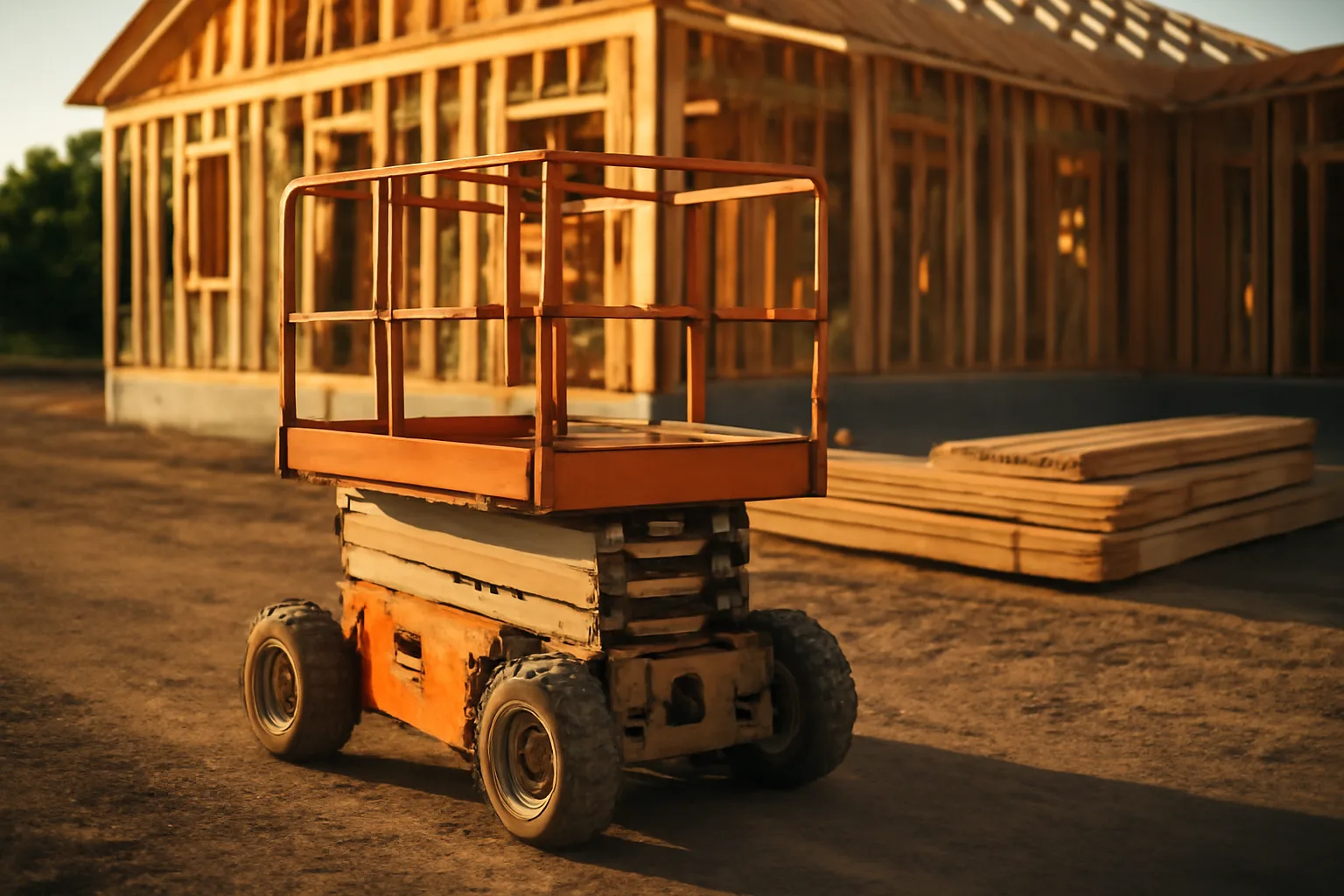
Scissor lift rental is the short-term hire of a self-propelled platform that rises straight up. You own or finance the machines. Customers pay by the day, week, or month. You deliver on a trailer, or they pick up. That is the product.
Most of the working U.S. fleet is electric slab machines in the 19 ft to 26 ft class, plus diesel or dual-fuel rough-terrain units for dirt. People now say MEWP. Older manuals say aerial work platform. OSHA does not use one tidy label. Vehicle-mounted rotating aerial lifts sit in 29 CFR 1926.453. Typical scissor lifts get treated as mobile scaffolds under 29 CFR 1926 Subpart L, including 1926.451.[1][2]
Census files the trade under NAICS 532412, Construction, Transportation, Mining, and Forestry Machinery and Equipment Rental and Leasing.[3] That bucket also holds excavators and other iron, so it will not give you a clean national headcount of scissor-only yards. Nobody publishes a good public count of pure scissor specialists.
You are hiring out a tool, not selling a finished building. The renter still owes a safe job under OSHA. You still owe a machine that is inspected, maintained, and handed over with the manual and the warnings intact. Mix those duties up and you get the ugly claim file.
Utilization pays the note. A lift that sits is a dying battery and a finance charge.
How do you start scissor lift rental?
You start scissor lift rental by standing up a real entity, getting a free IRS EIN, securing a legal place to park machines, buying insurance that schedules the lifts, writing a contract you will enforce, and putting a tiny fleet to work. Then you train people. Confirm every local fee and any processing time with the board that prints the permit. No writeup can promise you an approval date.
SBA's registration guide is a sane order of operations for the entity steps, even though it never mentions a lift.[4] Pick a structure you can explain to a banker in one sitting. A single-member LLC is what most first-year operators actually use. An S corp election is a later tax move with a CPA, after payroll exists.
Get the EIN before you sign a truck note in the company name. Open a bank account that matches the entity. Bind general liability and scheduled equipment coverage before the first machine rolls on a public road.
Buy fewer units than your optimism wants. Two or three electric 19 ft machines will teach you dead batteries, no-shows, and gate codes cheaper than a mixed diesel circus. Write the rental agreement before the first handshake. Put hour-meter limits, return condition, and who may operate in writing.
Hire only when you cannot physically deliver and retrieve alone. The day you have employees, workers' compensation and wage rules show up. Until then you are a person with a trailer and a phone.
State sales-tax permits, city yard permits, and any contractor-board questions are local. Start with the secretary of state and the tax department, then ask the city about outdoor storage. If you already know the state you will file in, read the real renewal paper for that state rather than a national blog, including scissor lift rental renewal in california and scissor lift rental renewal in florida.
Do you need a special license to rent scissor lifts?
No federal license says you may rent scissor lifts. OSHA regulates how lifts get used on a job, not whether you may own a rental yard. FMCSA cares if you haul them interstate over the weight trigger. States and cities stack ordinary business licenses, sales-tax permits, and sometimes zoning for outdoor storage.
Ignore anyone selling a national "rental operator license." That product is a course certificate at best. It is not a permit to open.
You may still need a seller's permit because many states tax equipment rental the same way they tax a sale. Some cities want a home-occupation or contractor-yard permit if machines sit outside overnight. A few contractor boards get nosy if your ads sound like you are furnishing labor. Answer those agencies with what you actually do. Do not invent a contracting classification you do not hold.
Confirm the fee schedule with the issuing board. Fees move. I will not quote a number I cannot pin to today's board page.
If you later add boom lifts, forklifts, or operators for hire, the paper changes. Stay in the lane you registered.
What OSHA rules cover lifts you send to a job?
OSHA construction rules are the ones that bite rental fleets. 29 CFR 1926.453 covers aerial lifts and still points design back to ANSI A92.2-1969 for vehicle-mounted elevating and rotating work platforms.[1] Typical scissor lifts get handled as scaffolds under 29 CFR 1926.451, including capacity, guardrails, and inspection.[2] Training sits in 1926.454.[5]
BLS counted 5,486 fatal work injuries in the United States in 2022.[6] Construction accounted for 1,069 of those deaths.[6] Falls, slips, and trips accounted for 865 across all industries that year.[6] That is why a sloppy handoff is not a paperwork nit.
Do not paste boom-lift harness rules onto every scissor. Guardrails are the primary fall protection on most scissor lifts under Subpart L. Follow the manufacturer's manual anyway. If the decal says use a harness, use a harness. Arguments on forums do not outrank the plate on the machine.
You are not the employer of every renter's crew. You are the owner who put a machine on a public road and onto their site. Keep annual inspections, daily checklists, and repair invoices. When a claim arrives, those files are the job.
What training do staff and renters actually need?
Your people need real training on the machines they touch. Renters need training too, and their employer cannot outsource that duty to a laminated card you toss in the basket. 29 CFR 1926.454 says, "The employer shall have each employee who performs work while on a scaffold trained by a person qualified in the subject matter to recognize the hazards associated with the type of scaffold being used and to understand the procedures to control or minimize those hazards."[5]
That text names the employer of the person on the platform. It does not name you as the national trainer of every drywall crew in the county. Still, handing a lift to someone who has never raised one is how machines get racked and people get hurt. I would require a written acknowledgment that the renter received the manual, the familiarization, and the site-hazard warning. I would refuse the delivery if the only operator on site cannot show any training record.
Wallet cards from a weekend class are a training record if the class was honest. They are not a federal license. Online-only slideshows with no hands-on time are a waste of money for your own yard staff.
Train your drivers on tie-down points and battery chargers before you train them on sales. Most first-year damage happens on the trailer, not at 19 ft.
When do you need a USDOT number or a CDL?
Look at weight and whether the trip crosses a state line, not at the word scissor. FMCSA treats many interstate combinations with a GVWR or GCWR of 10,001 pounds or more as commercial motor vehicles.[7][8] That is the common USDOT-number trigger for a contractor who hauls equipment across a state line. Confirm your facts on the FMCSA "Do I Need a USDOT Number" page and with your state DMV, because intrastate rules diverge.
A CDL is a different, higher bar. Under 49 CFR 383.5, a combination that hits 26,001 pounds GVWR and tows a unit rated over 10,000 pounds is the classic CDL combination case.[9] A 19 ft electric on a light trailer behind a three-quarter-ton pickup often stays under that line. A rough-terrain 32 on a 14,000 pound trailer behind a one-ton often does not. Weigh the combination. Do not guess from a forum photo.
I would not buy a heavy gooseneck in month one just to look like a regional house. Stay under the CDL combination line until the rates pay for a proper truck and a properly licensed driver. Confirm any medical-card or IRP/IFTA questions with the state, not with me.
What insurance is worth buying in year one?
Buy general liability and a scheduled equipment floater (inland marine) before the first delivery. Name each serial number. Add hired and non-owned auto if you or a helper will use a personal truck. Add workers' compensation the day you have an employee. Confirm limits and exclusions with a licensed agent who already writes equipment rental, not a friend who writes house policies.
I will not invent a premium. Rates swing with county, claims, driver records, and whether you allow untrained pickup customers. Anyone quoting a national average in a blog is making it up or recycling a stale survey.
A huge umbrella on day one is usually wasted if the lifts are not even scheduled on the equipment form. Rental reimbursement and boom-over coverage matter more than a glossy package name. Require commercial renters to carry their own liability and to list you as additional insured. For homeowners, get a card or a signed damage acknowledgment and assume you will eat more cosmetic damage.
Read the theft deductible. Read whether a machine left overnight on an open lot is covered. That clause hurts new yards.
What federal paper do you file on day one?
File the entity with the state, then get an EIN. The IRS page on EINs is blunt: "Applying for an EIN is a free service offered by the Internal Revenue Service. Beware of websites on the Internet that charge for this free service."[10] Use the official IRS application. Keep the CP 575 notice in the same folder as the operating agreement.
SBA's structure page is enough federal tax context for the first afternoon.[11] IRS Publication 334 is the small-business tax guide you actually want on the shelf once money moves. It is about records, income, and expenses, not about lift models.[12]
OSHA injury logs are a later federal file. 29 CFR 1904.1 says a company that had ten or fewer employees at all times during the last calendar year does not need to keep OSHA injury and illness records unless OSHA or BLS tells them in writing to keep them.[13] Many first-year yards sit under that headcount. Do not ignore a written request if one arrives. State-plan OSHA states can add their own twist. Confirm with that state office.
Store more than 1,320 gallons of diesel, gasoline, and oil in aboveground tanks and qualifying drums, and EPA's SPCC rule in 40 CFR 112 can apply.[14] A couple of electric machines and a five-gallon can will not get you there. A farm tank for a diesel fleet might. Count the 55-gallon drums. Confirm with EPA or a spill consultant before you pour a tank.
How should you buy the first machines?
Buy used electric 19 ft units with hour meters you can see, charger cords that are not melted, and serial plates you can read. I would skip rough-terrain diesels until indoor electrics are actually renting. New paint and dealer decals do not lift a floor. A fresh annual inspection and a battery pack that holds a charge do.
I will not post a fake "average" purchase price. Asking prices move with hours, battery condition, and whether the scissor pack has been crashed. Pull three dealer or auction comps the week you buy. If a seller will not let you cycle the machine to full height, walk.
Telematics starts to matter when machines leave your sight. A driveway unit you can see from the kitchen does not need a gadget. A two-to-six machine fleet that sits on other people's jobs does. ScissorPath sells a $179 one-time 2-6 Machine Telematics Kit if you want hour and location data without a monthly maze. Skip it if you only have one lift and you deliver every job yourself.
Do not finance a shop buildout in year one. A fenced slab, a charger circuit, and a shipping container beat a leased showroom.
What belongs in the rental contract?
Put the serial number, hour-meter start, rate, delivery address, who may operate, and who pays for damage in the contract. Add a line that the renter got the manual and a familiarization. Add a line that the renter will not use the lift on a truck bed, on uneven fill, or in wind beyond the plate rating. Keep it short enough that someone will read it.
I am not your lawyer. ScissorPath is not a law firm. Have a local attorney stab the indemnity and insurance clauses once. After that, stop rewriting the form every Saturday night.
Damage waivers are not magic. They fail when the renter lies about the operator or takes the machine off the stated site. Collect a card authorization that actually works. Photograph all four sides and the platform at delivery and at pickup. Those photos settle more arguments than a paragraph of adjectives.
Hour-meter caps matter on electrics because dead batteries create overtime calls. State the grace hours. State the charger rule. State that a missing charger is a billed accessory, not a mystery.
How often do you inspect a rented scissor lift?
Inspect it before every rental and after every return, at minimum. 29 CFR 1926.451 requires scaffolds and scaffold components to be inspected for visible defects by a competent person before each work shift and after any occurrence that could affect structural integrity.[2] Your yard is not the job, but that is the standard the plaintiff's expert will read aloud.
Do a documented annual inspection to the manufacturer's schedule. Keep load-floor, scissor-pack, pothole-guard, rail, and emergency-lower checks on a one-page form. If a pothole guard is bent, the machine stays home. If the emergency lower fails, the machine stays home.
Renters should still do a pre-shift check on site. Give them the manufacturer's checklist, not a cartoon. If they refuse, I would not leave the machine.
Software is optional. A binder with dates and signatures still works. What fails is the "we look at them when we remember" system.
How do state renewals and local yard permits work?
State paper is a stack, not a single card. You will usually renew an entity report, a sales-tax permit, and any city business license on different calendars. Some states also want a reseller or rental-specific tax account because lift hire is taxable. Confirm the list with the secretary of state, the tax department, and the city. Do not trust a Facebook group for due dates.
Zoning is the sleeper. A residential driveway with two electrics may pass as a home occupation in one town and draw a code complaint in the next. A fenced industrial yard solves that, then brings stormwater and outdoor-storage questions. Ask before you sign a lease.
Renewal content is state-specific on purpose. If you operate in the Southwest, read scissor lift rental renewal in arizona. For the Mountain West, use scissor lift rental renewal in colorado. Southeast operators should start with scissor lift rental renewal in georgia or scissor lift rental renewal in alabama. Those pages are about the real forms, not a national myth.
I will not invent a renewal fee or a processing clock. Boards change both. Call the number on the form.
What first-year mistakes waste the most money?
The expensive mistakes are predictable. People buy too many diesels. People skip scheduled equipment insurance. People let an untrained helper tow a combination they never weighed. People advertise like a contractor and then cannot explain the license they do not hold.
Underpricing to "get the phone ringing" is how you fund other people's jobs. Pull the two nearest yards and sit $10 under the sloppy one, not 40 percent under the tight one. If you cannot make the note at that number, you bought the wrong machine.
Custom wraps, a downtown office, and a four-truck livery are ego. Charge cycle testers, spare charger cords, and a second set of trailer straps are not.
Keep a paper path you can hand a lender or an adjuster: entity docs, EIN letter, insurance binder, titles, annual inspections, and every rental ticket. That file is the business.
Want a plain start checklist after you have read the rules? Use /start. ScissorPath is an independent publisher, not a law firm and not a rental house. Confirm variable facts with the board that issues the paper.
Frequently asked questions
What is scissor lift rental?
It is the short-term hire of a self-propelled vertical platform, usually an electric slab lift or a rough-terrain diesel. You own the machine. The customer pays for time. Delivery is extra or included, depending on the ticket. Census groups the work in NAICS 532412 with other construction equipment rental.
How do you start scissor lift rental?
Form an entity, get a free IRS EIN, open a matching bank account, bind liability and scheduled equipment insurance, lock a legal storage spot, write a short contract, and buy two or three electric 19 ft machines. Train staff and familiarize renters under OSHA 1926 Subpart L. Confirm local tax and yard permits with the issuing board. No federal rental license exists.
Do I need OSHA certification to rent out scissor lifts?
OSHA does not issue a national rental-yard certificate. 29 CFR 1926.454 requires the employer of the person on the platform to train that person. Your own employees need real, machine-specific training. A wallet card can record a class. It is not a license to open a yard, and it does not replace the renter's duty.
Are scissor lifts aerial lifts under OSHA?
Usually not in the 1926.453 sense. That section is written around vehicle-mounted elevating and rotating platforms and still cites ANSI A92.2-1969. Typical scissor lifts get treated as mobile scaffolds under 29 CFR 1926.451. Follow Subpart L and the manufacturer's manual, including any harness rule printed on the machine.
Do I need a CDL to deliver scissor lifts?
Only if the truck and trailer meet the CDL definition, commonly a 26,001 pound combination that tows a unit rated over 10,000 pounds (49 CFR 383.5). Many 19 ft electrics on a light trailer stay under that line. Weigh the combination. A 10,001 pound interstate trigger can still require a USDOT number even when a CDL does not.
How many machines should I buy first?
Two or three used electric 19 ft units is enough to learn delivery, batteries, and no-shows. A mixed diesel fleet in month one is how people stall cash. Buy a rough-terrain machine after the electrics actually rent, not because an auction photo looked cheap. Pull fresh comps. Walk if you cannot cycle the lift to full height.
Do renters need their own insurance?
Commercial renters should carry liability and list you as additional insured. Homeowners are messier. Get a card when you can, plus a signed damage acknowledgment and photos. Your own scheduled equipment policy is what actually pays when a machine disappears. Read the overnight-theft clause before you leave a lift on an open lot.
What NAICS code do scissor lift rental companies use?
Census NAICS 532412 covers construction, transportation, mining, and forestry machinery and equipment rental and leasing. It is the usual box for a scissor lift yard. The same code includes other iron, so government counts will not isolate scissors. Use it on bank and tax forms unless your CPA has a reason to split lines.
Is an EIN required before I buy the first lift?
If the company will hold title, finance the machine, hire anyone, or open a business bank account, get the EIN first. The IRS issues it at no charge on the official site and warns about vendors that bill for that free filing. Keep the CP 575 letter with the entity papers. Confirm any state tax ID separately.
Do I need a SPCC plan for diesel in the yard?
EPA's SPCC rule in 40 CFR 112 can apply when aboveground oil storage (diesel, gasoline, hydraulic oil in tanks and qualifying drums) exceeds 1,320 gallons. A small electric fleet with a can of fluid will not hit that. A farm tank plus 55-gallon drums can. Count capacity, then confirm with EPA or a spill consultant.
Can I run scissor lift rental from my driveway?
Sometimes, if zoning and the HOA allow outdoor storage and customer pickups. Many towns treat visible commercial equipment as a violation. A fenced industrial slab is cleaner. Ask the city before the first machine is delivered. Insurance may also exclude theft from an unfenced residential lot. Read that clause.
What records should I keep on each machine?
Keep the title or lease, serial number, hour-meter log, annual inspection, repair invoices, and every rental ticket with delivery photos. Add training or familiarization acknowledgments. That packet is what a lender, an OSHA inspector, or an adjuster will ask for. A binder works. Memory does not.
Which states have extra rental paper?
All of them have some mix of entity reports, sales-tax permits, and city licenses. None share one federal rental card. Tax treatment of equipment hire is the usual surprise. Read the state renewal path for the place you actually file, and confirm fees with that board. Do not copy another state's checklist.
Do I need a USDOT number for local deliveries only?
Interstate use at or above the 10,001 pound GVWR or GCWR threshold is the common FMCSA trigger. Purely intrastate hauls follow state motor-carrier rules, which may still want a state number. Confirm on FMCSA's USDOT page and with your DMV. Weigh the truck and trailer instead of assuming a pickup is exempt.
Sources
- OSHA 29 CFR 1926.453 Aerial lifts: Aerial lifts must conform to ANSI A92.2-1969 for vehicle-mounted elevating and rotating work platforms
- OSHA 29 CFR 1926.451 General requirements for scaffolds: Scaffolds must be inspected by a competent person before each work shift and after any occurrence that could affect structural integrity
- U.S. Census Bureau NAICS 532412 (2022): NAICS 532412 is Construction, Transportation, Mining, and Forestry Machinery and Equipment Rental and Leasing
- U.S. Small Business Administration, Register your business: SBA outlines federal and state registration steps to launch a business
- OSHA 29 CFR 1926.454 Training requirements: Employers must have each employee who works on a scaffold trained by a qualified person to recognize and control scaffold hazards
- U.S. BLS Census of Fatal Occupational Injuries, 2022 results: 5,486 fatal work injuries in 2022, including 1,069 in construction and 865 from falls, slips, and trips
- FMCSA, Do I Need a USDOT Number?: A USDOT number is commonly required for interstate vehicles at 10,001 pounds GVWR or GCWR
- FMCSA 49 CFR 390.5 Definitions: Commercial motor vehicle includes interstate property-hauling vehicles with GVWR or GCWR of 10,001 pounds or more
- FMCSA 49 CFR 383.5 CDL definitions: CDL commercial motor vehicle includes combinations of 26,001 pounds or more towing a unit over 10,000 pounds GVWR
- IRS, Apply for an Employer Identification Number (EIN) online: Applying for an EIN is a free IRS service and third-party sites that charge for it are a warning flag
- U.S. Small Business Administration, Choose a business structure: SBA summarizes federal tax and liability differences among common entity types
- IRS Publication 334, Tax Guide for Small Business: Small businesses must keep records of income and expenses for federal tax reporting
- OSHA 29 CFR 1904.1 Partial exemption for employers with 10 or fewer employees: Employers with 10 or fewer employees in the prior year generally need not keep OSHA injury logs unless notified in writing
- eCFR 40 CFR 112.1 SPCC general applicability: SPCC can apply when aggregate aboveground oil storage capacity exceeds 1,320 U.S. gallons