Last updated 2026-08-19
TL;DR
Scissor lift rental is short-term hire of scissors, dry or operated. Start with an entity, a free IRS EIN, a state tax permit, insurance, and inspection logs. OSHA scaffold rules apply to your workers. Interstate trucks at 10,001 lb GVWR can need a USDOT number. No federal rental license exists. Confirm fees with your state board.
What is scissor lift rental?
Scissor lift rental is the short-term hire of a scissor-type mobile elevating work platform. You own or finance the machine. The customer pays by the day, week, or month to put people at height. Most first shops run dry rental, which means the customer supplies the operator.
That is the product. It is not a construction contract. It is not a sale.
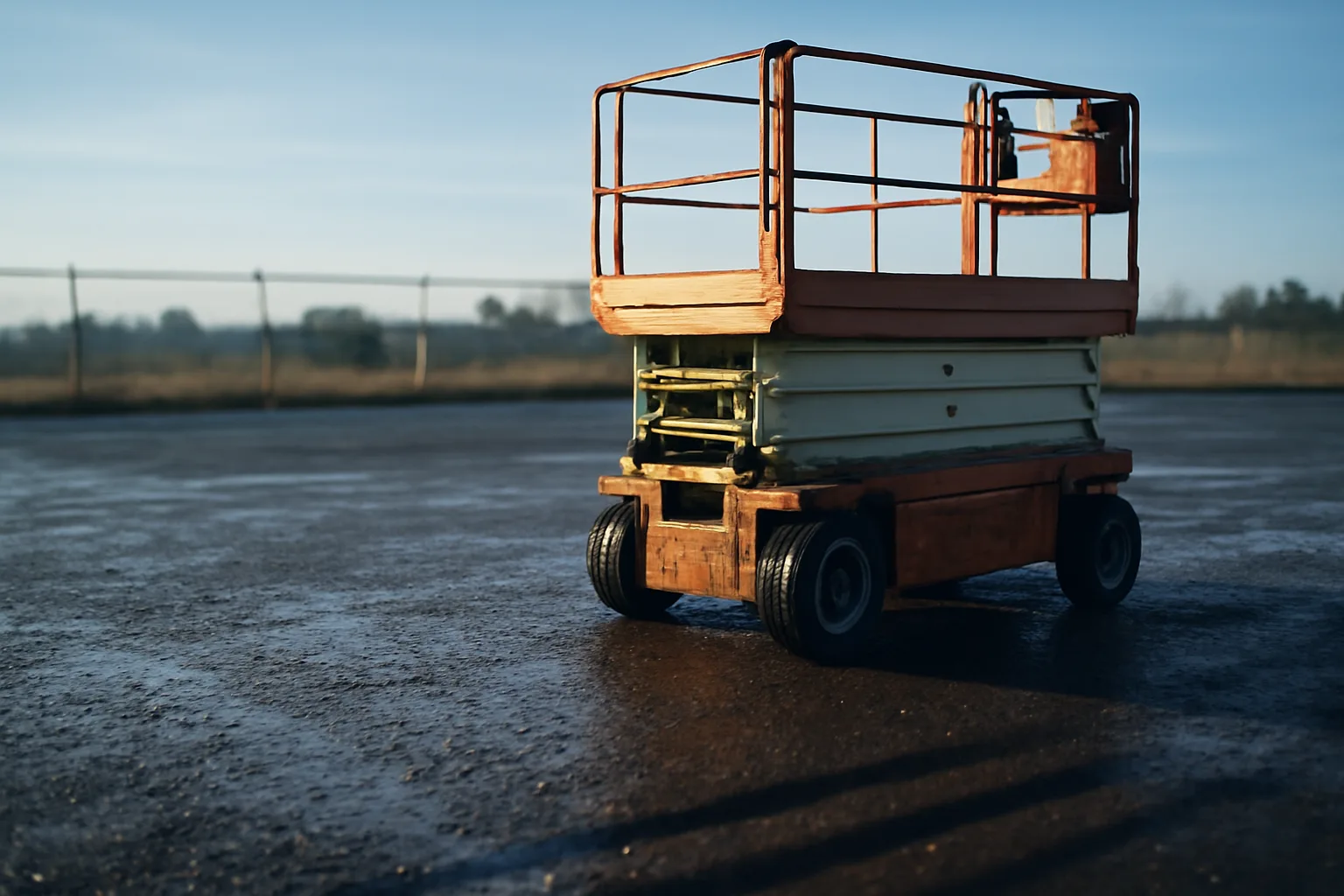
A typical rental unit is an electric slab scissor for indoor concrete, or a rough-terrain machine for dirt and grade. Heights people actually call about cluster around 19, 26, 32, and 40 feet. I will not pretend there is one national fleet mix. Finish carpenters and warehouse accounts want quiet electric 19s and 26s. Sitework wants gradeability and more weight.
Two commercial shapes show up. Dry rental is a machine, a contract, delivery or pickup, and a walk-around. Operated rental puts your employee on the platform. That second shape turns you into a labor employer with a thicker wage and injury file.
OSHA treats many scissor lifts as scaffolds under 29 CFR 1926 Subpart L. Boom-type aerial lifts sit under 29 CFR 1926.453. [1][2] Customers mix “scissor,” “aerial lift,” and “MEWP” in one phone call. Name the model on the contract anyway.
No federal scissor lift rental license exists in the United States. The work is property rental, safety duties, tax collection, and, if you haul iron across state lines, motor-carrier rules.
How do you start scissor lift rental?
You start scissor lift rental by forming an entity, getting a free IRS EIN, opening the tax and local permits your city actually issues, binding insurance, and putting inspection-ready machines on a written contract. That is the path. Buying a lift first is how people end up with iron and no right to collect tax.
Do this order. I would not reverse it.
File an LLC or corporation with your state. Get an EIN from the IRS online. The IRS states, “Applying for an EIN is a free service offered by the Internal Revenue Service.” [3] Open a business bank account. Register for sales and use tax, because most states tax tangible personal property rentals. Pull a local business license. Ask zoning about outdoor storage before you sign a yard lease. Bind general liability and an equipment floater before the first machine leaves the gate.
Then buy one or two common electric scissors, not a zoo of odd widths. Write a rental agreement that states who operates, who insures physical damage, what “damage” means, and when overtime rates start. Use a pre-delivery and post-return inspection sheet on every outing. If your truck and trailer will run interstate and sit over federal weight triggers, deal with FMCSA before you take that job. [4]
People want a national fee sheet and a day count. That sheet does not exist. Formation cost, seller permits, and any contractor overlay sit with the state. Confirm them with the board that will cash the check. California is not Alabama. Read your own state’s notes, then buy iron. The scissor lift rental board in california writeup is a sample of how local paper actually looks.
If you want utilization data on a tiny fleet, ScissorPath sells a $179 one-time 2-6 Machine Telematics Kit. You do not need it to be legal. A clipboard works on day one.
SBA still publishes a plain 10-step start sequence for entity, tax ID, and permits. [5] Use it as a map. It is not your permit.
Is there a national scissor lift rental license?
No. No national scissor lift rental license, card, or quota exists. The federal government does not issue a “rental yard” ticket that lets you hire scissors in every state.
What you will meet is a stack of ordinary business paper plus safety rules that attach when your people work on the equipment. Entity filing is state. Sales tax is state. Local business licenses are city or county. Zoning is local. If you hire anyone, federal Form I-9 applies to each employee. [6]
A few states layer dealer, auction, or contractor rules on equipment businesses. Some cities care more about outdoor storage than about the lift itself. I have not seen a clean 50-state table that stays true for a year. Confirm with the board that collects the fee. Do not trust a forum post with a dollar figure.
If your plan is dry rental only, you often do not need a contractor license. The moment you supply an operator and sell a work result, you may have walked into contractor territory. That line is state law. Ask before you advertise “we can hang the steel.”
SBA’s licenses and permits page is a decent federal reminder that you check city, county, and state, not one national desk. [7] Then call your own board. The scissor lift rental board in florida and scissor lift rental board in arizona pages show how different two Sun Belt stacks can be.
What OSHA rules apply to a rental yard?
OSHA rules apply to your employees and your workplace, not to a magic “rental license.” If you have no employees and you never work on the machines yourself as an employer, your OSHA file is thinner. The machine still has to be fit for use. Your customer, as the employer on their site, still has duties.
For scissors used as scaffolds, 29 CFR 1926.451 is the general scaffold rule. It says scaffolds and components “shall be inspected for visible defects by a competent person before each work shift, and after any occurrence which could affect a scaffold’s structural integrity.” [2] 29 CFR 1926.452 adds extra mobile-scaffold conditions. [8] 29 CFR 1926.454 is the training rule for employees who work on scaffolds. [9]
OSHA defines a competent person in 29 CFR 1926.32 as “one who is capable of identifying existing and predictable hazards in the surroundings or working conditions which are unsanitary, hazardous, or dangerous to employees, and who has authorization to take prompt corrective measures to eliminate them.” [10] That is a person with knowledge and stop-work authority. It is not a wallet card you bought online.
If you later add boom-type aerial lifts, 29 CFR 1926.453 says, “Only authorized persons shall operate an aerial lift.” [1] Keep boom rules and scissor rules straight on the contract.
Recordkeeping is a headcount test. OSHA 29 CFR 1904.1 sets the routine injury-log exemption at ten or fewer employees in the last calendar year, unless OSHA or BLS writes you and says otherwise. [11] The rule states, “If your company had ten (10) or fewer employees at all times during the last calendar year, you do not need to keep OSHA injury and illness records unless OSHA or the BLS informs you in writing that you must keep records under § 1904.41 or § 1904.42.” Small does not mean sloppy. It means the 300 log may not be your nightly chore.
Your customer’s site is still their site. Your yard, shop, charging area, and delivery crew are yours.
What first-week paper do you actually file?
In week one you file formation papers, an EIN, tax registration, and whatever local license your city prints. You do not file a federal rental application. That form does not exist.
Start with the state business filing office. Pay their fee. I will not invent the number. It moves. Then get the EIN yourself on IRS.gov. The IRS is clear that the service is free and that other websites charge for it anyway. [3] Anyone selling you an “instant federal rental EIN package” is selling you a copy of a free form.
Next is sales and use tax. Rental of tangible personal property is taxable in most states. You will collect tax on the hire charge unless a real exemption applies. Confirm the rate and the filing cycle with your revenue department. SBA’s start sequence puts tax ID work next to licenses for a reason. [5][7]
Local paper is the part people skip. Business license. Occupancy. Zoning for outdoor storage of equipment. Fire rules on charging banks and any diesel tank. If you store enough oil, EPA spill rules can enter the picture. Most tiny electric fleets never get there. A bulk diesel tank can.
Bank account. Insurance binder. A one-page rental contract you actually read. Inspection sheets. That is a real first week. A logo is not.
If you hire even one person in that week, complete Form I-9. USCIS says U.S. employers complete Form I-9 for each individual they hire. [6] Do it on time. Do not file I-9s with USCIS as a stack. You keep them.
When do USDOT numbers and CDLs show up?
A USDOT number can show up as soon as you run a commercial motor vehicle in interstate commerce at 10,001 pounds GVWR or more. A typical Class B CDL shows up at 26,001 pounds GVWR on a single vehicle. In-state-only hauls follow state rules, which you confirm with your DMV, not a national myth.
FMCSA’s USDOT registration page is the federal trigger sheet for interstate work. [4] FMCSA Class B under 49 CFR 383.91 is “any single vehicle with a GVWR of 26,001 pounds or more,” with the usual towed-unit limits. [12] Plenty of scissor deliveries sit on a dump trailer behind a one-ton truck and never touch that CDL line. A heavy rollback plus a 40-foot RT can cross it in a hurry. Weigh the combination you will actually drive. Do not guess from a brochure.
| Trigger | Number | What changes | Source |
|---|---|---|---|
| Fewer employees last calendar year | 10 | Often no routine OSHA 300 log | 29 CFR 1904.1 |
| Interstate CMV GVWR or GCWR | 10,001 lb | Possible USDOT number | FMCSA |
| Single vehicle GVWR | 26,001 lb | Typical Class B CDL | 49 CFR 383.91 |
If you stay inside one state, you may still need a state DOT number, IRP plates, or a CDL. That is a state call. I would get the truck spec on paper before I advertised “we deliver anywhere.”
Do not buy a show truck in month one. Rent a rollback for the odd 32-foot job until you know the lane.
Dry rental or operated rental: what should you run first?
Run dry rental first unless you already have a trained operator on payroll and workers compensation in force. Dry rental is a machine business. Operated rental is a labor business that happens to include a machine.
Dry rental keeps your OSHA and wage file smaller. The customer’s employer still must train their people. You still owe a safe machine, manuals, and familiarization on the model they are taking. You still inspect it before it leaves and when it comes home.
Operated rental means your employee is on someone else’s site, on your hook for wages, injury, and how that person drives the lift. Form I-9 applies. [6] Overtime rules apply if they are not a true exemption. Workers compensation is a state must once you have employees in most states. Your general liability will be rated like a contractor, not like a quiet yard.
I would not launch both shapes in week one. Pick dry. Learn damage, no-shows, dead batteries, and the customer who wants to tow a scissor with a pickup. Add an operator later if a real account will pay for it on paper.
If a GC says they will only take operated machines, that is a pricing and licensing conversation, not a dare. Check whether that work needs a contractor license in your state before you say yes. Georgia and Colorado do not read the same. Skim the scissor lift rental board in georgia and scissor lift rental board in colorado notes if those are your lanes.
What insurance and contracts do you need in year one?
You need general liability, an equipment floater or inland marine form that follows the machines off your lot, and commercial auto on anything you use to deliver. If you have employees, you need workers compensation in the states that require it. SBA’s insurance overview is a federal reminder to bind coverage before you open, not a rate card. [13] I will not invent a premium. Ask three agents the same week with the same fleet list.
The contract does more work than the brochure. Say who may operate. Say the customer must have a qualified operator. Say they will not remove guardrails, override controls, or use the rails as a ladder. Spell out dirty-machine fees, dead-battery fees, tire and rumble-strip damage, and when the weekly rate flips to monthly. Ask for a certificate that names you as additional insured when the account is a GC. Decide whether you sell a damage waiver and what it excludes. Water, rust, and theft exclusions are where friendships end.
Hold-harmless language is not a substitute for a machine that fails a pre-shift check. Courts and adjusters still look at your logs.
Do not copy a contract from a Facebook group. Pay a lawyer in your state once. Reuse that form. That is one of the few legal spends I think is worth it in year one.
Skip cyber policies and fancy umbrellas until a real landlord or GC requires a number. Buy the auto and the floater first.
What inspections and training files should you keep?
Keep a pre-delivery inspection, a post-return inspection, and a periodic inspection file on every serial number. If your people work on the equipment, keep competent-person shift checks and employee training records that match 29 CFR 1926.454. [9] OSHA 29 CFR 1926.451 already expects a competent person to look for visible defects before each work shift when the scaffold is in use. [2]
Familiarization is not the same as training. Training is the employer’s longer duty to make a person competent on hazards and controls. Familiarization is the model-specific walk-around you do when that trained person first takes your machine. ANSI A92.22 and A92.24 sit behind a lot of dealer practice. OSHA still cites its own scaffold and aerial-lift text. Keep both ideas on the ticket: the customer’s employer trains, you familiarize, you do not hand keys to a stranger and look away.
Files that save you in a damage fight: hour-meter at out and in, photos of rails and tires, battery voltage or hour reading, who signed the walk-around, and the written defect the customer refused to hear. A text message is better than a memory. A form is better than a text.
If you stay at ten or fewer employees, you may be off the routine OSHA 300 log. [11] Keep the inspection file anyway. That file is how you prove the machine left whole.
Manufacturer manuals stay with the machine. If the manual is missing, the lift is not ready.
How much money does year one take?
Nobody has a clean national P&L for a three-machine scissor shop. The closest honest answer is a stack of quotes, not a blog number.
EIN from the IRS costs $0 if you apply on the IRS site. [3] State formation is a published state fee. Confirm it. Local licenses vary by city. Sales tax is money you collect and remit, not a profit line. Insurance is quote-driven and often the first surprise. Machines move with hours, battery condition, and region. I will not print a fake “average 19-foot price.” Get three dealer quotes the same week on the same spec.
Cash also sits in the trailer, the yard deposit, charging gear, palettes of water for wash-down, and the weeks when a GC pays on 45 days. If you cannot float two idle months on one machine, you bought too much lift.
I would start with two boring electric 19s, or a 19 and a 26, not a 60-foot RT and a wish. Utilization on common indoor machines pays the note. Odd machines look busy on Instagram and sleep in the yard.
Financing a fleet before you have repeat accounts is how people end up working for the lender. Pay cash for the first unit if you can. Hate that advice later, once a real account will sign a term sheet.
What wastes money in a new scissor lift rental shop?
Paying a website for an EIN is a waste. The IRS already said the application is free. [3]
A custom-painted first machine is a waste. Renters care if it runs and if the rails are straight.
A long yard lease in a pretty district is a waste if zoning later hates outdoor storage. Check zoning first. Alabama and Connecticut will not give you the same answer. Use the scissor lift rental board in alabama and scissor lift rental board in connecticut pages as a reminder to call the local desk.
Buying five widths in month one is a waste. You will be out of parts and out of ramps.
Operated rental with no workers compensation binder is not brave. It is a hole.
Skipping incoming inspections to “save time” is how you eat a torn rail you cannot prove was the customer. The photo takes a minute.
A boom lift on day one is usually a waste for a scissor shop. Different customers. Different transport. Different OSHA text. [1] Add booms when scissors are actually out.
CRM software can wait. A shared inbox and a paper jacket per serial number will run a two-machine shop.
Which state board do you call before you buy machines?
Call the state office that files entities, the revenue department that issues the seller or rental tax permit, and the city that handles zoning and the business license. If you will have employees, call the state workers compensation board. If you will deliver heavy, call DMV or state DOT about plates and CDL class. Confirm every fee. Confirm every form name. Nobody at a federal desk will do that for you.
There is still no national rental board. OSHA writes safety rules for employers. [2][9] IRS writes the EIN process. [3] FMCSA writes the interstate truck triggers. [4][12] Your right to collect tax and park iron is local.
If you are comparing states before you pick a yard, read a state page the way you would read a lease. Idaho is not a copy of Florida. The scissor lift rental board in idaho notes are a start, not a permit.
ScissorPath keeps a start page at /start if you want the reader checklist for this series. The legal work still happens at the board. We are an independent publisher, not a law firm and not a service company. We do not approve applications and we do not quote processing times.
Buy the machine after the permit path is real. That is the whole guide.
Frequently asked questions
What is scissor lift rental?
Scissor lift rental is short-term hire of a scissor-type lift, usually by the day, week, or month. You own the machine. The customer pays to use it at height. Dry rental means they operate. Operated rental means your employee operates. It is equipment hire, not a federal licensed trade, and not the same product as selling a lift.
How do you start scissor lift rental?
Form an entity, get a free IRS EIN, register for state sales tax, pull the local business license, bind liability and equipment cover, then put inspection-ready machines on a written contract. Check zoning before you lease a yard. Deal with FMCSA if your delivery truck will run interstate over 10,001 lb. Confirm every state fee with the board that collects it.
Do I need OSHA certification to rent scissors?
OSHA does not sell a national “scissor rental certificate.” OSHA rules attach to employers and workplaces. If your employees work on scaffolds, 29 CFR 1926.454 requires training by a qualified person. Your customer’s employer still must train their operators. A wallet card from a website is not a substitute for that duty. Keep your own training file if you have staff.
Can I rent scissors without a contractor license?
Often yes if you only hire out the machine and the customer operates it. The line moves if you supply an operator or sell a completed work result. That is state law, not OSHA. Confirm with your contractor board before you advertise labor. Dry rental plus delivery is usually a different paper stack than hanging steel for a GC.
Do customers need training before they take a lift?
Their employer is responsible for training employees who work on scaffolds under 29 CFR 1926.454. You should still familiarize each operator on your model, hand over the manual, and refuse a machine if the person in front of you cannot show they know the controls. Familiarization is not a full training course. Write who got the walk-around on the ticket.
Are scissor lift rentals subject to sales tax?
In most states, rental of tangible personal property is taxable. You register with the state revenue department and remit on the cycle they publish. Exemptions exist, but they are documented, not vibes. Confirm the rate and any local add-ons with that department. Do not copy a rate from another state page.
How often do I inspect a rental scissor lift?
Inspect before every delivery and after every return. If your people use the lift, 29 CFR 1926.451 expects a competent person to check for visible defects before each work shift and after any event that could hurt structural integrity. Keep photos and hour-meter readings. A missing manual means the machine is not ready to go out.
Do I need a CDL to deliver a scissor lift?
Not always. A typical Class B CDL applies to a single vehicle with a GVWR of 26,001 pounds or more under 49 CFR 383.91. Many scissor moves sit under that line. A heavy rollback plus a large RT can cross it. Interstate combinations at 10,001 lb can need a USDOT number even when no CDL applies. Weigh the actual combo.
What is familiarization vs training?
Training is the employer’s duty to teach hazards and controls, including scaffold training in 29 CFR 1926.454. Familiarization is the model-specific walk-around on your serial number: controls, limit switches, descent, emergency lowering, and the manual. You can familiarize a trained person in a short gate visit. You cannot replace their employer’s training with a five-minute speech.
Can I start with one used electric 19-foot machine?
Yes, and that is how I would start if cash is tight. Indoor 19s get called. Parts are common. Transport is simple. A single machine still needs the same entity, EIN, tax permit, insurance, and inspection sheet as a fleet. The risk is downtime. If that one unit is in the shop, you have no shop. A second boring 19 beats one exotic RT.
Do I need workers comp if I have no employees?
If you truly have no employees, many states do not make you buy a workers compensation policy. The moment you hire, most states do. Owner-only rules differ. Operated rental without employees is a contradiction. Confirm with your state workers compensation agency. Do not take a broker’s shrug as the statute.
Where do I confirm my state fees?
Confirm formation fees with the state filing office, tax permit fees with the revenue department, and local license fees with the city or county. We do not publish live fee tables because boards change them. If a site quotes a current state fee without a board URL, ignore it. Call the desk that will cash the check.
What records do I keep if I have 8 employees?
Eight employees last calendar year usually sits under the OSHA 29 CFR 1904.1 routine log exemption, unless OSHA or BLS writes you. You still keep I-9s, payroll, training records, and machine inspection files. The 300 log is not the whole safety file. State workers compensation and unemployment accounts still apply at that headcount.
Is a boom lift the same as a scissor lift for OSHA?
No. OSHA puts many scissors under the scaffold rules in 29 CFR 1926.451 and 1926.452. Boom-type aerial lifts sit under 29 CFR 1926.453, including the line that only authorized persons shall operate an aerial lift. Your contract should name the model. Training and fall-protection practice are not copy-paste across the two families.
Sources
- OSHA 29 CFR 1926.453 Aerial lifts: 29 CFR 1926.453(b)(2)(ii) states that only authorized persons shall operate an aerial lift.
- OSHA 29 CFR 1926.451 General requirements for scaffolds: Scaffolds must be inspected for visible defects by a competent person before each work shift and after any occurrence that could affect structural integrity.
- IRS How to Apply for an EIN: Applying for an EIN is a free service offered by the Internal Revenue Service.
- FMCSA Do I need a USDOT number: A USDOT number can be required for a CMV used in interstate commerce at 10,001 pounds GVWR or more.
- SBA 10 steps to start your business: SBA publishes a 10-step federal overview for forming and launching a business, including tax ID and permit steps.
- USCIS Complete and Correct Form I-9: U.S. employers must complete Form I-9 for each individual they hire for employment in the United States.
- SBA Apply for licenses and permits: SBA advises checking federal, state, county, and city license and permit requirements rather than one national desk.
- OSHA 29 CFR 1926.452 Additional requirements applicable to specific types of scaffolds: 29 CFR 1926.452 includes extra requirements for specific scaffold types, including mobile scaffolds.
- OSHA 29 CFR 1926.454 Training requirements: Employers must have each employee who performs work while on a scaffold trained by a person qualified in the subject matter.
- OSHA 29 CFR 1926.32 Definitions: Competent person means someone capable of identifying existing and predictable hazards who has authority to correct them.
- OSHA 29 CFR 1904.1 Partial exemption for employers with 10 or fewer employees: Employers with ten or fewer employees at all times in the last calendar year generally need not keep routine OSHA injury and illness records unless notified in writing.
- FMCSA 49 CFR 383.91 Commercial motor vehicle groups: Class B includes any single vehicle with a GVWR of 26,001 pounds or more.
- SBA Get business insurance: SBA advises new businesses to arrange insurance such as general liability before opening; premiums are quote-driven, not a federal schedule.