Last updated 2026-08-19
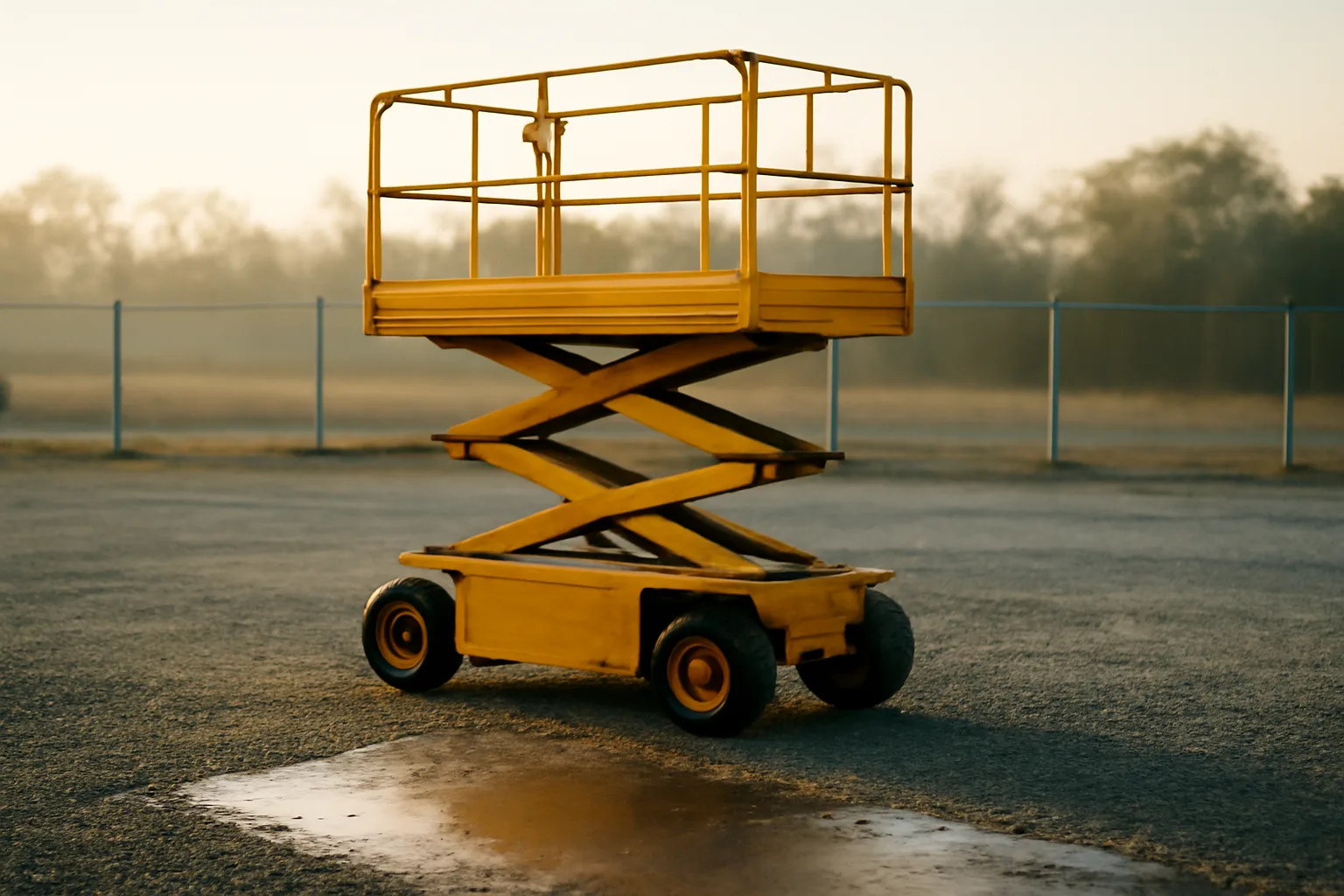
TL;DR
Scissor lift rental is hiring out vertical work platforms by the day, week, or month. There is no federal rental license. Form a state entity, get a free IRS EIN, register for tax if your state taxes rentals, insure the machines, and rent only on a written contract. OSHA training duties usually sit with the customer's employer. Confirm fees with the issuing board.
What is scissor lift rental?
Scissor lift rental is a hire business. You own machines that go straight up on stacked supports, and customers pay by the day, week, or month to put people on that platform. You are renting iron, a current inspection trail, and a contract that says who pays when a rail gets bent.
That is the whole loop. Deliver or let them pick up. They work. They bring it back. You inspect it. If the hour meter and the photos match the contract, you keep the deposit conversation short.
Most first shops live on 19 ft and 26 ft electric slab units for indoor slabs, plus a smaller number of rough terrain machines for dirt and unfinished yards. The customer is usually a contractor, a plant crew, or an event shop. You are not a dealer unless you also sell new units and hold a manufacturer line. Pure rental is simpler paper in most states.
Do not mix this up with a lift service that sends your own operator. That is a different OSHA posture and a different payroll. Keep operator-for-hire out of year one unless you already know why you want that risk.
The Census Bureau files this kind of shop under construction machinery and equipment rental (NAICS 532412) when you need a box on a form [12]. That code does not license you. It just tells a statistician what you do.
How do you start scissor lift rental?
You start on paper, not on a dealer lot. Form a state entity, get a free EIN from the IRS, pick up the tax and local licenses your yard actually needs, bind insurance that follows the machines, then release iron only on a written contract with an outgoing inspection. There is no national scissor lift rental license.
I would do it in that order. Buying the first lift before the entity and the insurance is how people end up insuring a machine in their personal name and arguing with a carrier later.
The SBA's register-your-business guide is blunt about the split: most businesses need state and local registration to operate where they sit [5]. The IRS EIN is the federal tax ID you will put on W-9s, bank accounts, and many state tax applications. The IRS says applying is free [4]. Do not pay a random site to do a free filing.
After the federal ID, the work is local. Seller's permit or sales tax account if your state taxes equipment rentals (most do). City or county business license if they require one. Zoning or occupancy if you will store machines at a yard. None of those boards publish a single national fee, and I will not invent one. Confirm with the board that stamps the form.
Only then do you buy or finance machines, write the rental contract, and set a delivery plan. If the truck and trailer cross federal commercial motor vehicle weight tests in interstate work, you may also need a USDOT number [9]. Check the FMCSA test before you guess.
A two-machine start is enough to learn the return inspection. A twelve-machine start is how you meet every size class before you have a customer for half of them.
Is there a national license for scissor lift rental?
No. The United States does not issue a federal scissor lift rental license. That myth wastes the first month.
What exists is a stack of ordinary business paper plus workplace safety rules that attach to employers and to equipment condition. OSHA does not license rental yards. It sets construction and general industry duties that hit you if you have employees, and it sets how scaffolds and related equipment must perform [1][2].
Your state secretary of state (or corporation commission) files the entity. Your state tax agency handles sales and use tax on rentals. Your city or county may want a business license. If you store diesel or run a shop drain, an environmental desk may want a word. Each of those is a real office. None of them is a magical aerial-lift rental card.
Operator qualification is also not a federal rental license. OSHA makes the employer train people who work on scaffolds [2]. In a typical rental, that employer is the customer, not you. Your job is a machine that is fit for use, with the manual on board, and a contract that does not pretend you trained their whole crew if you did not.
If a city clerk tells you that you need a "contractor license" to rent equipment, ask which statute they mean and read it. Some places blur rental with contracting. Push back with the actual text. If they are right, file it. If they are mixing you up with a general contractor, get that in writing before you pay a trade-exam fee you do not need.
What paper do you file before the first rental?
File the entity, the EIN, the tax permit, and the local license that applies to your address. Bind insurance. Then the rental contract and the outgoing inspection sheet are the papers that actually leave with the machine.
The SBA tells new owners to pick a structure first, because tax and liability follow that choice [6]. An LLC is common for a small yard. It is not magic, and it is not required. A sole proprietorship is legal, and I still would not use one once a lift can fall on a parked truck. Confirm formation fees with your state filing office. They change, and I will not quote a number I cannot stand behind today.
Get the EIN on IRS.gov. The Service's own page says, "Applying for an EIN is a free service offered by the Internal Revenue Service. Beware of websites on the Internet that charge for this free service." [4] I will not promise you a clock time. Use the official page and take whatever process is posted that day.
Sales tax on rentals is a state question. In many states the rental charge is taxable and you need to collect it. In a few situations resale or out-of-state delivery changes the answer. That is why a national blog that quotes one rate is lying to you. File with your state tax agency and ask them how they treat equipment rental, damage waivers, delivery fees, and fuel surcharges. Those line items get taxed differently more often than people expect.
If you have employees, add workers' compensation as your state requires, and hang the federal posters the DOL lists for your headcount. If you stay under 10 employees, OSHA's recordkeeping rule still carries a partial exemption you should actually read, not assume [8].
Here is the stack I would not skip, and who issues it.
| Paper | Who issues it | What to confirm |
|---|---|---|
| Entity formation | State filing office | Current fee, name rules |
| EIN | IRS | File only on IRS.gov, $0 [4] |
| Sales or seller's permit | State tax agency | Whether lift rentals are taxable |
| Local business license | City or county | Home-occupation vs yard |
| USDOT number | FMCSA | Only if you meet CMV tests [9] |
| Insurance binders | Your carrier | Inland marine on the aerials |
Licenses and permits are local on purpose. The SBA's license page is a map, not a stamp [7].
Which OSHA rules apply to lifts you rent out?
OSHA does not write a "rental company license." It writes employer duties and equipment rules. For scissor lifts on construction sites, OSHA treats the units as mobile scaffolds under 29 CFR 1926 Subpart L, not as boom-type aerial lifts under 1926.453 [11]. That distinction matters when someone emails you the wrong standard.
The capacity rule is not a suggestion. OSHA 29 CFR 1926.451(a)(1) says each scaffold and scaffold component "shall be capable of supporting, without failure, its own weight and at least 4 times the maximum intended load applied or transmitted to it." [1] If a customer wants to hang material off the rails, that sentence is why you say no.
Mobile scaffold rules sit in 1926.452(w). Wheels, brakes, and force to move the unit are spelled out there [3]. Your outgoing inspection should catch a bad caster or a tired pothole-protection system before the machine hits a warehouse floor.
Training is in 1926.454. OSHA says the employer shall have each employee who works on a scaffold trained by a qualified person to recognize the hazards of that scaffold type [2]. Quote the duty correctly when a customer asks you to "certify" their people. You can offer familiarization on the model they rented. You cannot swallow their employer duty with a 12-minute parking-lot speech and a sticker.
If you have your own techs and drivers, you are an employer. Then 1926.454 and your general safety program apply to your people, full stop. Shop work, load-out, and roadside tire changes are where rental owners get hurt while they obsess over the customer's platform. BLS counted 5,283 fatal work injuries in the United States in 2023 [10]. Almost none of them happened while an owner read a standard. They happened during the work.
Who handles operator training, you or the renter?
The customer's employer handles operator training for the people they put on the platform. That is the default OSHA posture, and you should write your contract that way unless you are truly providing a trained operator as a service.
OSHA 1926.454 puts the training duty on the employer of the person on the scaffold [2]. In a dry rental, that is almost never you. What you still owe is a machine in working order, decals that are readable, the right manual, and an honest outgoing condition report. Familiarization (here is the pothole switch, here is the descent, here is the emergency lower) is reasonable. Pretending that five minutes in your yard is a full qualified-person course is not.
Industry practice around ANSI/SAIA A92.22 also splits duties among owners, users, supervisors, and operators. I am not going to fake a page number from a paywalled standard. Read the current A92 set if you are going to print duties on your contract. Then make the contract match what you actually do.
If a general contractor demands "OSHA certified operators" as a bid term, ask what document they want. OSHA does not issue operator licenses for scissor lifts. They want proof the employer trained its people. You can ask for a certificate of insurance and a statement that their operators are trained on that class of machine. You cannot print an OSHA license you do not have.
I would not rent to a walk-in who has never seen a lift and wants to "figure it out on the job." Turn that one down. The machine you get back will cost more than the day rate.
How much money do you need to open a small shop?
There is no honest national dollar figure for opening a scissor lift rental shop. Anyone who gives you one number is selling a course. Yard rent, sales tax deposits, insurance deductibles, and the spread between a clean used 19 ft electric and a new rough terrain unit swing too hard.
What I would budget as categories, not as fake totals: entity and permit fees (state and city boards publish those, confirm them), a cash reserve for the insurance down payment, two machines you can inspect yourself, a trailer or truck that is legal for the weight, a fence or indoor slab, and enough working capital to eat a 30-day net invoice from a contractor who pays slow.
Machine prices move with hours, battery health, and whether the scissor pack has been recertified. I will not invent a list price here. Call two rental-house auction results and one dealer, then believe the overlap, not the brochure.
State-level cost pictures help more than a national average. For a local read on rates and the cost environment, start with scissor lift rental cost in alabama, scissor lift rental cost in california, or scissor lift rental cost in florida. Use them as a map, then call yards in your own county.
The money pit in month one is a mixed fleet. One electric class you can keep running beats a 19, a 26, a 32, and a 33 ft rough terrain with four different tire and battery problems. Another waste is a glass showroom. Contractors buy availability and a truck that shows up.
Financing the iron is normal. Financing the signs, the wrap, and the CRM you will not open is not.
What insurance should a new scissor lift rental shop buy?
Buy general liability, inland marine (or an equivalent equipment floater) on the lifts, commercial auto on the truck, and workers' compensation if you have employees or your state requires it for your entity type. A cheap general-liability-only policy is a waste, because the asset that pays the note is sitting on someone else's slab.
I will not quote premiums. They move with yard location, radius, driver records, and whether you allow customers to tow. Ask a broker who already writes aerial rental, not a personal-lines office that "can add a rider."
Inland marine should list serial numbers and a valuation method you understand. Actual cash value after a theft in a bad year is a painful lesson. Scheduled equipment with a stated value costs more. Know which one you bought.
Require the customer to carry liability and to name you as additional insured when the job is large enough that their GC already demands it. For a one-day indoor 19 ft to a local shop, still get a signed contract and a card if you can. Do not hand over keys on a text message.
Rental damage waivers are a product, not insurance, unless a regulator in your state says otherwise. If you sell a waiver, write what it does not cover (abuse, missing parts, dirty battery death). Confirm with your carrier that the waiver does not void something you need.
If you store machines at home, tell the broker. A policy written for a fenced commercial yard will fight you after a driveway theft.
What machines should you buy first?
Buy two used electric slab machines in one size class you can service, unless your actual customers already asked for rough terrain. I would start at 19 ft or 26 ft indoor units. They turn faster in cities and plants. They also fit in more vans and on lighter trailers.
Rough terrain diesel units earn more per day in some markets. They also bring DEF, filters, spin-on mess, and customers who drive them through mud up to the scissor pack. If your phone is not already ringing for outdoor work, wait.
Look at hour meters, battery test results, scissor bushings, rail welds, pothole protection, and whether the control harness has been chewed. A cheap machine with a dead pack is not cheap. Demand the last annual inspection and any repair invoices. If the seller cannot produce them, price it like a project, not like a rental-ready unit.
New iron has warranty and a clean ANSI file. It also sits on a note while you learn dispatch. I would rather put the first year on used electrics I can paint and recertify than on a new 4x4 I am afraid to rent to a first-time customer.
Match the trailer to the weight. Guessing is how you meet a trooper and an FMCSA threshold on the same afternoon [9].
If you later add a second market, read a local cost page before you buy a third size. Scissor lift rental cost in arizona and scissor lift rental cost in georgia are the kind of state-level reads that stop you from stocking the wrong class.
What should a rental contract actually say?
The contract should say who is the operator's employer, who inspects before each shift, what happens on damage, where the machine may go, and when the clock stops. Short is fine. Vague is not.
Write that the customer is responsible for trained operators and for site conditions. Write that the unit is a scissor lift used within the manufacturer manual. Write a forbidden list you will actually enforce: no riding the unit between floors as an elevator, no standing on rails, no outdoor use of an indoor slab machine, no overload.
Spell out delivery, pickup, dirty-machine fees, dead-battery fees, and missing-manual or missing-deck-extension charges. If you do not price the ugly stuff, you will give it away while you are angry.
Photograph the machine at release and at return, same four corners, hour meter, and serial plate. Attach those photos to the contract number. Courts and insurers like boring pictures.
Do not copy a 14-page dealer form you do not understand. If you cannot explain a clause out loud, delete it or pay a lawyer in your state to rewrite it. ScissorPath is not a law firm, and this page is not your contract.
Hold a deposit or a card authorization that matches your real damage risk. A $200 hold on a $20,000 machine is theater.
How do you run inspections in year one?
Run three layers: a pre-delivery check you keep, a shift inspection the customer initials, and a periodic (often annual) inspection that matches the manufacturer and the A92 practice for that unit. If you only do the annual, you will learn about a bad rail from a claim.
Your outgoing sheet should hit functions, emergency lowering, brakes, rails, deck extension, tires or casters, leaks, decals, and the manual. Incoming adds damage codes and hour-meter math. If the hours jumped 40 in a "one-day" rental, you have a conversation.
OSHA's 4-times load rule is a design and use limit, not a sticker you slap on after a bend [1]. If a rail is kinked, tag it out. Renting it anyway to "make the week" is how you fund an attorney.
Hours and location help when a machine does not come back on Friday. A paper log works. If you want a simple hours and geofence setup on a handful of units without stacking subscriptions, ScissorPath sells a $179 one-time 2-6 Machine Telematics Kit. It is optional. I ran shops on clipboards. The kit just shortens arguments about weekend use.
Keep files by serial number: purchase record, annuals, repairs, and each rental ticket. When a used buyer or an insurer asks, you hand them a folder. That folder is worth more than a new decal kit.
Your own techs need the same scaffold-hazard training duty any employer has [2]. Shop horses and makeshift stands are not a maintenance program.
What do new owners waste money on in year one?
They buy too many size classes. They lease a retail storefront contractors will never visit. They skip inland marine. They take verbal rentals from a friend of a friend. They pay a website to file a free EIN.
They also under-price delivery. The truck, the fuel, the second person on a blind unload, and the time you sit in site safety orientation are the job. If delivery is "free," you are hiding it in the day rate until a close-in customer subsidizes a far one.
Another leak is batteries. Indoor electrics die from opportunity charging done wrong and from sitting discharged on a Friday return. Budget charger discipline, more than a charger.
Marketing packages that promise you will "dominate local search in 30 days" are usually a retainer with reports. A readable phone number, a real photo of your actual machines, and calling back GCs the same morning still win more work.
I would spend on fencing, lighting, a legal trailer, and one reliable pickup truck before I spent on wrap and a trade-show booth. You cannot rent a booth.
Compare your rate card to nearby markets so you do not invent a fantasy day rate. Scissor lift rental cost in colorado and scissor lift rental cost in connecticut will not set your price, but they will tell you if you are off by a mile.
How do state costs and tax rules change the plan?
They change the plan more than any national blog admits. Sales tax on the rental, tax on the damage waiver, local business-license math, and what a city calls a home occupation all move your break-even. Confirm every one of those with the board that collects the money.
Some states want you on a frequent filing cycle once you collect tax. Miss that and the "cheap" first year gets expensive. Some cities treat a trailer of lifts on a residential lot as a zoning problem the first time a neighbor photos it.
Delivery across a state line can flip nexus and tax collection. I am not going to fake a multi-state matrix. If you plan to chase work two states over, talk to the tax agencies on both sides before the second month.
Workers' compensation rules for a single-member LLC also differ by state. In one place you can decline coverage on yourself. In another you cannot. Ask the state fund or a local agent. Do not copy a forum post from 2014.
Use state cost explainers as a start, then call. Scissor lift rental cost in alaska is a different animal from a Sun Belt indoor market, and that is the point.
When the public paper is straight and you want a single checklist of the kit path, use /start. ScissorPath is an independent publisher, not a law firm and not a rental company, and it will not stamp your permits for you.
Frequently asked questions
What is scissor lift rental?
It is hiring out vertical work platforms by the day, week, or month. You own the machines, keep inspection records, and rent them on a written contract. You are not automatically a dealer, and you are not an operator service unless you send your own people up on the platform.
How do you start scissor lift rental?
Form a state entity, get a free EIN from the IRS, file the tax and local licenses your address requires, bind insurance that covers the lifts, then rent on a written contract with inspections. There is no federal rental license. Confirm every fee with the office that issues the paper.
Do I need a federal license to rent scissor lifts?
No. OSHA does not license rental yards, and there is no national scissor lift rental card. You still need ordinary business registration, tax permits if your state taxes rentals, and insurance. Operator training duties usually sit with the customer's employer under 29 CFR 1926.454.
Is an EIN required, and what does it cost?
You will want an EIN for banking, W-9s, and most state tax accounts once you are more than a hobby. The IRS charges nothing. Use the official EIN application on IRS.gov. Ignore sites that bill you for that filing. Processing time is whatever the Service posts that day, not a promise from a blog.
Do customers need an OSHA license to rent a scissor lift?
OSHA does not issue scissor lift operator licenses. The customer's employer must train people who work on scaffolds under 29 CFR 1926.454. You can require proof of training and still give model familiarization. A parking-lot sticker from you does not replace their employer duty.
Do I need a CDL or a USDOT number to deliver lifts?
Maybe. A CDL depends on vehicle class and state rules. A USDOT number is required if you operate a commercial motor vehicle in interstate commerce that meets FMCSA tests, including a 10,001 pound gross weight threshold in many cases. Run your truck and trailer weights through the FMCSA page before you guess.
Can I run scissor lift rental from my house?
Sometimes, if zoning and your insurance both allow stored machines at that address. Many cities treat a yard of lifts as a commercial use. Tell the broker the real location. A policy written for a fenced shop will not love a driveway theft you never disclosed.
Is sales tax due on scissor lift rentals?
Often yes, but it is a state rule, not a national one. Delivery fees, fuel, and damage waivers can be taxed differently from the day rate. File with your state tax agency and ask them how they treat equipment rental. Do not copy another state's rate.
How many machines should I start with?
Two machines in one electric size class is enough to learn dispatch and return inspections. A dozen units across four classes is how you fund parts bins you do not yet need. Add a rough terrain unit after customers ask for dirt work, not before.
Are scissor lifts regulated as aerial lifts or as scaffolds?
On construction sites OSHA applies the scaffold rules in 29 CFR 1926 Subpart L, including 1926.451 and mobile-scaffold provisions in 1926.452(w). Boom-type aerial lift text in 1926.453 is the wrong first stop for a scissor unit. Read the standard that matches the equipment.
Do I need OSHA injury logs as a tiny shop?
29 CFR 1904.1 gives a partial recordkeeping exemption if you had 10 or fewer employees at all times last year, unless OSHA or BLS tells you in writing to keep records. The exemption is not a free pass on safety duties. Read the section. Confirm if you hire anyone mid-year.
Should I buy new or used scissor lifts first?
I would start used, in one indoor electric class, with hour-meter records and a recent annual inspection. New iron has warranty and a cleaner file, and it also sits on a note while you learn who pays late. Price a tired battery pack as a project, not as rental-ready.
Sources
- OSHA 29 CFR 1926.451 General requirements for scaffolds: Each scaffold and scaffold component shall be capable of supporting, without failure, its own weight and at least 4 times the maximum intended load applied or transmitted to it.
- OSHA 29 CFR 1926.454 Training requirements: The employer shall have each employee who performs work while on a scaffold trained by a person qualified in the subject matter to recognize the hazards associated with the type of scaffold being used.
- OSHA 29 CFR 1926.452 Additional requirements applicable to specific types of scaffolds: Paragraph (w) sets additional rules for mobile scaffolds, the category OSHA uses for scissor lifts on construction sites.
- IRS Apply for an Employer Identification Number (EIN) Online: Applying for an EIN is a free service offered by the Internal Revenue Service, and paid third-party sites are not the IRS process.
- U.S. Small Business Administration Register your business: Most businesses need to register with state and local governments to become a legal entity and do business in their location.
- U.S. Small Business Administration Choose a business structure: Business structure choice affects personal liability and tax treatment for a new shop.
- U.S. Small Business Administration Apply for licenses and permits: License and permit requirements come from federal, state, and local agencies rather than a single national office.
- OSHA 29 CFR 1904.1 Partial exemption for employers with 10 or fewer employees: Employers with 10 or fewer employees at all times during the last calendar year generally do not need to keep OSHA injury and illness records unless notified in writing.
- FMCSA Do I need a USDOT number: A USDOT number is required for many interstate commercial motor vehicles at or above 10,001 pounds gross weight, among other tests.
- U.S. Bureau of Labor Statistics Census of Fatal Occupational Injuries 2023 news release: There were 5,283 fatal work injuries recorded in the United States in 2023.
- OSHA 29 CFR 1926.453 Aerial lifts: 1926.453 addresses aerial lifts as defined in that section, which is a different equipment class than mobile-scaffold scissor lifts under Subpart L.
- U.S. Census Bureau NAICS 532412 Construction, Mining, and Forestry Machinery and Equipment Rental and Leasing: Construction machinery and equipment rental and leasing is classified under NAICS 532412.